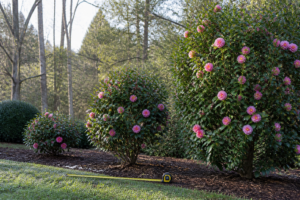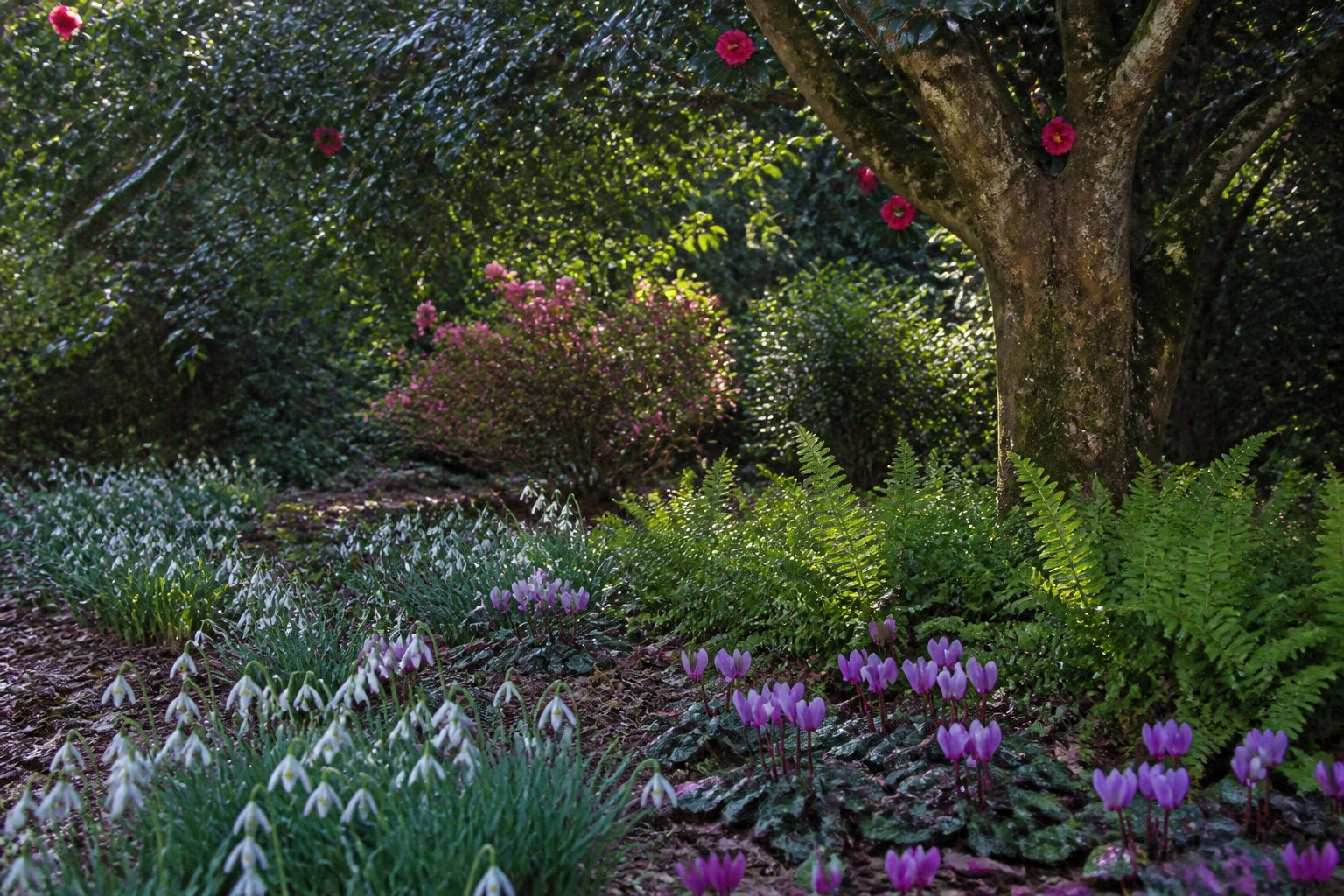
Nearly every camellia grower I’ve ever swapped notes with operates on the same unspoken assumption: the ground beneath a mature shrub is simply lost real estate, destined to stay bare or scraggly no matter what you throw at it. I believed that too for years, standing under my oldest camellia—a towering ‘Donation’ japonica that had claimed a shady corner of my garden long before I ever bought the property—and staring at nothing but compacted, lifeless dirt beneath all that rose-pink glory. I’d thrown things at that patch without much strategy: hostas that crisped up by July, ferns that quietly surrendered, even a doomed astilbe experiment that never had a chance.
Eventually, it dawned on me that the space wasn’t the problem—I was working against camellia biology instead of with it. The moment I actually understood what was happening beneath that canopy, the whole equation shifted. These days, that same patch bursts with winter snowdrops, dainty cyclamen, and sarcococca tucked discreetly into the shadows. What used to be an eyesore is now one of the highlights of my garden calendar.
So if you’ve got a well-established camellia presiding over an empty stretch of shade, know this: underplanting is entirely achievable. You just need to grasp the particular obstacles at play and know which plants have already figured out how to beat them. Here’s everything I’ve picked up along the way.
Why Planting Beneath a Mature Camellia Is Harder Than It Looks (And Why It’s Still Worth Doing)
Camellias make lousy neighbours for most other plants. Their roots sit close to the surface and grow thick—usually somewhere between 8 and 18 inches down—which means anything else trying to share that soil zone is fighting for scraps of water and nutrients. Try digging any real depth under a camellia and you’ll hit roots almost instantly.
The root competition is only half the battle—shade is the other complication. A camellia’s canopy doesn’t produce the soft, dappled light you’d get under an open tree. It casts genuine dry shade, the sort where rainfall struggles to reach the ground and the soil stays parched most of the year, barring the occasional soggy season. Combine dry soil, dense shade, and aggressive roots, and you’ve got conditions most plants simply refuse to tolerate.
Add soil chemistry to the mix. Camellias insist on acidic ground, generally somewhere in the pH 5.5 to 6.5 range, and they won’t budge on that requirement. Whatever you plant underneath needs to share that same tolerance—which instantly eliminates a long list of popular shade plants that prefer neutral or alkaline conditions.
Given all that, why even attempt it? Because the plants tough enough to handle these exact conditions repay you enormously. Watching snowdrops and cyclamen push up through fallen leaves right as camellia buds start to colour up is genuinely one of gardening’s small joys. That bare, apologetic patch becomes an actual garden feature rather than a gap you tiptoe around. And once these companions settle in, they demand almost nothing from you—true low-effort solutions for a spot that seemed impossible.
Ground Rules to Follow Before Planting Anything Under a Camellia
Before we get to the plant list, I want to walk through the practical dos and don’ts—lessons I picked up through trial and error, not from any manual.
Rule One: Keep the trunk collar clear. Never plant anything hard against the base of the camellia. Leave roughly 30–45 cm of open soil ringing the trunk. Camellias are notoriously prone to collar rot, and piling mulch or plants against that base creates exactly the damp microclimate that invites fungal problems. Begin your planting scheme at the drip line instead—the point where the canopy stops and rain would naturally fall.
Rule Two: Work around the roots, never through them. Put the spade away. When I’m underplanting a well-established camellia, a hand trowel and a good deal of patience are my only tools. I dig only as much as absolutely necessary, tucking new plants into natural gaps between surface roots instead of severing the root mat. Disturbing those roots stresses the shrub and opens the door to disease.
Rule Three: Choose your mulch deliberately. I rely on pine bark and leaf mould. Both hold moisture in that dry-shade zone while gradually acidifying the soil, which suits the camellia’s chemistry perfectly. Apply it 5–7 cm thick, keeping that bare collar zone untouched, and top it up every year.
Rule Four: Treat this as a true dry-shade garden. Once your underplanting has taken hold, it shouldn’t need routine extra watering. If you’re reaching for the hose more than once a month during the growing season, either you’ve picked plants unsuited to dry shade, or you’re really watering the camellia itself (nothing wrong with that—just aim for the outer edges, not the area under the canopy where you’re trying to garden).
Top Bulb Choices for Planting Beneath Camellias
Bulbs are where I always recommend people start, because they neatly solve the timing puzzle. Tuck them in during autumn, and they’ll surface right as the camellias start flowering—the whole thing looks choreographed.
Snowdrops (Galanthus) are essential, full stop. I tucked a batch beneath my ‘Yuletide’ sasanqua eight years back, and they’ve spread so contentedly I hardly think about maintaining them anymore. They open January into February, right alongside early sasanqua and japonica blooms. Snowdrops handle dry shade and acidic soil without complaint. Plant them 7–10 cm deep, grouped in clusters of ten or more—scattered singly, they barely register. My go-to varieties are ‘Flore Pleno’ and ‘Samuel Arnott’.
Winter aconite (Eranthis hyemalis) opens right alongside the snowdrops. Its bright yellow cups sit above lacy foliage, giving a cheerful splash of contrast. Give the tubers an overnight soak before planting, since they arrive bone-dry in the packet. Plant 5–8 cm deep. Once established, they’ll self-seed a little, which I’ve always considered a welcome extra.
Species cyclamen—Cyclamen coum in particular—is my go-to for long-term colour. Unlike the fussier hybrid cyclamen, Cyclamen coum naturalises happily under shrubs and actually prefers the dry shade a camellia produces. Blooms run January through March, and even without flowers, the foliage holds its own visually. Plant the tubers flat-side down, just barely covered, in autumn. Give them a few years and they’ll start self-seeding—that’s when things really take off.
Dwarf iris—Iris reticulata especially—flowers early and stays compact. Topping out at just 15–20 cm, it won’t overwhelm your planting scheme. Set bulbs 8–10 cm deep. ‘Katharine Hodgkin’ is a particular favourite of mine, its blue-and-gold colouring echoing tones found in some camellias.
Small species tulips like Tulipa sylvestris succeed where big hybrid tulips flop. Here’s a mistake worth sharing: years ago I planted standard Darwin Hybrid tulips beneath my ‘Donation’, and the water competition left them leggy and underwhelming. Species tulips behave differently—smaller, tougher, with far less demanding root systems. Tulipa sylvestris produces delicate yellow blooms and genuinely prefers drier ground. Plant 10–12 cm deep.
One rule applies across all these bulbs: group them, don’t scatter them. A dozen snowdrops clustered together make a statement. The same dozen spread thin across the bed simply vanish.
Shrubs That Thrive in the Shade Under a Camellia
Shrubs are where the real structure comes into play—the plants delivering year-round shape and presence rather than a brief seasonal display.
Azaleas make obvious companions. They share the camellia’s insistence on acidic soil and bloom around the same window—sasanqua camellias and early azaleas often flower in tandem beautifully. Stick to dwarf or compact cultivars: I favour ‘Hino Crimson’ and ‘Kermesina Rose’ beneath taller camellias. They won’t compete with the canopy above, and since their roots stay shallow, they sit at roughly the same depth as established camellia roots, minimizing conflict. Dwarf azaleas max out around 1–1.5 metres, which is the ideal scale for underplanting.
Pieris japonica (andromeda) performs remarkably well here. It shares the camellia’s love of acid soil and produces drooping clusters of white, pink, or red flowers come early spring. New growth often emerges copper-red, adding another layer of colour. Position it 1–2 metres from the trunk rather than directly underneath, and give it room—it can grow to 3 metres, so it’s better suited to the edge of your planting zone than the centre.
Sarcococca (Christmas box) is hands-down my favourite trick for dry shade. I’ve got three planted around my property, each tucked into a corner where almost nothing else would survive. It handles dense shade and dry, poor soil without flinching. From January into February, it produces small, unshowy flowers with an almost unbelievable fragrance for something so tiny. The scent alone reshapes how the garden feels, and the foliage stays tidy and attractive all year. Honestly, this is the plant that convinced me underplanting camellias didn’t have to be difficult.
Compact rhododendrons are another solid option. Try smaller cultivars such as ‘Ramapo’ (purple, around 60 cm) or ‘Scarlet Wonder’ (red, 60–90 cm). Like the azaleas, they crave acid soil and shade, and spacing them 1.5–2 metres apart keeps things from feeling cramped. Their roots tend to stay above the camellia’s own root zone, which cuts down on competition.
Hellebores earn a spot here even though they’re not technically shrubs. These semi-woody perennials bloom January through March, often overlapping with japonica camellias. Both Helleborus niger (Christmas rose) and Helleborus × hybridus (Lenten rose) handle dry shade fine once they’ve settled in. Space them 45–60 cm apart, and think carefully about placement—since the flowers nod downward, you’ll want a spot where you can view them from above or below to actually appreciate them.
Steer clear of hostas, ferns, and anything craving steady moisture. I once planted a sizeable hosta collection beneath a camellia in zone 8a. Even with afternoon irrigation, they scorched and collapsed within two growing seasons. Ferns run into the same trouble in dry shade unless you’re prepared to supplement water constantly. If you’re attached to these plants, find them a different home and accept that a camellia’s shadow simply isn’t their territory.
Ground Cover Options to Plant Beneath a Camellia
Ground covers act as the glue holding bulbs and shrubs together as one composition. They fill in bare patches, choke out weeds, and give the whole planting visual cohesion.
Epimedium (barrenwort) tops my list for underplanting a mature camellia. I’ve experimented with dozens of ground covers over the years, and epimedium is the one I’ll recommend without hesitation for established trees. It’s drought-tolerant, acid-loving, spreads at a manageable pace without turning invasive, and produces delicate blooms in late winter and spring. New foliage comes in bronze, matures to green, and often shifts coppery once the weather cools. Plenty of varieties handle deep shade with ease. Beneath my oldest camellias I’ve planted Epimedium × rubrum (red blooms) and Epimedium pinnatum subsp. colchicum (yellow blooms). Space divisions 30–45 cm apart, and within three years they’ll fill in completely without needing division or extra watering.
Mondo grass (Ophiopogon japonicus) contributes structure more than colour. It forms tidy, grass-like clumps of dark foliage and copes with deep, dry shade impressively well. Space plants 15–20 cm apart—it spreads slowly, so patience is part of the deal, but once it’s in, upkeep is minimal. The ‘Nigrescens’ cultivar, with its near-black leaves, looks especially striking against pale camellia blooms.
Japanese forest grass (Hakonechloa macra) suits lighter, dappled spots beneath more open camellias. It wants a touch more moisture than mondo grass but still manages fine in dry-shade conditions overall. The golden ‘Aureola’ cultivar adds a bright note under darker-leaved camellias like ‘Black Lace’ or ‘Midnight’. Space plants 45–60 cm apart and allow them room to mound outward.
Sweet woodruff (Galium odoratum) fits nicely into the damper pockets within a camellia’s shade. Tiny white flowers show up in late spring, and the foliage releases a pleasant scent when brushed. I plant it near drip points where moisture tends to gather naturally. It self-seeds modestly, which I count as a plus since it settles wherever conditions suit it best. Space plants about 30 cm apart to start.
Creeping Jenny (Lysimachia nummularia ‘Aurea’) adds golden contrast under dark-foliaged camellias. Its bright foliage lights up shady corners nicely. It tolerates dry shade reasonably well, though it thrives even more with a touch of extra moisture. I limit it to spots where a bit of wandering doesn’t bother me—it’s persistent but not unmanageable. Space at 30–45 cm.
My Go-To Underplanting Combination
After two decades of experimenting, I’ve landed on a three-plant combination that performs consistently under every mature camellia I grow. It’s uncomplicated, it looks polished, and once it’s settled, it needs almost nothing from me.
Layer One: Epimedium as the base layer. Space it 30–45 cm apart across the entire underplanting zone, keeping that collar area untouched. Within three years it will blanket the bare ground, crowd out weeds, and hold visual interest year-round—the flowers are simply a bonus on top.
Layer Two: Species cyclamen for cold-season colour. Nestle Cyclamen coum tubers in loose clusters through the epimedium. They’ll bloom right as the camellia peaks, setting up a lovely dialogue between the two. Given time, the cyclamen will self-seed and thicken up the display naturally.
Layer Three: Sarcococca tucked into a quiet corner. Place a single sarcococca somewhere within the planting zone, ideally near a path you walk often. The fragrance does the heavy lifting here—it won’t add visual drama, but it gives the space a hidden, luxurious quality.
That’s the whole formula—three plant types, all acid-loving, all drought-tolerant once settled, all flowering somewhere in that winter-to-early-spring stretch. Epimedium is your safety net, laying the groundwork everything else builds on. Cyclamen supplies the enchantment. Sarcococca brings the atmosphere.
Start with the epimedium and give it a full season to settle in. The following autumn, add the cyclamen tubers and sarcococca. By the second year, you’ll have a layered planting that reads as deliberate and lush, all without monthly upkeep.
Why It’s Worth the Effort
Underplanting a camellia changes your entire relationship with that tree and that patch of garden. Rather than staring down at bare dirt, you’re greeted with flowers, textured foliage, and fragrance. The camellia stops standing alone and becomes part of a fully composed garden scene.
Every plant covered here—epimedium, cyclamen, and sarcococca—shares the same qualities: acid-loving, drought-tolerant once established, and perfectly at home in the shade a camellia throws. Give them a season to root in, and the ground under your camellia stops being empty space and starts being part of the garden itself.
About This Article

Written by Helen Pritchard. Helen Pritchard is a lifelong gardener in the Pacific Northwest who has grown more than 200 named camellia cultivars over two decades. She writes practical, experience-based guides to camellia care, from variety selection and pruning to troubleshooting yellowing leaves and bud drop. More about this site.
Verify this against a primary source
Specifics change, and your situation may differ from the one described here. These are the authorities worth checking directly:
- American Camellia Society — cultivar registration and culture guides
- USDA Plant Hardiness Zone Map — zone verification for your location
- Royal Horticultural Society — camellia cultivation and pest guidance