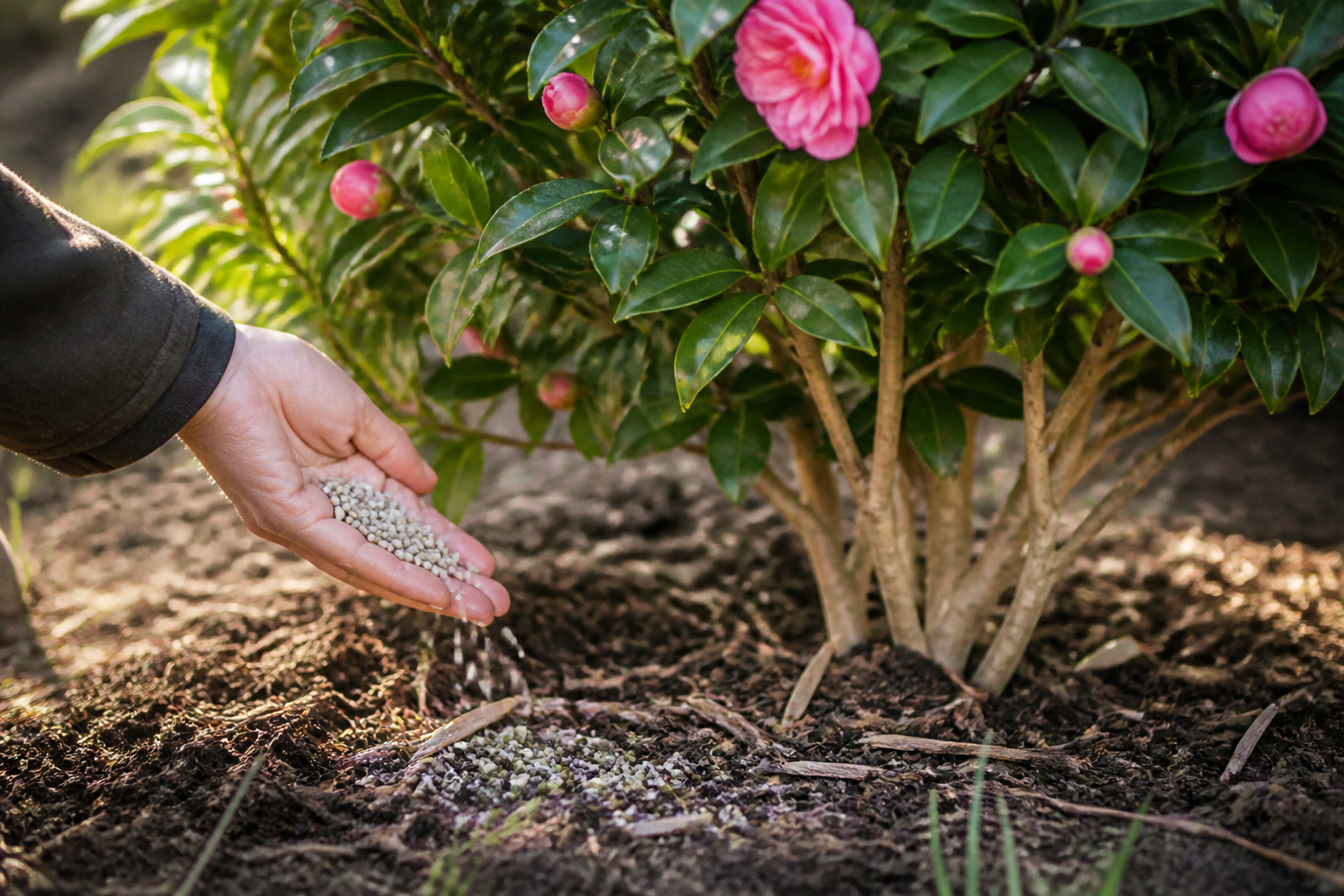
If you have searched for when to fertilize camellias, you have probably seen three different answers: late winter, early spring, or “after the first frost.” Each one is right somewhere. The real answer depends on when your particular plant finishes blooming and how many weeks of growing season you have before the first hard freeze. After about twenty years growing more than 200 named cultivars in the Pacific Northwest, I have learned that calendar dates alone will steer you wrong.
This post gives one organising principle and then applies it region by region. Feed after bloom finishes. Then stop early enough that the late flush of growth can harden off before frost. The rest is working out what those two points mean in your climate.
When to Fertilize Camellias by Region: Start After Bloom
Why use bloom as the trigger? A camellia that is still flowering is spending its energy on open flowers and the buds behind them. Feed it heavily during that stretch and the plant shifts resources toward new shoots and leaves instead.
I have made this mistake myself. A plant I fed while it was still flowering put out lush, soft growth, and several buds that should have opened simply dropped. The fertiliser did not cause bud drop on its own, but it pulled the plant’s energy in the wrong direction at the wrong time.
Calendar dates fail because camellias do not share one bloom calendar. A cold winter can hold a japonica back by three weeks, and a warm one can bring it on early. Watching the plant tells you more than the date on your planner does.
The Hard Stop: Frost Sets the Last Feeding
The second rule is simpler. Do not apply nitrogen within roughly six to eight weeks of your average first frost. Nitrogen drives soft, sappy new growth. That tissue is full of water and has thin cell walls, so a freeze that arrives before it hardens can scorch it badly.
Average first frost is a local statistic, not a promise. Your county extension office or a few years of your own weather notes will give you a better number than any general map. Keep a record of the first frost you actually see, because it often differs from the published average.
In practice, this rule pushes the final feed well before autumn in most of the country. That is why the warm-zone and cool-zone answers look so different. The stop date is set by frost, not by how much growing season remains on the calendar.
Sasanquas and Japonicas Bloom at Different Times
This is where most confusion starts. Sasanquas bloom in fall, usually from October into early winter, depending on the cultivar. Japonicas bloom in late winter and spring, with most varieties opening between roughly February and April in mild climates.
Say it plainly: a sasanqua’s post-bloom feed lands in late winter or early spring. A japonica’s post-bloom feed lands in mid-to-late spring. Both are following the same rule. They simply finish blooming at different points in the year.
Be careful not to feed a sasanqua right after its autumn flowers drop. Those plants are heading into cold weather, and the new growth you would trigger has little time to harden. Wait for the spring flush to begin, then feed.
Zone 7: North Georgia, the NC Piedmont, and Upstate SC
In zone 7, the first feed comes once the last japonica blooms have dropped, usually late March into April. Feed lightly and water it in well. A second feed, if you want one, is a light application in early June. After that, stop.
Zone 7 has the tightest window. First frost often arrives in late October or early November, so the six-to-eight-week rule points to early September. In practice I stop by mid-July, because summer heat and a late flush do not harden well. Other growers feed later, and I am not certain they are wrong. I simply prefer the margin.
Zone 8 and Zone 9: Earlier Starts, Longer Warm Autumns
Zone 8 covers the coastal Carolinas and much of south Georgia. The shape is similar to zone 7, shifted earlier. The first feed goes on in March, after early japonicas finish. A second light feed in late April or May is reasonable. Stop by late July or early August.
The zone 8 window is longer because first frost comes later, often in mid-to-late November. That extra time is useful, but it is easy to overuse. Give the plant a second feed only if it looks pale or the new growth is weak.
Zone 9, including the Gulf Coast and central Florida, has the earliest start. Begin in February or early March as blooms finish. A second feed in April is plenty. The real risk here is feeding too late into a long, warm autumn, when the plant keeps pushing growth that never gets a chance to harden.
Frost is rare in central Florida, but it is not impossible. A single cold night in January can damage tender growth. Stop feeding by late August, and the plant will set its own growth down for winter without help.
Northern California and the Pacific Northwest: Water First
These regions have mild, wet winters and dry summers. Cold is rarely the limit. Moisture is. Fertiliser applied to dry soil during a rainless summer does little good, and granular feed sitting on dry ground can draw water out of the roots and burn them.
So water first. Soak the root zone a day or two before feeding, then apply the fertiliser, then water again to carry it down. In my own garden, I feed japonicas in March and April after bloom, and I only make a second light application in May if the plants are irrigated through summer.
Stop by early August. If you do not irrigate through summer, skip the second feed entirely. Feeding a plant that cannot drink the nutrients is wasted money and an unnecessary risk to its roots.
The UK: Cooler, Wetter, and Ericaceous
In the UK, feeding generally runs from spring to midsummer, and it should stop by about July. Cooler temperatures and more rain mean growth matures more slowly, so the frost rule still applies but the window closes earlier. If you are new to this, my guide to growing camellias in the UK covers the broader picture.
Start with a first feed in April or May, once the spring flowers have finished. A second, lighter feed in June is optional. Use an ericaceous fertiliser, formulated for acid-loving plants, rather than a general-purpose feed that may push the soil pH in the wrong direction.
Before you feed anything, check your soil. Feed will not solve a pH problem. Getting the soil pH right first is more important than any fertiliser schedule, so read getting the soil pH right first before you buy anything.
Containers Need More Frequent, Weaker Feeds
Container camellias are a separate case. Every time you water a pot, some of the nutrients wash out through the drainage holes. Open ground holds on to nutrients far longer, so a pot needs feeding more often, though each dose should be weaker.
For potted plants, I use a half-strength feed every four to six weeks after bloom, through the growing season, following the same stop date as the plants in the ground. The hard-stop rule does not change just because the plant is in a pot. For more detail, see my notes on feeding and watering camellias in containers.
Pots also dry out faster in summer, which makes the water-first rule even more important. Check the soil with a finger before feeding, and never feed a container that is bone dry.
Feeding Camellias and Azaleas Together
Camellias and azaleas are both acid-lovers with similar broad needs, so feeding them together is fine. In my garden they share a bed, and they get the same feed on the same schedule. Their bloom windows overlap enough that the same post-bloom timing works for both.
Do not add extras on top. Whether Epsom salt and tomato feed actually help is a separate question, and the answer is less impressive than many gardeners expect. Stick with a balanced acid-plant feed, applied at the right time.
Quick Reference by Region
The table below summarises the timing for each region. Treat the months as starting points, not fixed dates. Adjust them for your own bloom and frost records, especially in a cold or unusually warm year.
| Region or Zone | First feed | Second feed | Stop feeding by | Note |
|---|---|---|---|---|
| USDA zone 7 (north Georgia, NC Piedmont) | Late March to April, after japonica bloom | Light feed in early June, optional | Mid-July | Frost arrives sooner, so the window is tight |
| USDA zone 8 (coastal Carolinas, south Georgia) | March, after early japonicas finish | Late April or May, light | Late July to early August | Later frost gives a longer window; avoid overuse |
| USDA zone 9 (Gulf Coast, central Florida) | February to early March | April | Late August | Main risk is feeding into a long warm autumn |
| Northern California and Pacific Northwest | March to April, after bloom, watered in | May, only if irrigated through summer | Early August | Moisture is the limit; water before and after feeding |
| UK | April or May, after spring flowers | June, optional, lighter | Early July | Use an ericaceous feed; cooler, wetter growing season |
Sasanquas follow the same logic but with a later first feed, usually late winter or early spring in every region. If you need the full guide to what to feed and how much, that is covered separately. This post only addresses timing.
Where Sources Disagree, and What I Am Not Sure Of
Published advice varies. Some guides allow feeding into late summer in warm zones, while others say to stop by midsummer everywhere. I lean toward the conservative end because a missed feed costs little, but a freeze on soft growth can cost a plant its spring flush.
I am also less certain about cool-summer sites than warm ones. My garden is in the Pacific Northwest, where summers are dry and mild. Gardeners in cooler, damper places may need to shorten the window further, so watch how your plants respond rather than trusting my dates blindly.
The principle holds across every region: feed after bloom, stop before the new growth is at risk, and check the soil before you apply anything. Get that right, and the exact month matters much less.
About This Article

Written by Helen Pritchard. Helen Pritchard is a lifelong gardener in the Pacific Northwest who has grown more than 200 named camellia cultivars over two decades. She writes practical, experience-based guides to camellia care, from variety selection and pruning to troubleshooting yellowing leaves and bud drop. More about this site.
Verify this against a primary source
Specifics change, and your situation may differ from the one described here. These are the authorities worth checking directly:
- American Camellia Society — cultivar registration and culture guides
- USDA Plant Hardiness Zone Map — zone verification for your location
- Royal Horticultural Society — camellia cultivation and pest guidance