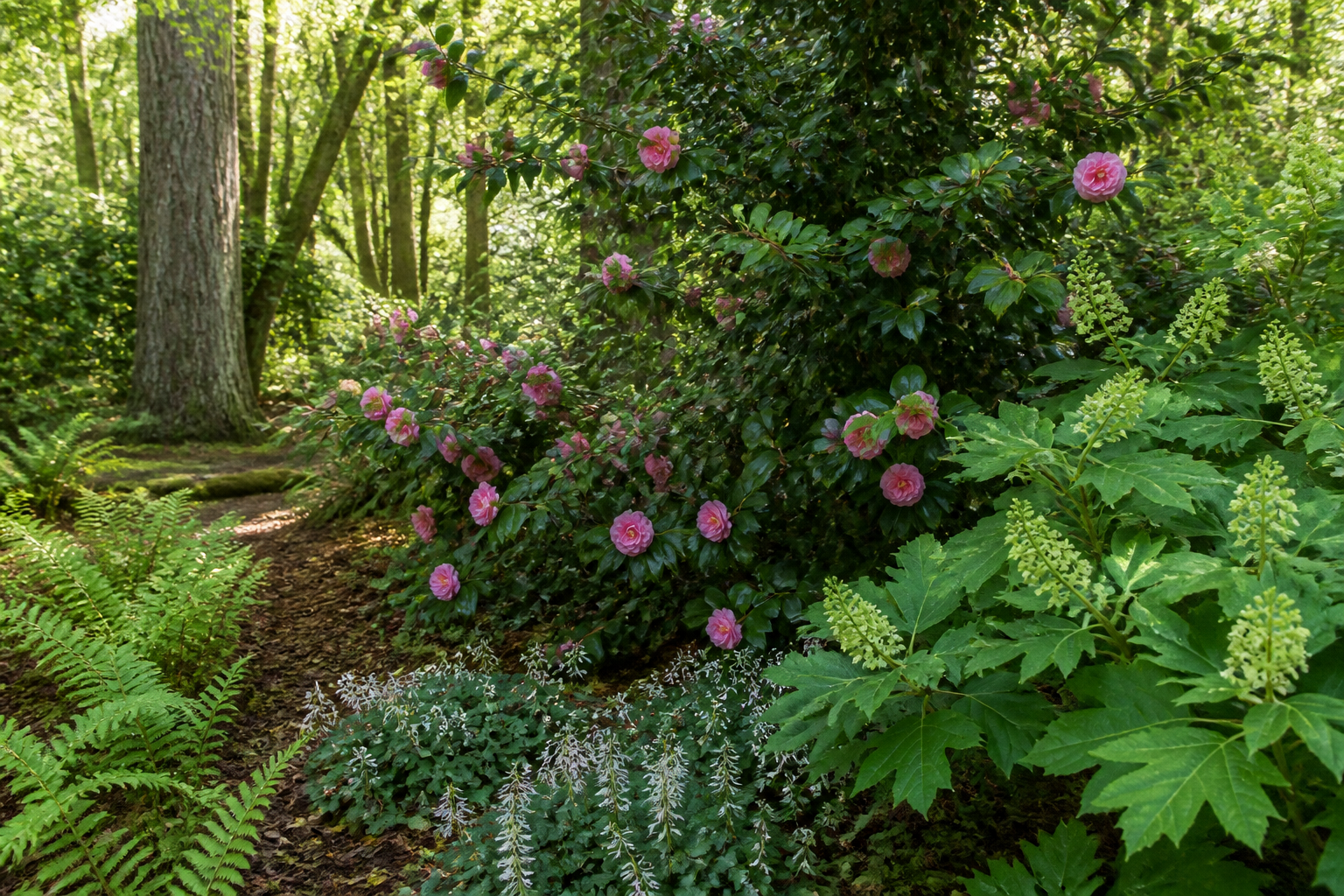
Two hundred million years — give or take a few million — is roughly how long camellias have been sorting out which plants make good neighbors in the wild, long before any of us started drawing up companion-planting charts. And yet the internet keeps recycling the same handful of pairings: azaleas here, hydrangeas there, rinse and repeat. A gardener writing to me from North Carolina last year cut straight through that noise with one question I hadn’t considered nearly enough: what actually grows alongside camellias in their native habitat? Her email is the reason this piece exists. It pushed me to look past the usual nursery-tag suggestions and dig into the woodland ecology camellias actually descend from. What I found is this: the strongest partners for your shrubs often aren’t showy cultivars at all — they’re the plants shaped by the same shade, soil, and rainfall patterns camellias themselves grew up in, whether that’s their ancestral Asian forests or the native understory of your own backyard.
The Case for Pairing Camellias With Native Plants
Strip away the ornamental hype and camellias are, at their core, understory shrubs. They came up beneath a forest canopy in East Asia, tucked into acidic, humus-heavy ground that holds moisture without ever turning swampy. Once you understand that origin story, planning what goes around them gets a lot simpler.
Twenty-some years of trial and error taught me this: forget picking companions based on some botanical kinship to camellias. Look instead for plants suited to that same part-shade, acid-loving woodland pocket. And when those plants happen to be native to wherever you garden — the Carolinas, the Pacific Northwest, or the coast of southern Australia — they settle in faster, demand less coddling, and simply look right at home, rather than like one more imported specimen competing for attention.
There’s a bigger payoff too: native neighbors feed the pollinators, birds, and soil life that depend on whatever grows beneath your camellia canopy. Early on, I treated my camellia beds like formal showcase gardens, ringing them with hostas and shade perennials that needed constant fussing, deadheading, and soil amendments. The moment I swapped those out for native companions, the whole bed started running itself. It’s a slightly wilder look than a manicured border — and honestly, it’s held up far better through droughts, storms, and neglectful weeks than anything I babied before.
Native Picks for US Camellia Beds
Gardening anywhere east of the Mississippi, or within that sweet spot of zones 7b to 9b where camellias flourish, puts a whole toolkit of native woodland plants within reach. These shrubs, ferns, and low groundcovers evolved for exactly the acidic, part-shade ground camellias love, and — happily — they’re showing up more often at native plant nurseries and regional plant society sales, not just in botanical garden displays.
Shrubs Worth Planting
If I had to name one favorite, it’s oakleaf hydrangea (Hydrangea quercifolia). This southeastern native shares camellias’ taste for acidic soil and filtered light, but its real gift is timing: it flowers from June into August, right when your camellias are just green foliage on standby. Its upright white flower panicles play beautifully against those glossy camellia leaves. Come autumn, the foliage deepens to burgundy and clings on through winter, and the peeling, cinnamon-toned bark keeps the plant interesting even in the bare months.
On the north-facing edge of my garden, I’ve tucked oakleaf hydrangea beside my ‘Yuletide’ camellia, that rich red winter bloomer, and it fills the gap perfectly once camellia season winds down but before anything else has caught up. It’ll tolerate dry shade after it’s established, though it does its best work with the kind of steady moisture a camellia’s roots also appreciate.
Another southeastern staple in my garden is Virginia sweetspire (Itea virginica), an upright, refined shrub with fragrant white flower spikes in early summer. Its leaves turn a rich burgundy by fall and often hold on well into winter. Sweetspire handles the same acidic, moisture-retentive ground camellias need and will grow in part shade, though it flowers more heavily with roughly four hours of direct sun.
Set beside oakleaf hydrangea, sweetspire reads as the more tailored, sculptural option rather than a bulky mass. One warning worth heeding: it spreads through underground runners, something I learned only after mine wandered straight into a neighboring camellia bed. Give it a spot where that habit won’t cause trouble, or install a root barrier up front to save yourself the removal work later.
Native deciduous azaleas belong in this conversation too. Most gardeners default to hybrid azaleas as camellia companions, but native species such as Rhododendron periclymenoides (pinxterbloom) and R. canescens (piedmont azalea) offer fragrance and a much deeper connection to local pollinators. They’re also less uniform in shape and bloom color than mass-produced hybrids, which lends your planting a bit more personality. Flowering in mid-to-late spring, they ease the transition between camellia season and the heavier summer foliage that follows.
Ferns and Groundcovers Worth Adding
The ground beneath a mature camellia is ideal territory for native ferns. Christmas fern (Polystichum acrostichoides) stays evergreen, roots shallowly, and shrugs off the dense shade and root competition a large camellia creates without complaint. Its leathery, textured fronds hold their green year-round. Native Dryopteris species and Onoclea sensibilis (sensitive fern) work just as well, though sensitive fern spreads with real ambition — best kept in a bounded space rather than let loose across a bed.
For low, ground-hugging cover, foamflower (Tiarella cordifolia) is hard to beat. It creeps into dense mats over time, handles even quite dry shade, and sends up delicate white flower spikes each spring. I’ve grown it beneath several of my ‘Nuccio’s Pearl’ camellias with great results. Wild ginger (Asarum canadense) is another go-to of mine — its heart-shaped leaves make a lush living carpet, and few plants I’ve tried tolerate root competition from a camellia as gracefully.
One honest heads-up: finding true native species is trickier than picking up a cultivar off a garden center shelf. Big-box retailers rarely stock them. Your better bet is a dedicated native plant nursery or a native plant society sale — in my region, the North Carolina Native Plant Society runs one every quarter, and those events are a direct line to growers who know exactly what thrives in your zone and soil.
Native Companions for Camellia Gardens in Australia
Gardening in Victoria, New South Wales, or anywhere else across southern Australia where camellias — sasanquas especially — are a garden mainstay, this section is aimed squarely at you. Plenty of gardeners want to take the edge off a formal camellia specimen or hedge by underplanting with something that feels genuinely local rather than imported.
Full transparency: I garden in the United States and haven’t grown any of these Australian natives myself. Still, the underlying logic holds up exactly as it does in my own beds. Growers across Australia are applying that same shade-and-acid-soil reasoning to native species suited to that niche, and I’ve built this section on their firsthand experience and established best practice — so consider it borrowed knowledge, not personal soil-tested advice, but sound all the same.
Low Growers and Strappy-Leaved Options
Top of my list for underplanting Australian camellias is native violet (Viola hederacea). It tolerates shade, spreads gently across bare soil, and thrives in the moist, acidic root zone a camellia produces. Its tiny blue-and-white blooms add charm without stealing the spotlight from camellia flowers, and it handles the humidity and steady moisture camellias favor, making the pairing almost effortless.
Flax lily (Dianella species) brings a different kind of interest — strappy, evergreen foliage that contrasts sharply with camellias’ rounded, glossy leaves. It handles part shade with ease and asks for little once it’s settled in. Come summer, delicate blue flowers appear, adding a quiet accent rather than a showy one. It’s a hard-working, low-maintenance choice that fits equally well into formal or looser, naturalistic designs.
Lomandra (mat rush) offers a similar structural role. Its tight, upright clumps of strappy leaves make a strong border edge around a camellia bed. It’s remarkably drought-tolerant once established, so it’s a smart choice for drier pockets of the garden, and its more formal look suits a clipped, structured camellia hedge especially well.
Where there’s more room to work with, soft tree fern (Dicksonia antarctica) delivers the same layered, woodland feel that ferns bring to US plantings. It thrives on the humidity and part shade a camellia canopy provides, slowly building into a genuine architectural centerpiece. Give it space to reach its full size — these ferns can eventually top three meters — along with mulch and reliable moisture.
Pairings to Steer Clear Of
Here’s the key warning for Australian gardeners: a lot of striking native plants — grevilleas, banksias, and other Proteaceae — are built for low-phosphorus, fast-draining soil. They genuinely struggle in the rich, well-fed, moisture-holding beds camellias thrive in. Plant them side by side and you’re likely looking at nutrient toxicity or root rot on the native’s end of things.
If those showier natives have your heart, give them their own bed with soil and drainage suited to their needs rather than crowding them next to camellias. For true companions, stick with the shade-tolerant groundcovers and ferns covered above — plants that genuinely share a camellia’s growing conditions. That’s not settling for less; it’s respecting what each plant actually needs and building a garden that functions ecologically, not just visually.
Finding and Planting These Companions
True native plants can be trickier to hunt down than standard cultivars, though that’s shifting. Start by searching for native plant nurseries near you or reaching out to your state or regional native plant society — many keep online directories of growers and sales. These specialists understand your specific zone and soil in a way most big-box garden center employees simply don’t.
Once you’ve got your native companions in hand, plant them the way you’d plant a camellia: work peat moss or composted pine bark into the soil to acidify it and improve drainage. Most woodland natives want consistent moisture through that first growing season. After that, they can generally settle into whatever watering rhythm you’ve already got going for your camellias.
Don’t skip the mulch. A layer three to four inches deep — pine needles or shredded bark both work — keeps soil temperatures cooler, locks in moisture, and slowly breaks down into the organic matter both camellias and their native neighbors depend on.
A Closing Thought
More than two decades in, the camellia gardens I’m proudest of were never the ones packed with the priciest hybrid companions. They’re the ones where I paused long enough to ask what genuinely belongs there. For gardeners in the US, that answer tends to be oakleaf hydrangea, Christmas fern, and foamflower, weaving together a woodland edge that feels unforced and native. For gardeners in Australia, it’s native violet and flax lily, softening a camellia specimen until it feels like it grew up in that exact spot.
Choosing native companions for your camellias isn’t just about ease or aesthetics — it’s the ecologically sound choice, full stop. Lean into that logic, the same one that governs woodland gardens everywhere, and you’ll find your camellia beds thriving with a fraction of the effort you’re used to putting in. Your garden benefits, and so do the birds and pollinators counting on it.
About This Article

Written by Helen Pritchard. Helen Pritchard is a lifelong gardener in the Pacific Northwest who has grown more than 200 named camellia cultivars over two decades. She writes practical, experience-based guides to camellia care, from variety selection and pruning to troubleshooting yellowing leaves and bud drop. More about this site.
Verify this against a primary source
Specifics change, and your situation may differ from the one described here. These are the authorities worth checking directly:
- American Camellia Society — cultivar registration and culture guides
- USDA Plant Hardiness Zone Map — zone verification for your location
- Royal Horticultural Society — camellia cultivation and pest guidance