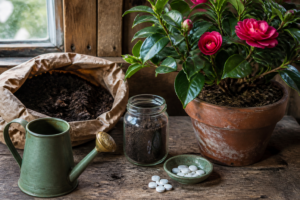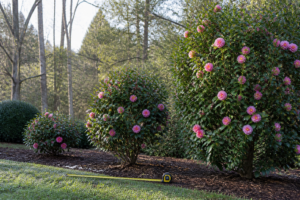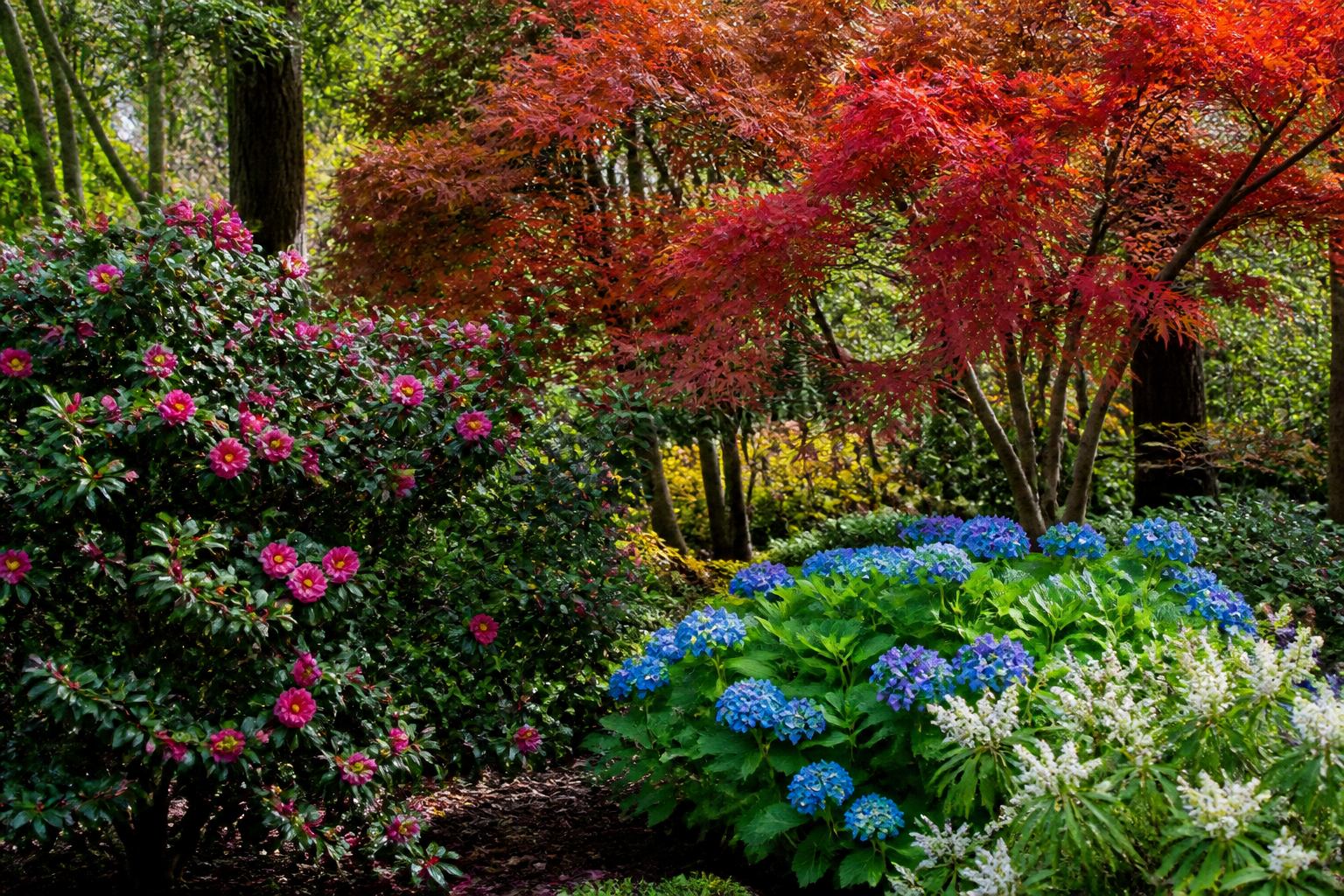
“What do I even put around a camellia once it’s planted?” a fellow gardener asked me at a plant swap a few years back, phone in hand, showing me a photo of her solitary Camellia × williamsii ‘Donation’ surrounded by nothing but mulch. Funnily enough, I’d asked myself the same thing not long before, staring at that exact cultivar in my own garden—stunning in February, but ringed by bare dirt and a handful of plants that had no business being there. That’s when it clicked for me: camellia companion plants aren’t decorative extras—they’re what separates a one-season showpiece from a garden that keeps giving for the better part of a year.
That bed has since become something I show off to anyone who’ll stand still long enough. It carries winter perfume into spring color and finishes with an autumn blaze. What changed things wasn’t luck—it was figuring out which plants genuinely thrive beside camellias instead of crossing my fingers and hoping the mix would work itself out.
Two decades in, with more than two hundred named cultivars tended across three different USDA zones, I can tell you the question of what to plant with camellias boils down to a single answer: reach for acid-loving species. What follows is my honest rundown—the combinations that earn their keep, the ones that don’t, and everything I’ve picked up the hard way.
Why Soil pH Makes or Breaks a Camellia Companion
This is the trap most gardeners fall into. They pick plants for looks alone, then can’t understand why half the bed sulks.
Camellias want soil on the acidic side—somewhere between 5.5 and 6.5 pH is the sweet spot. Once you’ve adjusted a bed to suit them, you’ve essentially built a little acid pocket in your garden. The obvious next step is filling that pocket with plants that want the exact same thing.
The logic is simple: a single soil strategy covers the entire bed. Test once, amend once, keep it steady from there. You’re not stuck liming for one plant while adding iron chelate for another in the same square yard. I found this out the painful way after tucking roses into a camellia bed—two full seasons spent chasing contradictory soil amendments with nothing to show for it.
The strongest camellia partners all lean the same acidic direction. Azaleas, rhododendrons, pieris, Japanese maples, hellebores—none of these made my list by accident. They’re plants that are already at home wherever a camellia is happy.
My Go-To Plants for the Camellia Bed
Through years of trial, I’ve narrowed things down to a dependable roster of camellia partners. None of these are experiments anymore—they’re proven performers that build real magic once you place them with intention.
Azaleas — Still the Gold Standard Pairing
If I had to pick just one companion for camellias and nothing else, azaleas would win every time.
The reasoning is straightforward. Both want acidic ground. Both keep their leaves through most or all of the year. And the timing works out beautifully—camellias tend to bloom in winter into early spring, then azaleas take over the color show through mid and late spring, keeping momentum going.
The palette on offer is remarkable. I use Japanese azaleas—various Rhododendron japonicum hybrids among them—as a lower tier beneath my taller camellias. This past spring, ‘Donation’ stood behind a wash of magenta and coral blooms. Come next year, I might swap in soft pinks and whites instead. There’s real room to play.
From what I’ve seen, azaleas top out anywhere from 3 to 6 feet depending on the variety, which pairs neatly with most camellia sizes. The result is layered height, varied foliage texture, and a canopy that reads as intentional rather than scattered. I can’t think of a single time an azalea disappointed me next to a camellia. Not once.
Pieris, Rhododendrons, and Company
Pieris japonica—Andromeda, if you know it by that name—feels like the refined pick. It’s an evergreen acid-lover that keeps a bed interesting across all four seasons.
New foliage comes in fiery red or bronze tones. Spring brings little bell-shaped white blossoms, not unlike lily-of-the-valley. Even outside bloom time, the leaves stay glossy and hold their shape well. My personal favorite is ‘Forest Flame’—that scarlet flush of new growth is hard to walk past. It flowers right around when sasanqua camellias are winding down, closing the seasonal gap nicely.
Rhododendrons belong in this conversation as well. They share the acid requirement and bring bold spring color. That said, tread carefully—big rhododendron hybrids can swallow a smaller camellia whole. I lean instead toward Rhododendron yakushimanum and its offspring, which stay compact—usually under 4 to 5 feet—and give a woodland feel without hogging the space.
Both pieris and rhododendrons handle partial shade well, which lines up with what most camellias want anyway. That practicality is half of what makes them such good partners.
Can Hydrangeas and Camellias Really Coexist?
This is probably the question I field most. Short version: yes, camellias and hydrangeas get along fine. Longer version—there’s some detail worth knowing.
Both Hydrangea macrophylla, the classic mophead, and H. serrata prefer acidic ground, right in that 5.5 to 6.5 pH band. Bonus: at that acidity, blue hydrangea varieties intensify into a rich true blue, thanks to anthocyanin pigments reacting to soil pH. Grow them beside camellias and you’ve already nailed the chemistry both need.
The visual contrast is a treat too. Hydrangeas lose their leaves come fall; camellias hold theirs year-round. That keeps the bed interesting even in the dead months. Summer belongs to blooming hydrangeas while camellias rest; winter flips it, with camellias flowering and hydrangeas dormant. Between the two, color never really quits.
One warning, though: skip panicle hydrangeas (H. paniculata) in this pairing. They’re hardier and tolerate alkaline soil just fine, which means an acid-amended camellia bed can leave them struggling. Stick to macrophylla and serrata types instead—you won’t be sorry.
Japanese Maples for Shape and Fall Color
Acer palmatum is a genuine asset in an acidic bed. Japanese maples ask for the same conditions camellias do—soil on the acidic side, filtered light, sharp drainage, and steady moisture.
Beyond matching soil needs, maples contribute something camellias simply can’t on their own: a burst of autumn color. Right as camellias settle into dormancy, a Japanese maple lights up in crimson or gold. My ‘Osakazuki’ turns a spectacular scarlet like clockwork every October, planted near my C. sasanqua ‘Narumigata,’ a winter bloomer. Together they tell a story that runs from fiery leaves straight into soft pink flowers.
Maples also cast light, dappled shade come summer—useful since camellias appreciate afternoon protection in warmer climates. The finely cut leaves of a Japanese maple soften harsh sun without turning the bed into a cave. It’s functional companionship dressed up as ornament.
Sizing runs the gamut—dwarf types stay near 4 feet, while larger forms can reach 15 feet or beyond. Pick a cultivar sized to match your camellia’s spread and height. The goal is partnership, not one plant swallowing the other.
Sarcococca, Hellebores, and Ferns for the Lower Tier
These plants operate on a smaller scale, settling in at the base of camellias and taller shrubs. Their contribution to the overall picture, though, is anything but minor.
Sarcococca, or Christmas Box, is my quiet trick for winter gardens. This evergreen shrub rarely climbs past 3 feet, yet in January and February its small white flowers throw scent across the whole bed. I think of it as the ideal winter counterpart—while camellias dazzle the eye, sarcococca handles the nose, adding a sensory layer camellias don’t offer. Put Sarcococca confusa somewhere you’ll walk past on a cold morning; that’s when the fragrance really lands.
Winter-flowering hellebores open right alongside the early japonicas. They handle shade and acidity without complaint, and they bloom during the bleakest stretch of the year. Their color range—deep plum through creamy white—sits comfortably beside camellias rather than competing with them. I keep hellebores as ground-level supporting players, not centerpieces.
Ferns complete the layer. Shield ferns (Polystichum) and lady ferns (Dryopteris) enjoy the exact same environment camellias do. They bring texture and a lush, woodland quality that suits the setting perfectly. No blooms involved, but they hold visual interest through form and foliage alone.
Leucothoe fontanesiana earns a special call-out. This arching evergreen tops out at 4 to 6 feet, tolerates shade and acidity, and puts on a striking display of red and orange come autumn. Since it stays shorter than most camellias, it slots in as a companion without stealing the spotlight. Understated, but it changes the whole feel of a bed.
Roses Beside Camellias — Worth It or Not?
I’ll give it to you straight. Can roses and camellias share a bed? Technically, yes. Should you do it? Rarely.
Camellias want pH 5.5 to 6.5. Typical garden roses prefer 6.0 to 7.0. There’s a sliver of overlap—around 6.0 to 6.2—where, in theory, both could be content.
I tested that theory myself. About five years ago I planted hybrid tea roses near my C. × williamsii ‘Jury’s Yellow.’ The roses didn’t die, but they never really thrived either. Blooms dropped off, disease crept in a bit more than usual, and any attempt to lime the soil for the roses’ sake put my camellia’s health on the line.
If you insist on combining them, go with shrub roses over hybrid teas—they tolerate the compromise better. Hold pH firmly at 6.0 to 6.2, and check both plants regularly. It’s extra labor, no question.
These days, I do something simpler: I keep roses in their own separate bed entirely, where pH can climb to 6.5 or higher without any concern for a nearby camellia. That one change eliminated the whole balancing act. Each plant gets exactly the soil it wants.
Plants That Don’t Belong Near Your Camellias
Certain plants simply can’t stand acidic soil. Put them beside a camellia and you’re setting up a fight neither will win outright.
Steer clear of lavender, clematis, lilac, dianthus, and most Mediterranean herbs—all of them want soil that’s neutral to alkaline. Plant them in camellia territory and they’ll limp along or die back. Lime the bed to keep them happy, and you’ll trigger iron chlorosis in your camellias instead.
It simply isn’t worth the ongoing battle. Pick acid-loving neighbors from the start, and you’ll spend far less time troubleshooting and far more time enjoying a bed that actually cooperates.
A Look Inside My Favorite Camellia Border
Let me take you through what I call my “winter to spring border”—the same bed I overhauled three years back. It’s the layout I point beginners toward whenever they’re planning their first camellia companion planting.
The anchor: Camellia × williamsii ‘Donation,’ which matures to 8 to 10 feet. It puts out semi-double pink flowers from February into March. I picked it for its height, staying power, and consistency—it’s the plant everything else in the bed answers to.
The spring color band: Japanese azaleas in a mix of coral, magenta, and white, arranged in a loose arc around the camellia’s base. Standing 4 to 5 feet tall, they form a lower tier that kicks into bloom just as the camellia’s flowers fade—one act handing off to the next without a gap.
The structural piece: A single Pieris ‘Forest Flame’ set off to one side. Its scarlet spring foliage draws the eye immediately. Positioned at the bed’s edge, its 5 to 6 feet of height frames the scene without blocking any sightlines, and its tiny white flowers open right when the azaleas are peaking.
The autumn showpiece: A Japanese maple, Acer palmatum ‘Osakazuki,’ placed where it stays visible year-round. Its dissected leaves give the camellia dappled shade come summer, then turn scarlet in fall—a striking contrast against the camellia’s pink winter flowers.
The winter scent: Sarcococca confusa planted at the bed’s border, right where anyone walking by in winter will brush against it. Nothing showy to look at, but the fragrance does the work instead, peaking in January as the earliest camellias start to bloom.
The quiet texture: Shield ferns scattered through the bed. They give the eye somewhere to rest between bloom cycles and add a soft, understated presence. Almost no maintenance required, yet the payoff is constant.
Taken together, this border performs from December straight through May. The camellia opens its flowers, sarcococca perfumes the air, azaleas bring spring color, the maple flares gold and red, pieris glows, and the ferns tie it all together. Then June arrives and things go quiet—but by that point, the bed has already done its job, and I’m content to let it rest.
Every plant in that bed shares the same requirement: pH 5.5 to 6.5. I amended the soil just once, four years back, using sulphur, and I’ve kept it in check ever since with an annual leaf-mould mulch. One approach, no clashing needs, nothing I’d change.
Other Ways to Landscape Around Camellias
Outside of my own border, there are a few other directions worth considering for landscaping ideas with camellias.
A woodland-style planting: Combine camellias with rhododendrons, azaleas, pieris, and ferns, then tuck hellebores and sarcococca underneath. This echoes the forest-edge habitat camellias originally came from, and it reads as effortless and calm.
A modern mixed border: Combine camellias with hydrangeas, ferns, and low grasses such as Hakonechloa macra, then bring in a Japanese maple for backbone. The overall effect leans contemporary—crisper lines, surprising texture pairings, and constant seasonal shift.
A spring bulb layer: Tuck acid-tolerant bulbs in around and beneath your camellias. Trilliums, erythroniums, and snowdrops all handle the same soil conditions comfortably. As camellia flowers wind down, the bulbs take over, keeping color running from February clear through May.
Whichever route you choose, it works for the same underlying reason—it respects the camellia’s soil chemistry and pairs it with plants built for those same conditions.
Reader Questions on Camellia Companion Planting
Which companions suit Camellia ‘Winter’s Snowman’ best?
‘Winter’s Snowman’ is a real trouper—I grow it in zone 7b myself, and those upright white semi-double blooms look their best against a dark, textured backdrop. Try dwarf conifers such as Chamaecyparis, or a dwarf Japanese holly, for deep green contrast. Down at ground level, evergreen ferns and dark-leaved plants like Heuchera ‘Obsidian’ or a dark Ajuga do the trick nicely.
My rule of thumb with this cultivar: everything you plant nearby should shrug off hard cold just as well. Since ‘Winter’s Snowman’ was specifically bred for northern gardens, I never introduce tender companions that would need coddling over winter. The whole grouping should weather January together, without exception.
What pairs well with Camellia sasanqua ‘Kanjiro’—companions and ornamental trees alike?
‘Kanjiro’ is that bold pink bloomer that flowers late autumn into early winter, staying a tidy 4 to 6 feet naturally. I plant mine near Japanese maples for a real one-two seasonal punch—their fall color lines up beautifully with Kanjiro’s bloom window.
For interest once the camellia goes quiet, add a multi-stem Amelanchier for spring. At soil level, Sarcococca supplies winter scent, hellebores fill in late-winter color, and low ornamental grasses like Hakonechloa macra give a textural counterpoint to all that dense evergreen foliage. The result reads as layered and active in every season.
Do hollies make good camellia partners?
They really do. Hollies rank among my favorite structural companions for camellias. Both are broadleaf evergreens content in partial shade, and both prefer acidic soil, so there’s zero pH conflict between them. Hollies also bring spiky texture and winter berries, extending the bed’s interest well past when the camellia flowers are gone.
One caution: give a full-sized holly like Ilex aquifolium generous space—8 to 10 feet away from the camellia. Mature hollies build wide, aggressive root systems that will crowd out a camellia planted too close. Compact varieties such as Ilex crenata are the safer bet within a camellia’s root zone.
Will white or variegated liriope work as underplanting for Camellia sasanqua ‘Setsugekka’?
Definitely—liriope might be the single best underplanting option for camellias in general. ‘Setsugekka’ is that vigorous, upright white semi-double variety, and liriope (including variegated types like ‘Variegata’) stays shallow-rooted, tolerates shade, and holds its leaves year-round. It’s fine with the same acidic soil and won’t meaningfully fight your camellia for root space once both are established.
Set liriope divisions out at the drip line rather than crowding the trunk. Give it a full growing season to establish, and it’ll reward you with its own purple or white flower spikes come late summer. Minimal upkeep, solid payoff.
Can camellias fit into a naturalistic woodland or ‘forest’ planting scheme?
Honestly, this is my favorite approach of all, and it’s the closest match to how camellias grow in the wild—as understory shrubs in woodland. Build it in layers: tall deciduous canopy trees like oaks, Japanese maples, or magnolias up top for filtered shade; camellias and rhododendrons filling the middle tier; then ferns, hellebores, and Sarcococca covering the ground.
Every plant in that arrangement wants the same acidic, humus-rich, well-drained ground. That layered woodland structure also shields camellia flowers from harsh sun and wind far better than a lone specimen out in the open ever could. It has a natural, unforced quality, and camellias visibly respond to it.
Which shrubs generally pair well with camellias?
Aside from azaleas, pieris, and rhododendrons, I’ve had good luck with Sarcococca for winter fragrance, Leucothoe fontanesiana for its low arching form and fall color, and dwarf conifers for structural contrast. Hollies also perform beautifully, as covered above.
The pattern that holds true every time: acid-loving, comfortable in part shade, and not aggressive enough to crowd out a camellia’s shallow root system. Any shrub that checks those three boxes is likely to do well planted alongside yours.
Now I want to turn the question back around. What companion combinations have worked in your own garden? Have you stumbled onto pairings I haven’t mentioned here? Drop them in the comments—I read every single one, and honestly, some of my best ideas over the years have come from gardeners sharing what worked for them, not from any book.
The real appeal of camellia companion plants is that there’s no universal “correct” combination. It comes down to your garden, your soil, your light, and your own taste. Whatever direction you take, though, start from the soil chemistry. Get that pH right, and nearly any pairing becomes possible.
Happy planting.
About This Article

Written by Helen Pritchard. Helen Pritchard is a lifelong gardener in the Pacific Northwest who has grown more than 200 named camellia cultivars over two decades. She writes practical, experience-based guides to camellia care, from variety selection and pruning to troubleshooting yellowing leaves and bud drop. More about this site.
Verify this against a primary source
Specifics change, and your situation may differ from the one described here. These are the authorities worth checking directly:
- American Camellia Society — cultivar registration and culture guides
- USDA Plant Hardiness Zone Map — zone verification for your location
- Royal Horticultural Society — camellia cultivation and pest guidance