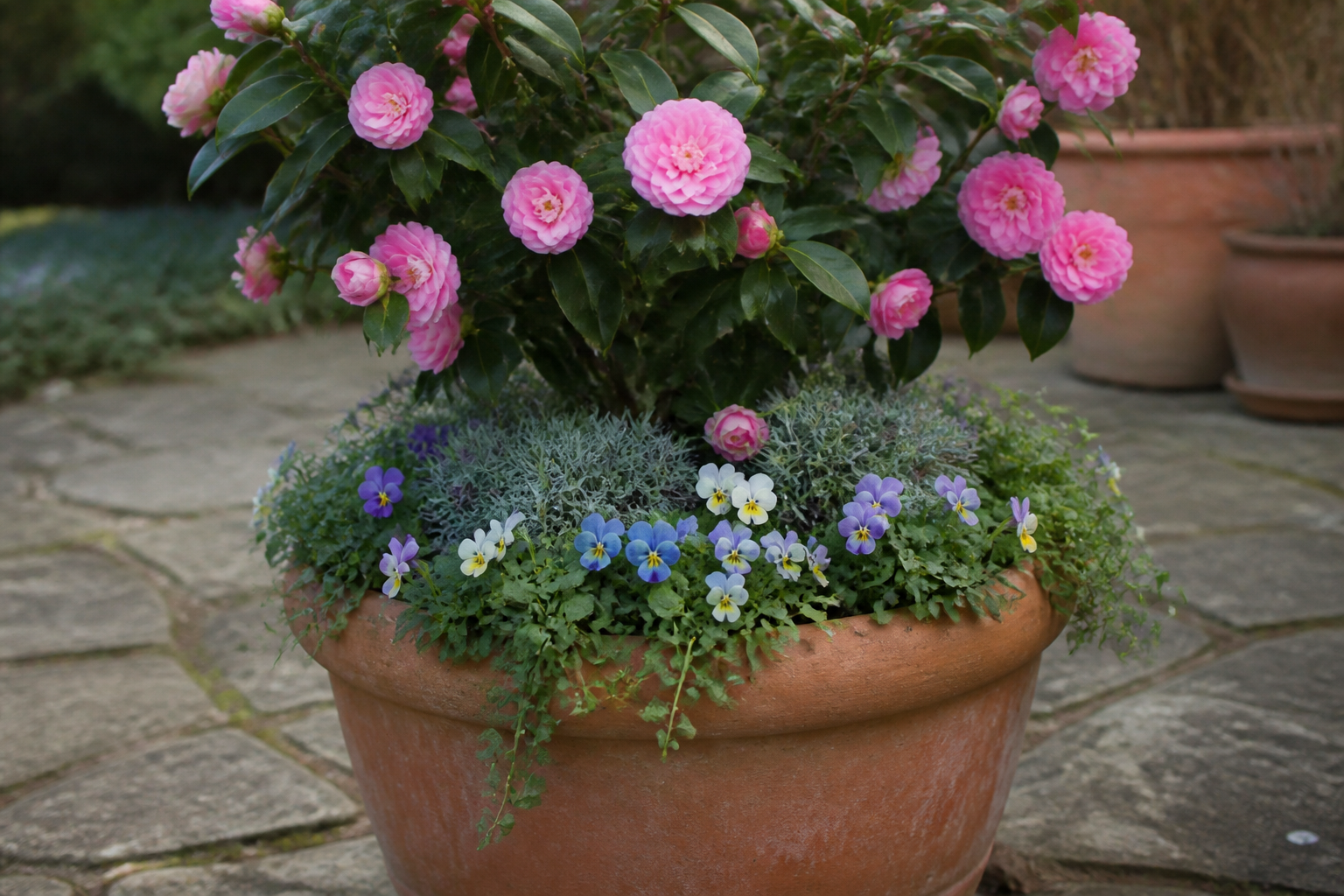
Hi there! I’m Helen Pritchard, and I’ve been cultivating camellias in the beautiful Pacific Northwest for over two decades. With more than 200 named cultivars under my belt—ranging from sasanquas to japonicas, reticulatas, and hybrids—I’ve learned a thing or two about creating vibrant, healthy gardens. Friends and neighbors often stop by my patio, eyeing my collection and asking if they can squeeze another plant into the same pot as my beloved camellias. It’s a question I’ve pondered many times myself, especially when staring at a 50-litre tub holding just one solitary shrub. Let me share my insights on companion plants for potted camellias—after all, I’ve had my fair share of successes and failures along the way!
When it comes to gardening, particularly with potted camellias, the margin for error shrinks significantly. The consequences of a bad match can be quite sharp. But if you get it right, you can create a stunning container that offers layered interest across multiple seasons—a payoff well worth the extra caution and thought.
Container Neighbors Don’t Follow Border Logic
In my garden beds, I’ve been fortunate to sit camellias comfortably beside hydrangeas, pieris, and Japanese maples. In that setting, the plants seem to thrive without any quarrels, happily pulling moisture and nutrients from the vast, uninterrupted root run. A camellia planted in open ground will stretch its roots out three meters or more in search of water and nutrients.
However, put the same camellia into a pot, and everything changes. Inside a 45cm container, a camellia’s fine, fibrous roots will claim the entire space in just eighteen months to two years, packing themselves densely. When you introduce a companion plant into that same compost, it’s not just a matter of adding a splash of color or some texture; you’re forcing a second contender into a root zone that is already stretched thin. Every drop of water and every bit of slow-release feed has to be shared, which can lead to trouble if the plants aren’t compatible.
This is why the companions worth considering for a shared pot look nothing like the shrubs and perennials I’d happily pair with a camellia in the ground. Anything sharing a container must have shallow roots, slow growth, and a laid-back attitude toward water and nutrients. I once made the mistake of pairing a trailing lobelia with a camellia, and let me tell you, I learned that lesson the hard way!
The Conditions Any Companion Must Survive
Before I dive into specific companion plants, I want to highlight some non-negotiable conditions that any companion must meet:
- Acidic, ericaceous compost. Camellias thrive in a pH range of 5.5 to 6.5, which means most plants suited to standard neutral patio mixes are immediately disqualified.
- Limited water on tap. While camellias enjoy even moisture, they are quick to sulk—or worse, rot—in soggy conditions. A companion that craves constant summer watering won’t work.
- An identical feeding routine. My potted camellias get liquid ericaceous fertilizer from late winter through midsummer. Any companion plant needs to be fine with that regimen, not fighting against it.
These constraints explain why summer bedding plants often flop in a camellia’s container. Petunias, geraniums, and marigolds prefer neutral-to-alkaline soil and generous feeding—they’ll be yellow and miserable within weeks. Trailing lobelia, on the other hand, craves consistent moisture and rich nutrition, the exact opposite of what a camellia’s pot offers.
Another rule I’ve come to insist on: don’t attempt underplanting in anything smaller than 45–50cm (18–20in) across. Anything smaller simply lacks the root volume to support two plants at once. Trust me, I’ve learned this the hard way!
Small Companions That Actually Earn Their Place in the Pot
Over the seasons, I’ve built a trusted shortlist of small plants that genuinely thrive alongside a potted camellia. These aren’t just fallback options; they’re tried-and-true companions that perform well.
Seasonal Flowers—Violas and Pansies
This is my go-to strategy, and it’s the simplest one. Winter violas and pansies are shallow-rooted, tolerate acidic conditions, and—most importantly—come and go with the seasons. You can lift them before they start competing with the camellia’s summer growth.
Plant them in September or October, depending on your local climate, and you’ll enjoy months of color running right alongside your camellia’s peak flowering. I particularly love ‘Matrix’ violas and the compact-flowered ‘Sorbet’ pansies for this job. They don’t sprawl aggressively and are built to handle the cool, damp conditions that camellias love.
By late May or early June, when the flowers begin to fade with the heat, I pull them out entirely. This gives the camellia the whole pot back for summer—no competition, no fuss, just uninterrupted growth.
And when autumn rolls around, I simply repeat the process. Year after year, without exception!
Foliage Interest—Ferns, Sedges, and Heuchera
If you’re looking for a companion that sticks around all year instead of rotating out with the seasons, I recommend plants that provide visual texture without demanding much in return.
Compact ferns top my list. Blechnum penna-marina (hard fern) and Polystichum setiferum ‘Herrenhausen’ are two favorites. They both have delicate fronds and genuinely shallow roots, thriving in the part-shade and evenly moist conditions that camellias enjoy. They also stay low, letting the camellia shine as the centerpiece.
Compact sedges like ‘Evergold’ or Carex oshimensis add fine texture and year-round presence, with roots so minimal and unassertive that they settle around the pot’s rim, hardly touching the camellia’s root ball.
Miniature heuchera or heucherella selections bring foliage color—think burgundy, lime, or variegated hues—without the heavy summer thirst of larger perennials. I’ve found ‘Obsidian’ and ‘Lime Rickey’ to be dependable in my pots with camellias like ‘Donation’ and ‘Cinnamon Cindy’.
Remember, any of these year-round companions will need to be lifted, divided, and replanted whenever you repot the camellia—usually every two to three years. Be gentle when loosening the roots if they’ve tangled, and tuck them back in as you refresh the camellia’s compost.
Trailers and Early-Season Bulbs
Compact ivy cultivars like Hedera helix ‘Duckfoot’ or ‘Needlepoint’ do a lovely job of softening a pot’s stiff rim. They tolerate acidic compost without complaint and don’t require frequent feeding or watering. But—and this is crucial—you need to keep them cut back aggressively. Given the chance, ivy will smother a camellia’s shallow surface roots without hesitation.
Every spring, I trim mine back hard, snipping away any runners heading toward the camellia’s main stem. It’s a small chore for a lovely visual payoff.
For a burst of very early spring color, I love tucking dwarf or species narcissus and crocus around the pot’s rim in autumn. Since bulbs stay dormant through most of the growing season, they won’t compete with the camellia’s active root development, and they finish their show well before summer heat sets in. Just plant them shallow, right at the outer edge, and they’ll come back and naturalize year after year with minimal upkeep.
Plants That Have No Business Sharing a Camellia’s Pot
Some of my mistakes stung more than others, and I want to spare you the same experience.
Avoid anything with an aggressive, deep-reaching root system. Spreading grasses like miscanthus will muscle their way straight through a camellia’s roots. Vigorous herbs like mint will simply take over the entire container. Most groundcover sedums prefer drier, alkaline soil—your camellia’s damp, acidic environment will eventually kill them off while they hog valuable root space.
Thirsty summer bedding is off the table entirely. This is where my lobelia disaster comes in—a lesson I remember vividly.
About fifteen years ago, I planted a trailing lobelia in a spacious camellia pot, hoping for a splash of summer blue after the spring blooms faded. It seemed reasonable at the time, but the outcome was terrible: the lobelia wilted constantly. It wanted rich, consistently damp soil—far more than a camellia can tolerate. I could water deeply for the camellia’s sake, and the lobelia would sulk from thirst, or I could water extra for the lobelia and risk drowning the camellia. To top it all off, the lobelia’s vigorous roots crowded out the camellia’s shallow surface network.
After six frustrating weeks, I pulled it out for good. Now I know better—petunias, geraniums, marigolds, and impatiens will all disappoint in exactly the same way. They simply thrive in entirely different conditions, so don’t waste your effort forcing that match.
Finally, skip anything that craves full sun if your camellia is happiest in part shade or dappled afternoon light. A dwarf rose or sun-hungry heliotrope will sulk indefinitely, and you’ll end up expending all your energy nursing a plant that was never going to thrive in those conditions.
Planting a Companion Without Wrecking the Camellia’s Roots
How you plant matters just as much as what you plant. The goal is to add a neighbor without harming the camellia in the process.
Work only in the outer third of the pot, and never disturb the area directly around the camellia’s main stem. That’s usually where the busiest roots cluster, and disturbing them can cause significant harm.
Opt for small plug plants or carefully teased-apart divisions over anything with a large root ball. I often use a dibber—a simple pointed stick—to open a planting hole instead of digging with a trowel, which helps keep disruption to the camellia’s roots to an absolute minimum.
After planting, water the new companion by hand with a watering can, rather than incorporating it into your usual camellia watering routine. The freshly planted companion needs to settle while the compost around it is still loose from the disturbance.
Move gently through all of this. You’re introducing a neighbor, not overhauling the container. Excessive digging can cause more harm than the companion is worth.
My Season-by-Season Routine
Just starting out with underplanting? Keep it simple. Skip the idea of juggling several permanent companions and instead follow the seasonal rotation I’ve used for years.
In September, I tuck winter violas into the outer third of the camellia’s pot, choosing varieties bred for shade and cool, damp conditions. They’ll provide color from October through May, while the camellia does its own flowering. Once late May or early June rolls around and the flowers begin fading, I lift the violas out and add them to the compost heap.
This gives the camellia the entire pot to itself for summer—no heat-stressed annuals, no constant fiddling, just uninterrupted growth. When September comes around again, I lift the camellia to check its roots, top up the compost if necessary, and start the viola cycle fresh.
It’s a reliable system. It looks good and respects exactly what your camellia needs to thrive.
If you fancy adding a permanent fern or sedge to one of your other pots, go for it—just treat it as an ongoing commitment. Every two or three years, when the camellia needs repotting, you’ll need to lift, divide, and replant that companion too. That’s not a downside; it’s simply how the arrangement works.
The real value of companion plants for potted camellias isn’t about transforming a single container into a miniature cottage garden. It’s about extending the season of interest, adding a touch of complementary color, or introducing some textural contrast—while still allowing the camellia to remain the star of the show.
Stick with shallow-rooted, acid-loving, low-maintenance companions. Position them carefully around the pot’s outer edge, resist the urge to pack too much in, and when in doubt, rely on seasonal violas. Your patio display—and your camellias—will be all the better for it.
About This Article

Written by Helen Pritchard. Helen Pritchard is a lifelong gardener in the Pacific Northwest who has grown more than 200 named camellia cultivars over two decades. She writes practical, experience-based guides to camellia care, from variety selection and pruning to troubleshooting yellowing leaves and bud drop. More about this site.
Verify this against a primary source
Specifics change, and your situation may differ from the one described here. These are the authorities worth checking directly:
- American Camellia Society — cultivar registration and culture guides
- USDA Plant Hardiness Zone Map — zone verification for your location
- Royal Horticultural Society — camellia cultivation and pest guidance