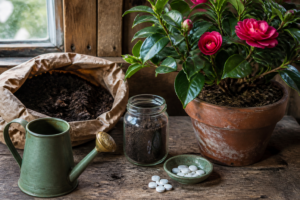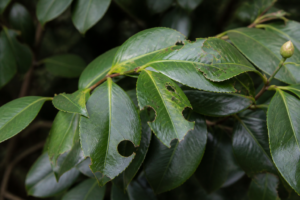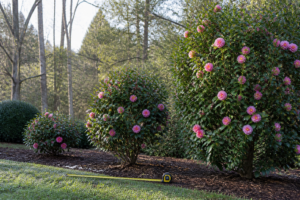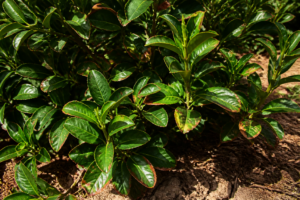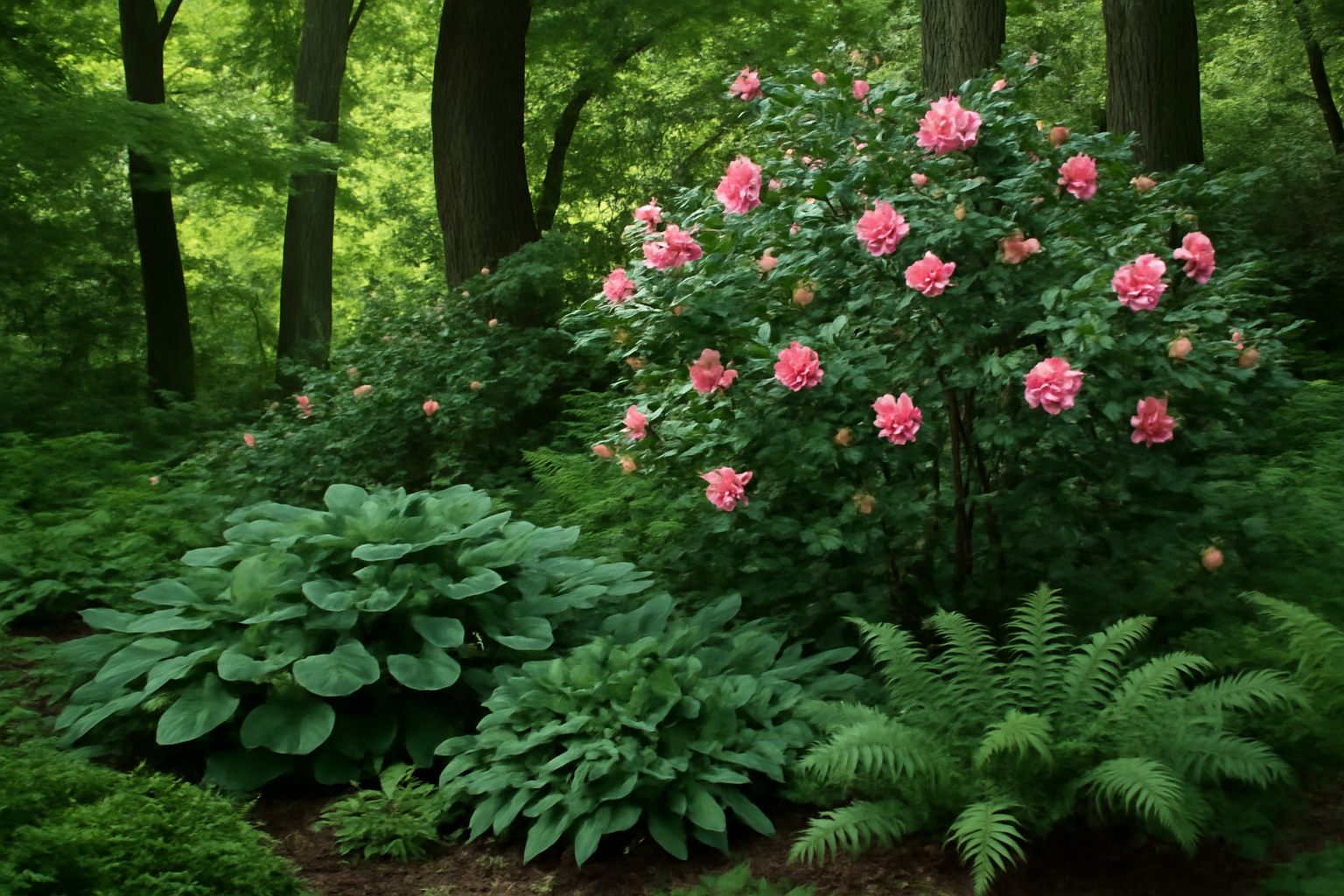
- Group plantings in odd counts. Threes, fives, or sevens of a single cultivar look deliberate and abundant, whereas one lone shrub tucked beneath a big tree can end up looking stranded.
- Weave the bloom calendar together rather than block-planting by type. I avoid clustering every sasanqua in one spot and every japonica in another — mixing them lets colour drift through the bed season after season.
- Factor in mature dimensions before you dig. ‘Elegans Champagne’ remains tidy enough for a modest shaded corner, while ‘Professor Sargent’ and ‘Francie L’ will eventually balloon into substantial shrubs, so budget room for that growth early.
- Borrow vertical space on purpose. Columnar japonicas such as ‘Berenice Boddy’ can be coaxed into a loose espalier form along a fence line or trunk, gaining height without eating into your footprint.
- Map your view from indoors before planting. One of my smartest placement calls was tucking the first-to-bloom japonicas where I’d catch them through the kitchen window on grey winter mornings.
“Can anything actually bloom under that much shade, or am I basically planting fancy ground cover?” A fellow gardener asked me that while staring down a gloomy, root-tangled patch beneath his backyard oaks, and the question stuck with me because I’d stood in that exact spot myself roughly fifteen years earlier. My own oak grove was patchy, moss-covered, and — I assumed — a lost cause. Then another gardener pressed a rooted cutting of Camellia japonica ‘Elegans’ into my hands and told me, “Just put it in the shade, trust the process.” That one plant rewired how I’ve approached garden design ever since, and it’s the reason shade garden camellias have become one of the most rewarding parts of everything I grow.
These days I’m tending north of 200 named cultivars spread across three properties in USDA zones 7b, 8a, and 8b, and a large share of them are living contentedly under tree canopies. What follows is my actual working method for building camellia-based shade gardens that hold visual interest across all twelve months — not just the handful of weeks when flowers steal the show.
Why Shade Is Practically the Camellia’s Native Habitat
Camellias didn’t evolve out in open meadows — they came up under the forest canopies of East Asia, and that’s more than a nice bit of trivia. Out in the wild, both Camellia sinensis (the source of tea) and native Camellia japonica populations grow as understory shrubs, catching whatever light filters down past taller trees. Their biology is essentially built around reduced direct sun.
What I’ve found in practice is that most camellias respond better to four to six hours of dappled or filtered brightness than to blasting afternoon sun. Push them into too much direct exposure — this is especially true in zones 8a and 8b — and you’ll get scorched leaves, washed-out flower colour, and stressed root systems. Go too far the other direction, though, and heavy shade will choke off flowering almost entirely. The zone you want sits right in the middle: bright, indirect light beneath a high, open canopy — think tall pines, open-limbed oaks, or mature hickories rather than a low, dense-crowned maple.
Sorting Out Which Camellia Types Tolerate Shade Best
Shade tolerance isn’t uniform across the camellia world. Here’s roughly how I categorize the major groups when I’m deciding what goes where:
- Camellia japonica varieties — the champions of shade tolerance in my garden. ‘Elegans,’ ‘Professor Charles S. Sargent,’ and ‘Magnoliaeflora’ all settle in beautifully beneath my oaks with barely any coddling. Their late-winter-into-early-spring bloom window fills a quiet stretch in the shade garden’s yearly rhythm.
- Camellia sasanqua varieties — a bit more light-hungry than japonicas, though many still hold their own in partial shade. ‘Setsugekka,’ ‘Yuletide,’ and ‘Cleopatra’ line my woodland edge where morning sun still reaches them, flowering from autumn into early winter — a season the shade garden badly needs covered.
- Camellia reticulata varieties — think of these as the prima donnas of the group. Their blooms are enormous and showy, but they demand more light than their relatives. My ‘Francie L’ and ‘Captain Rawes’ live on the brighter fringe rather than under a full canopy, and in zone 8b that arrangement works out fairly well.
- Interspecific hybrids — cultivars like ‘Winter’s Star’ and the various Ackerman introductions are sturdy, flexible plants that manage partial shade without complaint. Several are also hardy down into zone 6b, which opens the door to shade gardening for growers further north.
Building a Camellia Shade Garden Season by Season
The tricky part of shade gardening isn’t finding plants tough enough to survive there — it’s engineering genuine interest across all four seasons. Camellias hand you a huge head start on that front, since their various bloom windows stack together so conveniently. Even so, you need a plan before a single plant goes in the ground.
My first move is always to track the light. I’ll walk the site four separate times over one day — morning, midday, afternoon, evening — noting which patches catch sun, which stay dim all day, and which pick up bounced light off a nearby wall or fence. That single day of observation saves years of replanting headaches down the road. I use what I learn to sort the space into zones: brighter margins for sasanquas, dimmer pockets for japonicas, and in-between spots for hybrids.
Fall: Sasanquas Set the Stage
Autumn in my shade gardens is entirely a sasanqua show. Between October and December, cultivars such as ‘Setsugekka’ (fragrant, white, semi-double) and ‘Yuletide’ (a dependable bright red single) do most of the heavy lifting. I position them along the sunnier woodland margins where they’ll pick up the most available light.
‘Cleopatra’ earns a regular spot in this lineup too, with its semi-double rose-pink blooms and its unusual tolerance for deeper shade than most sasanquas manage. I use it as a transitional plant, bridging the brighter edge of the bed with the darker interior of my oak grove. Plants like this that straddle two light zones are really what keeps a design feeling seamless rather than choppy.
Winter Into Spring: Japonicas Take the Lead
January through April is japonica territory in my shade garden, and the timing couldn’t be more useful — this is the group’s peak performance, arriving right when nearly everything else in the landscape has gone dormant.
In my darkest planting pockets, ‘Professor Charles S. Sargent’ — a formal double in deep red — proves almost indestructible beneath my thickest oak canopy. In moderately shaded ground, ‘Elegans’ (soft pink, anemone form) and ‘Berenice Boddy’ (semi-double, light pink) supply months of steady colour. And for the brightest, most luminous look in filtered light, I turn to ‘Magnoliaeflora,’ a blush-pink semi-double that seems to glow on an overcast winter afternoon.
Growers in zone 7b need to watch bloom timing closely, since early-flowering japonicas are vulnerable to late-season frosts. For shaded beds with real exposure in that zone, I favor mid-to-late-season cultivars like ‘Easter Morn’ and ‘Hagoromo’ — they tend to dodge the harshest cold snaps entirely.
Summer’s Job: Let Foliage Carry the Design
Let’s be honest about summer: your camellias won’t be flowering. That’s not a problem, though, as long as you’ve planned around it. Mature camellia foliage — glossy and richly green — is genuinely striking on its own merits, creating a cool, lush backdrop that flatters whatever else is growing nearby.
Summer is also the season I notice the structural contrasts between cultivars most clearly. The bold, oversized leaves of reticulata types play beautifully off the finer, denser foliage of sasanquas. And new growth flushes — frequently bronze or copper-toned — add a surprising splash of colour from roughly May through July.
Pairing Companion Plants With Shade Garden Camellias
A camellia bed shouldn’t stand alone. The designs that have worked best for me pair camellias with companions that plug seasonal gaps, contribute contrasting texture, and share compatible growing needs — specifically, plants that also want acidic, well-draining soil somewhere in the 5.5 to 6.5 pH range.
Here’s the shortlist of companions I reach for most often under trees, alongside camellias:
- Hydrangea macrophylla and serrata — nearly identical growing preferences, a strong presence during the summer lull, and reasonable tolerance for tree-root competition provided they get consistent moisture and decent compost.
- Japanese forest grass (Hakonechloa macra) — the golden-lime tone of ‘Aureola’ practically glows against dark camellia leaves, and it handles moderate to heavy shade without complaint.
- Hellebores (Helleborus orientalis hybrids) — flowering from late winter through spring, their bloom time overlaps neatly with japonicas, producing a striking late-winter combination.
- Native ferns — southern shield fern and Christmas fern perform admirably across my zone 7b and 8a properties, filling in low ground cover, crowding out weeds, and asking for almost nothing in return.
- Mahonia — blooms in winter, tolerates shade, and shares the acid-loving preference. ‘Soft Caress’ offers a refined, fine-textured presence that nicely bridges the gap between sasanqua and japonica season.
I go into much more depth on plant pairings — including specific shade-layer combinations — in my companion planting article, if you’d like to dig further into that topic.
Soil Prep Beneath Trees: Where Most People Slip Up
I’ll be direct about this one. Skipping proper soil preparation before planting camellias under mature trees is, hands down, the mistake I see most often among newer camellia growers. I made this exact error myself in my early years, and it cost me two shrubs and roughly two years of frustration before I figured out what went wrong.
Beneath an established tree, you’re up against an enormous, fibrous root network that pulls water and nutrients aggressively out of the surrounding soil. That soil is frequently compacted, depleted, and sometimes alkaline thanks to years of decomposing leaves forming an alkaline duff layer on top. None of that is friendly territory for camellias.
How I Actually Prepare the Soil
Instead of digging down and battling tree roots directly, I build upward. I construct raised planting mounds or island beds blending quality topsoil, composted pine bark, and acidic compost, aiming for at least 18 inches of improved growing medium. This lifts camellia roots above the fiercest root competition and delivers the sharp drainage camellias require, since soggy roots are one of the fastest ways to lose a plant.
I also check soil pH before anything goes in the ground. I aim for 5.8 to 6.2 for camellias specifically — a touch more acidic than the broader 5.5 to 6.5 range you’ll often see quoted. Anything reading above 6.5 gets amended with granular sulfur and acidic compost, and I retest six weeks later. This isn’t a step to skip — high pH triggers chlorosis, that telltale yellowing of leaves, along with stunted growth, no matter how well everything else is handled.
For mulch, I spread a 3-inch layer of pine bark mini-nuggets, keeping it clear of the main stem. It holds moisture, buffers soil temperature swings, and slowly nudges pH downward as it breaks down. On my zone 7b property, this same mulch layer also offers meaningful root insulation during hard freezes.
Watering and Fertilizing Camellias in Shaded Beds
Trees produce what I think of as a “rain shadow,” and it catches a lot of newer gardeners off guard. Dense canopies intercept a surprising amount of rainfall, so the ground underneath can end up noticeably drier than the surrounding open yard. My own oak garden can turn bone dry in summer even while the rest of the property gets plenty of rain.
During the first two years after planting, I give newly established shade garden camellias a deep watering once a week during dry stretches, more often when summer heat spikes. Once they’ve settled in, camellias handle drought reasonably well on their own — but they still need supplemental water through prolonged dry spells, particularly while they’re carrying flower buds in late summer and fall.
For fertilizing, I apply a slow-release, acid-formulated feed in early spring as new growth starts, then a lighter application again in early summer, and I stop entirely by August. Feeding too late pushes out tender growth that late frosts can easily damage — a lesson I learned the hard way after a lovely ‘Kramer’s Supreme’ suffered tip damage two years running before I finally adjusted my schedule.
Layout Strategies That Actually Work in a Camellia Shade Garden
Whenever I’m designing a camellia shade garden from the ground up, I lean on a handful of guiding principles that have proven reliable across all three of the zones I garden in.
- Group plantings in odd counts. Threes, fives, or sevens of a single cultivar look deliberate and abundant, whereas one lone shrub tucked beneath a big tree can end up looking stranded.
- Weave the bloom calendar together rather than block-planting by type. I avoid clustering every sasanqua in one spot and every japonica in another — mixing them lets colour drift through the bed season after season.
- Factor in mature dimensions before you dig. ‘Elegans Champagne’ remains tidy enough for a modest shaded corner, while ‘Professor Sargent’ and ‘Francie L’ will eventually balloon into substantial shrubs, so budget room for that growth early.
- Borrow vertical space on purpose. Columnar japonicas such as ‘Berenice Boddy’ can be coaxed into a loose espalier form along a fence line or trunk, gaining height without eating into your footprint.
- Map your view from indoors before planting. One of my smartest placement calls was tucking the first-to-bloom japonicas where I’d catch them through the kitchen window on grey winter mornings.
About This Article

Written by Helen Pritchard. Helen Pritchard is a lifelong gardener in the Pacific Northwest who has grown more than 200 named camellia cultivars over two decades. She writes practical, experience-based guides to camellia care, from variety selection and pruning to troubleshooting yellowing leaves and bud drop. More about this site.
Verify this against a primary source
Specifics change, and your situation may differ from the one described here. These are the authorities worth checking directly:
- American Camellia Society — cultivar registration and culture guides
- USDA Plant Hardiness Zone Map — zone verification for your location
- Royal Horticultural Society — camellia cultivation and pest guidance