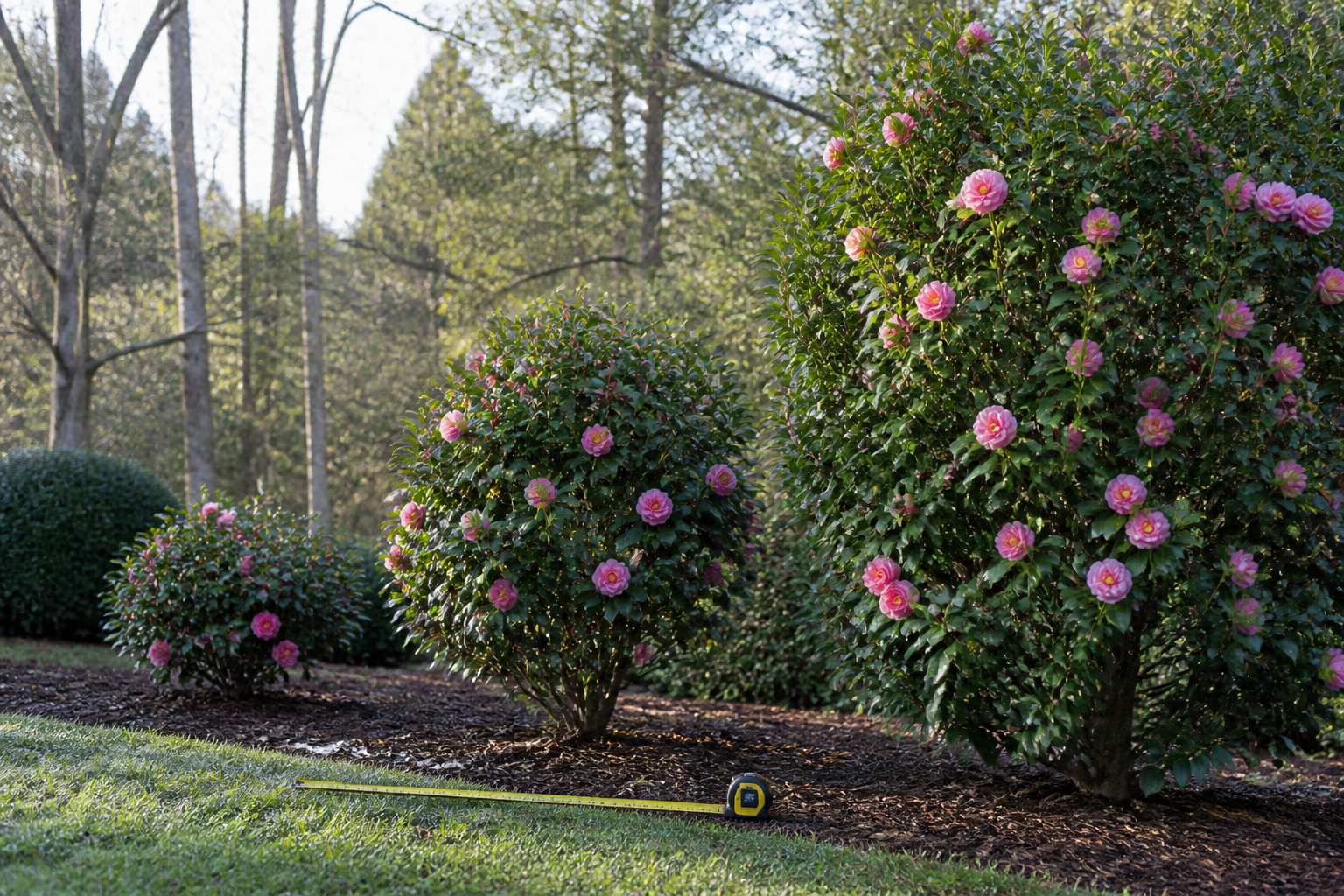
I keep a small notebook where I record the annual growth of each camellia in my garden. After twenty years and more than 200 named cultivars across three USDA zones, I’ve learned something that most published camellia growth charts won’t tell you: the same cultivar can grow twice as fast—or half as fast—depending on three things you control. That’s why a camellia growth rate by variety matters less as a prediction and more as a range to aim for.
A ‘Kanjiro’ sasanqua in my amended acid bed with afternoon shade grows 14 inches a year. The same cultivar in my neighbor’s heavy clay and afternoon sun? Eight inches. Neither of us is doing anything wrong. We’re just operating at different ends of the camellia spectrum.
This reference is built on what I’ve actually measured in my own garden, not on the hopeful guesses that float around online. I’ll show you exactly which cultivars deserve the “fastest growing camellia” title, which ones are genuinely slow, and—most importantly—how to read your own numbers when you bring a named variety home.
If you’re comparing sasanqua versus japonica growth at the species level, I’ve covered that in detail here. This post dives into the individual cultivars instead: the specific varieties you can actually buy and the real size they’ll reach in your garden.
How to Read These Numbers
Every camellia cultivar entry below includes three measurements: annual growth, size at ten years, and approximate mature size. Here’s what each one means and why they matter.
Annual growth is the new wood produced per year under good conditions. I measure this in late summer, before fall flush, as the distance from the previous year’s bud scar to the new terminal bud. This is the number that varies most between gardens.
Size at ten years tells you how much screening or framework you’ll have by the time most people stop actively shaping their camellias. It’s the most practical number for garden planning.
Mature size is what the cultivar reaches when left unpruned for twenty to thirty years. Not all camellias need that long to finish sizing, but some do. This matters for backdrop hedges and specimen plantings that you want to define a space.
I’ve organized growth into four categories:
- SLOW: Under 6 inches of new growth per year
- MODERATE: 6 to 12 inches per year
- FAST: 12 to 18 inches per year
- EXCEPTIONAL: More than 18 inches per year
These ranges assume you’re growing camellias the way they want to be grown: in amended, acidic, well-draining soil with consistent moisture during establishment (roughly the first three years) and afternoon shade in hot climates.
The three levers you control are soil pH and drainage, water management early on, and light. Amend your bed with compost and pine bark. Keep new plants consistently moist—not wet, but never bone dry—for the first two seasons. Plant where afternoon shade breaks the hottest part of the day.
If your soil is heavy clay, unamended, neutral to alkaline, or your summer sun is relentless, move every figure below down one category. A camellia that would be FAST in my garden might only hit MODERATE in yours. That’s not failure. That’s honesty about site conditions.
Sasanqua Cultivars: The Fast Group
Sasanquas are the sprinters of the camellia world. They break dormancy earlier in spring, push growth vigorously through summer, and flower in fall and early winter. If you need screening quickly, you’re looking at this group.
That said, not all sasanquas grow at the same rate. ‘Yuletide’ and ‘Shishi Gashira’ are markedly slower than their cousins ‘Kanjiro’ and ‘Setsugekka.’ Knowing the difference between fast and merely moderate within the group is where this reference pays for itself.
‘Kanjiro’
Annual growth: 12 to 18 inches per year
At ten years: 5 to 6 feet tall and wide
Mature size: 8 to 10 feet tall and wide
Habit: Dense, upright, pyramidal
Best for: Hedging and screening
‘Kanjiro’ is the workhorse sasanqua. Stiff, upright growth. Excellent foliar density. Dark green foliage. Rose-red semidouble flowers that appear reliably in mid-fall. This is the plant people buy when they say “I need a hedge fast.”
It lives up to that reputation. In my zone 8a bed, ‘Kanjiro’ plants push 15 inches of new growth most years. A three-foot specimen grows to five feet in five years. By year ten, you have a proper tall shrub.
I plant ‘Kanjiro’ at 4 feet on center for hedging. At 3 feet, the plants touch by year seven and you’re removing alternates by year nine. I learned this the hard way. Patience at planting saves thinning later.
‘Setsugekka’
Annual growth: 12 to 18 inches per year
At ten years: 6 to 7 feet tall, 4 to 5 feet wide
Mature size: 8 to 10 feet tall, 5 to 6 feet wide
Habit: Upright, vase-shaped, more open than ‘Kanjiro’
Best for: Espaliers, specimen plantings, tall narrow screens
Same growth rate as ‘Kanjiro,’ but entirely different architecture. ‘Setsugekka’ grows upright and vase-shaped, with a more open interior and visible branching structure. The foliage is finer. The white single flowers are luminous at dusk.
This is the sasanqua I choose when I want speed but not a hedge wall. Plant it where you can see through it. It’s beautiful as a specimen and exceptional trained as an espalier against a fence. At 4 to 5 feet wide, it doesn’t fill the way ‘Kanjiro’ does.
In my experience, ‘Setsugekka’ is slightly more particular about drainage than ‘Kanjiro.’ It sulks in wet soil. Make sure your planting bed drains freely, especially in winter.
‘Yuletide’
Annual growth: 6 to 10 inches per year
At ten years: 4 to 5 feet tall and wide
Mature size: 6 to 10 feet tall and wide
Habit: Compact, densely branched
Best for: Accent plantings, smaller gardens, containers when young
Don’t confuse ‘Yuletide’ with the speed of ‘Kanjiro.’ It’s a sasanqua, yes, but noticeably more compact and slower. The bright red single flowers bloom reliably from November through December, even in cold winters. It’s a workhorse for seasonal color.
I grow three ‘Yuletides’ as anchors in a mixed border. They’re tight, well-branched from the ground up, and they don’t need aggressive pruning to stay full. At ten years, expect a shrub four to five feet tall and nearly as wide. These plants don’t rush.
For hedging, ‘Yuletide’ is less efficient than ‘Kanjiro.’ You’ll wait longer for a closed screen. But if you want a narrower, more refined hedge, space them at 3 feet and accept a slightly slower fill.
‘Mine-no-Yuki’
Annual growth: 8 to 12 inches per year
At ten years: 3 to 4 feet tall, 5 to 6 feet wide
Mature size: 4 to 5 feet tall, 8 to 10 feet wide
Habit: Spreading, somewhat pendulous
Best for: Banks, foreground screens, low hedging
‘Mine-no-Yuki’ spreads more than it climbs. Moderate to fast growth, but the habit is horizontal. White double flowers on dark foliage. In my zone 8a, this plant builds width quickly—five to six feet wide by year eight—but tops out around three feet tall.
Use this cultivar where height isn’t your primary goal. It’s excellent on slopes and berms where the spreading habit follows the land. At the front of a mixed border, it softens the line without blocking the view behind it.
I planted one ‘Mine-no-Yuki’ as a foundation planting nine years ago. It’s now six feet wide and three feet tall, barely reaching the base of the window. Exactly what I wanted, but exactly not what someone planting it expecting upright growth would get.
‘Shishi Gashira’
Annual growth: 4 to 6 inches per year
At ten years: 2.5 to 3 feet tall and wide
Mature size: 4 to 5 feet tall and wide
Habit: Dense, compact, low-growing
Best for: Foundation plantings, short hedges, areas that call for a true dwarf
This is the sasanqua for gardeners who plant a full-size variety in front of the window and regret it ten years later. ‘Shishi Gashira’ genuinely stays small. Rose-pink semidouble flowers. Glossy foliage. Slow, steady growth that tops out around four to five feet even when mature.
Growth is under six inches per year on average. At ten years, expect a neat, full plant about three feet in all dimensions. This is the only sasanqua I’d feel comfortable planting directly in front of a house foundation without worrying about future pruning headaches.
Because ‘Shishi Gashira’ is genuinely slow, don’t expect the fast screening you get with ‘Kanjiro.’ Plant it where you’re comfortable waiting or where you’re using it for fall color, not for sight lines.
Japonica Cultivars: The Slow Group
Japonicas are the opposite of sasanquas. They break growth later in spring. They push more deliberately through the growing season. They’re slower to mature, but they can live a hundred years. If you’re building a long-term structure in your garden, you’re probably looking at this group.
The fastest japonica is still slower than the slowest sasanqua. Even the vigorous ones in this group top out in the 8 to 12 inch annual growth range. Plan accordingly.
‘Marie Bracey’
Annual growth: 8 to 11 inches per year
At ten years: 5 to 6 feet tall, 4 to 5 feet wide
Mature size: 8 to 10 feet tall, 6 to 7 feet wide
Habit: Upright, vigorous for a japonica
Best for: Mid-season color, specimen plantings, tall screens
‘Marie Bracey’ is the japonica search that brings gardeners here asking “How fast does it actually grow?” The published information is sparse. Most nurseries don’t size it. So here’s what I’ve measured: it’s one of the faster japonicas, and if you need a japonica with real presence by year ten, this is it.
Mid-season bloomer. Rose-red semidouble flowers. Upright branching. Foliage holds well through winter. In my zone 8a, established plants average nine inches of new growth per year. At ten years, a well-sited specimen is five to six feet tall.
This is not a fast plant compared to any sasanqua. But compared to other japonicas, ‘Marie Bracey’ delivers results faster. Plant it where you’re comfortable with japonica timing but need the vigor.
‘Debutante’
Annual growth: 4 to 8 inches per year
At ten years: 3 to 4 feet tall and wide
Mature size: 5 to 7 feet tall and wide
Habit: Compact, heavily branched
Best for: Container cultivation when young, specimen plantings, mixed borders
‘Debutante’ is genuinely slow. Light pink semidouble flowers. Compact growth. In my garden, it averages six inches of new growth per year, sometimes less. At ten years, a ‘Debutante’ is typically three and a half feet tall.
If you’re looking for a japonica for a container or a small space where you want to watch a plant develop slowly and deliberately, this is it. Don’t plant it expecting fast fill. Plant it for the habit and the flowers, and accept that maturity takes time.
‘Adolphe Audusson’
Annual growth: 7 to 10 inches per year
At ten years: 5 to 6 feet tall, 4 to 5 feet wide
Mature size: 10 to 12 feet tall, 8 to 10 feet wide
Habit: Upright, well-branched
Best for: Long-term screens, specimen plantings, hedging where patience exists
‘Adolphe Audusson’ is the japonica that actually performs. Reliable grower. Dark red semidouble flowers. Excellent foliage. One of the better choices if you’re a japonica person who’s tired of waiting for size.
Average annual growth is about eight to nine inches. At ten years, you have a solid five to six foot plant. By year fifteen, it’s closing in on eight feet. It won’t replace ‘Kanjiro’ for speed, but it’s dependable and worth the patience.
I have three ‘Adolphe Audusson’ camellias forming a tall informal screen along my property line. Planted fifteen years ago. They’re nine feet tall now and absolutely earning their space. If you can wait, plant this variety.
‘Mathotiana’
Annual growth: 8 to 12 inches per year
At ten years: 6 to 7 feet tall, 5 to 6 feet wide
Mature size: 12 to 15 feet tall, 8 to 10 feet wide
Habit: Upright, becoming taller than wide with age
Best for: Tall specimen plantings, long-term screens, backdrop hedges
‘Mathotiana’ is a camellia you plant for legacy. Moderate to vigorous growth for a japonica. Large red double flowers. Dependable bloomer across many climate zones. This plant wants to reach twelve feet or more, and it has the vigor to get there.
Annual growth averages ten inches in my garden. At ten years, expect six to seven feet. But unlike most japonicas that seem to plateau, ‘Mathotiana’ keeps pushing height. By year twenty, it’s genuinely tall and imposing. It’s a plant that rewards patience with real structure.
Don’t underestimate the mature width. At ten years, ‘Mathotiana’ is about five feet wide, but it fills considerably more by year twenty. Space accordingly if you’re hedging.
‘Nuccio’s Gem’
Annual growth: 5 to 8 inches per year
At ten years: 3.5 to 4.5 feet tall, 3 to 4 feet wide
Mature size: 6 to 8 feet tall, 5 to 6 feet wide
Habit: Upright, compact branching
Best for: Specimen plantings, containers when young, mixed borders
Here’s a camellia worth waiting for. Formal white double flowers. Exceptionally slow early growth. Compact branching. ‘Nuccio’s Gem’ is not a plant you buy if you need immediate impact. You buy it because the flowers are extraordinary and you’re willing to wait four or five years to see them in abundance.
In my zone 8a garden, ‘Nuccio’s Gem’ pushes five to seven inches of new growth per year when established. At ten years, plants are four feet tall. They start blooming at year two or three, but you don’t see the full display until year six or seven when the plant has built better structure.
This is not a japonica for the impatient. But if you can plant it and ignore it for five years, the formal doubles make every bit of that wait worthwhile.
Williamsii and Other Hybrids
Williamsii hybrids split the difference. They inherit the growth vigor of sasanquas and the refined flowers of japonicas. Most reach moderate growth rates. A few are genuinely fast. If you want screening with good flowers, look here first.
‘Donation’
Annual growth: 10 to 15 inches per year
At ten years: 6 to 8 feet tall, 5 to 6 feet wide
Mature size: 10 to 12 feet tall, 7 to 9 feet wide
Habit: Upright, vigorous
Best for: Tall screens, specimen plantings, the impatient japonica lover
‘Donation’ is one of the quickest routes to a substantial flowering shrub if you want japonica-like flowers. Upright growth. Vigorous. Large pink semidouble blooms. In my zone 8a, established plants push twelve to fourteen inches of new growth most years.
At ten years, you have a plant six to eight feet tall. That’s real height. That’s usable screening. The growth rate is only slightly slower than a fast sasanqua, but the flowers are considerably more refined.
This is the hybrid I recommend to someone who says “I want japonica flowers but sasanqua speed.” It’s not quite as fast as ‘Kanjiro,’ but it’s close enough to matter.
‘Les Jury’
Annual growth: 8 to 12 inches per year
At ten years: 5 to 6 feet tall, 4 to 5 feet wide
Mature size: 8 to 10 feet tall, 6 to 7 feet wide
Habit: Upright, well-branched
Best for: Specimen plantings, mixed borders, display gardens
‘Les Jury’ is a New Zealand-bred williamsii hybrid. Moderate growth. Red formal double flowers. Excellent foliage. In my zone 8a, established plants average nine to ten inches of new growth per year.
Here’s what you need to know: formal double camellias with tightly packed petals—including ‘Les Jury’—are prone to bud balling and browning in persistently wet or cold spells. I get questions about this constantly. The issue isn’t feeding or root disease. It’s site conditions.
Plant ‘Les Jury’ where air circulates freely and afternoon sun dries foliage after rain. Shelter it from cold, wet east-facing wind if you’re in zone 7. Formal doubles need protection from prolonged wet weather. Site it right, and flowering problems vanish.
‘Anticipation’
Annual growth: 9 to 13 inches per year
At ten years: 5.5 to 7 feet tall, 4.5 to 5.5 feet wide
Mature size: 9 to 12 feet tall, 7 to 8 feet wide
Habit: Upright, vigorous
Best for: Tall screens, specimen plantings, containers when young
‘Anticipation’ is the hybrid that performs like a sasanqua but flowers like a japonica. Large peony-form flowers. Deep red color. Vigorous growth. In my garden, this plant averages eleven inches of new growth per year.
At ten years, expect a plant six to seven feet tall and nearly as wide. By year fifteen, it’s approaching eight feet and filling in substantially. This is not as fast as ‘Donation,’ but it’s close. The flowers are marginally larger.
If you’re choosing between ‘Donation’ and ‘Anticipation’ and you want pure height quickly, go ‘Donation.’ If you want fractionally larger flowers and can accept marginally slower growth, ‘Anticipation’ is worth considering.
‘Jury’s Yellow’
Annual growth: 8 to 11 inches per year
At ten years: 5 to 6 feet tall, 4 to 5 feet wide
Mature size: 8 to 10 feet tall, 6 to 7 feet wide
Habit: Upright, well-branched
Best for: Specimen plantings, containers when younger, exceptional color
I grow ‘Jury’s Yellow’ as a specimen in my zone 8a garden, where it reaches about five feet tall by year ten. Moderate growth. Cream-yellow peony-form flowers with a yellow stamen center. The bloom is unique in the genus, which is precisely why I planted it.
This is not a plant for fast screening. It’s a camellia for gardeners who care about flower color and are willing to wait for bulk. Average annual growth is around nine inches. It’s dependable, not spectacular, but the flowers justify the patience.
Reticulatas, Compact Selections, and Dwarfs
Reticulata hybrids are large-flowered, slow-growing camellias bred for warmer zones. Modern compact selections are marketed for small gardens. True dwarfs live in containers. These are narrow categories, but they’re important if you’re choosing for specific conditions.
Reticulata Hybrids (‘Captain Rawes’, ‘Francie L’, and Others)
Annual growth: 6 to 9 inches per year
At ten years: 4 to 5 feet tall, 3 to 4 feet wide
Mature size: 8 to 12 feet tall, 6 to 8 feet wide
Habit: Open, upright, becoming tall with age
Best for: Warmer zones (8b and above), specimen plantings with large flowers
Reticulatas are slow-growing plants bred for exceptional large flowers and warmer climates. They’re not candidates for cold zone 7 gardens. But in zone 8b and above, they’re worth the long build time.
‘Captain Rawes’ is the most cold-hardy reticulata hybrid. Pink formal double flowers, sometimes reaching five inches across. ‘Francie L’ is warmer-zone favorite with deep red flowers. Both grow at six to nine inches per year. At ten years, they’re four to five feet tall. At twenty years, they’re substantial plants.
These plants are for gardeners who collect camellias and don’t need instant gratification. They’re also excellent in containers while young, which is where most people first encounter them.
‘Mojo’
Annual growth: 5 to 8 inches per year
At ten years: 2.5 to 3 feet tall and wide
Mature size: 3 to 4 feet tall and wide
Habit: Compact, upright
Best for: Small gardens, containers, foundation plantings
‘Mojo’ is a modern compact sasanqua-type selection. This is where the camellia breeding game is heading: smaller, tighter, marketed for containers and tight spaces. Red single flowers. Glossy foliage. Slow to moderate growth.
Here’s the caveat: newer patented compact selections have significantly less long-term field data behind their published sizes than the old cultivars that have been growing in gardens for fifty years. The nursery tag says three feet mature. That might be accurate. It might not be. We won’t know until enough ‘Mojo’ plants have lived in enough gardens for twenty years.
If you’re planning a bed around newer compact selections, size conservatively. Assume they’ll grow 20 to 30 percent larger than the published mature height. Plant with that possibility in mind, and you’ll be comfortable either way.
‘Baby Bear’ and ‘Tiny Princess’
Annual growth: 3 to 5 inches per year
At ten years: 1.5 to 2 feet tall and wide
Mature size: 2 to 3 feet tall and wide
Habit: Extremely compact
Best for: Containers, alpine troughs, indoor bonsai cultivation
These are genuinely small plants. ‘Baby Bear’ is a pink sasanqua-type with tiny flowers. ‘Tiny Princess’ is similar. Growth under five inches per year. These are plants for containers, not garden beds. Even in full sun and amended soil, they max out around two to three feet tall.
If you’re looking for a camellia that stays small enough for a patio container or an indoor plant in a cold frame, this is the category. Just accept that growth is very slow and maturity is measured in inches, not feet.
What Is the Fastest Growing Camellia?
The honest answer: a vigorous sasanqua like ‘Kanjiro’ or ‘Setsugekka’ at 12 to 18 inches of new growth per year under good conditions. That’s as fast as the genus gets.
Nothing in the camellia world competes with privet or photinia for screening speed. If you’re replacing a dead photinia and you need a screen in three years, camellias will disappoint you. Plan for five to seven years. Plant accordingly.
That said, ‘Kanjiro’ and ‘Setsugekka’ are as close as camellias come to “fast.” In amended acid soil with consistent water for the first three years and afternoon shade, both reach four to five feet tall by year five. By year eight, they’re touching if planted three feet apart.
If speed is your only goal, sasanquas are your best bet. If you want speed plus refined flowers and long-term plant longevity, the williamsii hybrids ‘Donation’ and ‘Anticipation’ bridge the gap. They’re not sasanqua-fast, but they’re close.
What These Numbers Mean for Spacing
This is where most gardeners make their biggest mistake. Young camellias look spare and open. People plant them too close together. Seven years later, they’re crowded and require removal of half the plants.
Use the mature width figures above to determine spacing. Don’t space according to what the plant looks like at purchase.
For ‘Kanjiro’ hedging: Plant on 4-foot centers. At maturity, the plants will be eight to ten feet wide. You’ll touch by year ten. Earlier removal isn’t necessary. By year ten, you have a closed screen.
For ‘Setsugekka’ or ‘Anticipation’ screening: Plant on 4.5-foot centers. These plants are narrower than ‘Kanjiro,’ so 4.5 feet gives you good spacing without leaving gaps.
For mixed borders with specimen plants: Check the mature width. A ‘Donation’ reaches seven to nine feet wide. Space it accordingly. A ‘Debutante’ tops out at five to seven feet wide. These measurements matter at year fifteen, not year two.
Here’s my spacing regret: I planted a ‘Setsugekka’ hedge at three-foot intervals because the young plants looked thin. The row filled beautifully by year seven, but by year nine, every other plant was crowded and weak. At year ten, I removed seven of the fourteen plants. All wasted space and effort.
Now I space according to the ten-year size, not the year-one appearance. The bed looks thin the first three years. By year seven, I’m glad I waited. By year ten, I have a mature screen that needs no further thinning.
Final Notes on Reading Camellia Growth Rate By Variety
All figures in this reference come from my own observation across zones 7b to 8b in amended, acidic soil with consistent water establishment and afternoon shade. Your camellia growth rate by variety will differ based on your site conditions.
Colder zones (7a and below) will see slower growth. Zone 9 might see fractionally faster growth, depending on summer heat and winter chill patterns. Unamended soil, poor drainage, full sun, or drought stress will reduce every figure by 25 to 50 percent.
The three controls—soil amendment, water during establishment, and afternoon shade—are not optional. They’re the levers you pull to move your plants into the upper end of their growth range. Neglect them, and you’ll sit in the lower range and wonder why your camellia isn’t performing.
Choose your cultivar based on your mature size goal, not the way it looks in the nursery pot. Space based on year ten width, not year-one appearance. Amend your soil before planting. Water consistently for the first three years. Plant where afternoon shade breaks the heat.
Do those things, and the growth rates in this reference will match your garden. Ignore them, and no reference will help.
About This Article

Written by Helen Pritchard. Helen Pritchard is a lifelong gardener in the Pacific Northwest who has grown more than 200 named camellia cultivars over two decades. She writes practical, experience-based guides to camellia care, from variety selection and pruning to troubleshooting yellowing leaves and bud drop. More about this site.
Verify this against a primary source
Specifics change, and your situation may differ from the one described here. These are the authorities worth checking directly:
- American Camellia Society — cultivar registration and culture guides
- USDA Plant Hardiness Zone Map — zone verification for your location
- Royal Horticultural Society — camellia cultivation and pest guidance