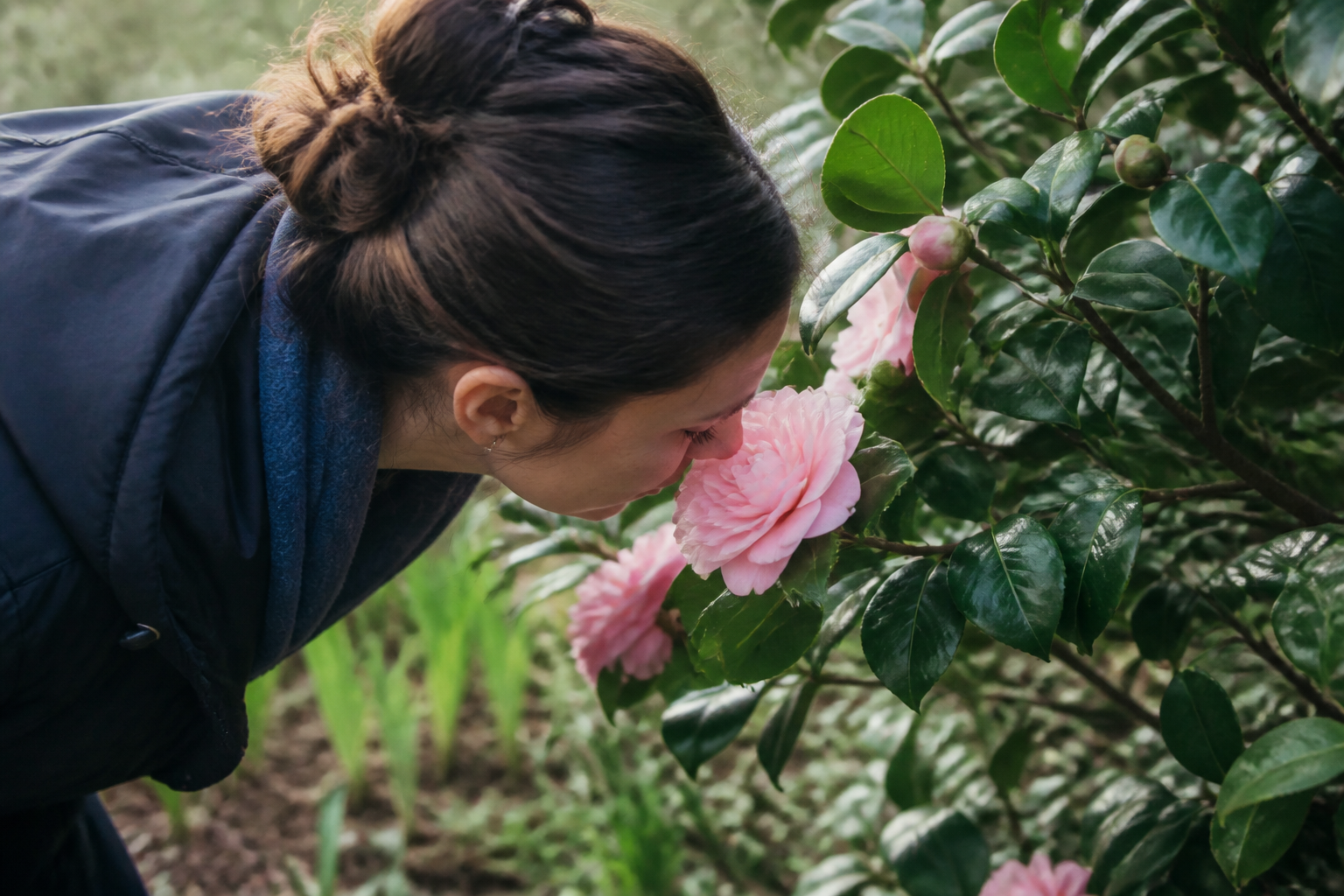
Most camellias are odorless — full stop. That single fact catches nearly everyone off guard the first time they hear it, and I watched it land like a small deflating balloon at a winter garden society gathering last year when a member asked me point-blank which of my camellias smelled the best. Three dozen faces turned my way, waiting, and I had to admit that the vast majority of camellias offer nothing to the nose at all. You’d have thought I’d announced their beloved japonicas were made of plastic. Yet the myth isn’t the whole story: a genuine, if small, category of fragrant camellia varieties really does exist. They’re harder to find, more coveted, and entirely worth the chase. Having grown upward of 200 named cultivars across three separate USDA zones over the past two decades, I’ve sorted out which fragrant camellias actually deliver on scent — and that’s exactly what I want to hand over to you here.
So Do Camellias Actually Have a Scent?
Straight talk: the overwhelming majority of camellias carry no fragrance whatsoever. This is the single biggest letdown I hear about from newer camellia growers. You plant a showstopping specimen loaded with vivid pink or red blooms, give it the best spot in the yard, and wait for that perfume to drift through the garden. It never arrives. The blossoms themselves are breathtaking — almost unfairly so — but on the scent front, they’re completely mute.
Take the classic Japanese camellia (Camellia japonica), the backbone of countless gardens across the UK and US — it’s essentially scentless as a rule. The graceful sasanquas fare no better; fragrance is largely absent there too. People are routinely thrown by this, especially those who assume that anything this visually stunning must smell just as good. That assumption doesn’t hold. Camellias, in their natural habitat, evolved to lure pollinators purely through looks — scent never entered the equation.
That said — and this matters — a select handful of camellia cultivars break from that pattern entirely, carrying real, unmistakable fragrance. Consider these the outliers rather than the norm. But stumble across one in bloom, and it feels like discovering something rare.
Tracing the Scent Back to Its Source Species
Wherever fragrance shows up in a garden camellia, you can trace it back to a handful of wild species native to East and Southeast Asia. Recognizing this makes the scarcity of scented types much less mysterious — they exist because breeders intentionally crossed these fragrant wild relatives with the big, flashy japonicas that dominate the market.
Top billing goes to Camellia lutchuensis, a slight species native to the Ryukyu Islands that produces small white flowers carrying a sweet, jasmine-tinged scent. Don’t expect drama from the blooms themselves — they’re understated, even minor. But the fragrance more than compensates. Breeders spotted the potential and began pairing it with larger-flowered japonicas, eventually producing hybrids that blend respectable bloom size with real, detectable scent.
Camellia transnokoensis plays a similar role, contributing its own small, fragrant flowers to the gene pool. Add C. fraterna and C. rosiflora to the list — two less familiar species that also hand down fragrance genes to breeders willing to work with them. So most fragrant camellias you’ll come across today trace their lineage directly back to these wild forebears.
That ancestry also explains a pattern you’ll notice: fragrant camellias tend to bloom smaller than their unscented relatives. It’s essentially a swap — fragrance in exchange for a bit of bloom size. From where I stand, after years of growing both types, it’s a trade I’ll happily make every time.
Helen’s Shortlist: The Fragrant Camellias Worth Your Garden Space
Across two decades of growing, I’ve tried out nearly every fragrant camellia cultivar sold commercially. Some more than earn their reputation. Others talked a big game and barely followed through. What follows are the ones I stand behind, all judged from personal experience in my own beds and pots.
‘Scentuous’ — Fragrant Camellia Royalty
If any fragrant camellia has earned celebrity status, it’s ‘Scentuous’. Bred in New Zealand, it’s become the default suggestion whenever someone asks about camellia fragrance — and rightly so.
Blooms arrive pale pink and semi-double, opening anywhere from late winter through early spring. They’re not the showiest or most intricately formed camellia flowers around, but there’s real charm to them. The true draw, though, is the scent — potent, honeyed, sweet, and noticeable from several paces away without any effort at all.
I’ve got a ‘Scentuous’ trained against a south-facing wall in my main garden bed, and it’s become one of the plants I check on most through January and February. Catch it on a mild, windless day and the fragrance is impossible to miss. Even on chilly, wet afternoons it still carries some scent, just quieter.
You shouldn’t have much trouble sourcing it either — most specialist camellia nurseries carry ‘Scentuous’ as a matter of course. It’s popular, dependable, and widely grown for good reason. New to fragrant camellias? This is your starting point.
‘High Fragrance’ — The Powerhouse of Camellia Scent
Where ‘Scentuous’ is the crowd-pleaser, ‘High Fragrance’ is the heavyweight. A hybrid descended from Camellia lutchuensis, it carries more scent than any other japonica-type camellia I’ve grown.
Its flowers come pale pink, full peony form, opening in late winter. There’s real structural beauty here too — stacked petals building that formal, almost rose-like shape camellia fans go weeks waiting for. But it’s the fragrance that steals the show: sweet, close to warm honey on a summer afternoon, at least by my nose. Everyone smells it a little differently, but to me it’s about as close to the ideal camellia scent as you’ll find.
Each winter I keep a potted ‘High Fragrance’ tucked into my conservatory, since it won’t reliably survive the harshest cold snaps outdoors in my zone 7b garden. Indoors, it thrives and fills the entire room with scent. Even during those cool stretches when outdoor fragrant camellias go quiet, this one indoors keeps performing without fail.
Worth flagging: ‘High Fragrance’ isn’t the fastest grower out there. Give it time. Once it settles in, the payoff is steady, impressive blooms season after season.
More Fragrant Cultivars That Deserve a Spot in Your Garden
Past those two standouts, several other scented cultivars have earned their place in my garden over the years:
- ‘Cinnamon Cindy’ stands apart from the pack — its white-to-blush blooms carry a distinctly spiced scent, nothing like the honeyed sweetness of ‘Scentuous’. It flowers in spring, stays compact, and fits neatly into smaller garden spaces. Another one bred from C. lutchuensis.
- ‘Fragrant Pink’ turns out consistent scent from its bright pink, semi-double flowers. Its smaller stature compared to taller varieties makes it easy to tuck somewhere you’ll pass by often enough to catch the perfume.
- ‘Fragrant Joy’ brings pale-to-medium pink blooms with a gentle, agreeable scent. Yet another C. lutchuensis descendant, so the fragrance genes come baked right in along with the good looks.
- ‘Nicky Crisp’ has become something of a staple in UK gardens I’ve toured, often planted as an understory shrub. Its pale orchid-pink flowers give off a modest but very real scent, and its more restrained growth rate makes it easy to manage.
- ‘Sweet Emily Kate’ produces white blooms with an intensely strong fragrance — another product of C. lutchuensis breeding, and among the most dependably scented varieties I’ve ever grown.
- ‘Spring Mist’ keeps things dainty — tiny pale pink flowers on a neat, compact plant. The fragrance is soft, low-key, and I happen to find it quite endearing. It’s a cross between C. lutchuensis and C. japonica.
- ‘Brushfield’s Yellow’ is, technically speaking, a primrose-yellow anemone-form bloom with a faint scent, grown mostly for its unusual color rather than its perfume. It’s a genuine talking point and a rarity in the camellia world.
- ‘Minato-no-akebono’ is a Japanese cultivar you won’t often find outside specialist collections. The blooms are pink and fragrant. Spot it for sale, and don’t hesitate.
Timing It Right: When Fragrant Camellias Smell Their Best
Early on, I assumed a fragrant camellia would smell equally strong all day, every day it was in bloom. That’s simply not true. How much scent reaches your nose depends heavily on temperature and weather conditions in the moment.
Fragrant camellias put on their best performance in warm, calm air. A sunny late-winter or early-spring morning, once temperatures climb past 50°F (10°C), is the sweet spot. Warmth coaxes volatile oils out of the petals, and that’s what your nose actually picks up. Cold, overcast, damp days mute the same plant down to barely a hint.
Individual sensitivity plays a role too. Some people catch camellia fragrance instantly; others need to work at it. If floral notes generally register strongly for you, camellia scent will come through easily. If your nose leans toward heavy musks or spices, camellia fragrance might read as faint at first.
Time of day matters as well. Late afternoon, once sheltered spots have soaked up warmth, often produces stronger scent than early morning does — despite the usual assumption that dew-covered flowers smell best. My own rule of thumb: mid-morning on a mild day hits the sweet spot, when enough warmth has built up to release fragrance but the heat hasn’t yet burned off those volatile oils.
Placement Strategy: Getting the Most Scent from Fragrant Camellias
Where you put a fragrant camellia matters as much as which one you choose. Site it somewhere you’ll pass regularly, and somewhere conditions naturally encourage the scent to carry.
A south-facing wall checks every box — it blocks harsh wind, banks warmth, and as the plant matures, brings blooms up to roughly nose height. That reflected heat warms the flowers and helps push fragrance outward. My own ‘Scentuous’ sits against a wall exactly like this, and the payoff has been consistent year after year.
A conservatory or enclosed porch is where potted fragrant varieties like ‘High Fragrance’ spend my winters. Sheltered, warm, out of the weather — these settings pull maximum fragrance out of every single bloom. Gardening somewhere cold and still craving camellia scent indoors? This is the move.
Steer clear of cold, wind-exposed corners or deep shade for these varieties. You’re already trading some bloom size and quantity by choosing scent over the vigorous, showier non-fragrant types — no sense also robbing them of the warmth and shelter their fragrance depends on.
Sheltered. Warm. Easy to reach. Keep those three requirements in mind when deciding where a fragrant camellia goes — the planning genuinely pays off.
Sourcing Fragrant Camellias: Where to Actually Find Them
Here’s where things get irritating: your average garden center simply doesn’t stock fragrant camellias. I’ve checked, repeatedly. Generic nurseries lean toward non-scented japonicas since they’re tough, easy-growing, and instantly recognizable to shoppers. Fragrant cultivars demand specialist expertise and smaller production runs, so they rarely make it to mainstream shelves.
Your best bet is a dedicated camellia specialist. Tregothnan in Cornwall — a working nursery with a historic collection — stocks fragrant cultivars. Nuccio’s Nurseries in California has a well-earned reputation for camellia variety generally, scented types included. Across North America, regional camellia societies are a great way to get pointed toward trustworthy specialist growers.
Ordering online from a specialist works well — young fragrant camellias ship and transplant reliably. When you place an order, mention your USDA zone and ask directly which cultivars will actually perform where you garden. Specialist growers genuinely enjoy these conversations and tend to give you the honest answer, not just the sales pitch.
Give yourself lead time — it’s worth it. Line up nursery sources ahead of planting season, and consider joining a local camellia society; members frequently have cuttings or spare plants to pass along, and that network alone is worth the membership. I’ve picked up rare cultivars through society contacts that I never would have tracked down through a catalog.
A Trio I’d Plant First for Fragrance
If I were building a fragrant camellia collection from zero, here are the three cultivars I’d start with to get scent and variety across the season:
- ‘Scentuous’ covers late-winter fragrance — it’s dependable, easy to source, and beautiful on top of the scent.
- ‘High Fragrance’ delivers the fullest sensory hit — the strongest scent of the bunch, ideal indoors or somewhere warm and sheltered.
- ‘Cinnamon Cindy’ rounds things out with something different — spiced notes layered over the sweetness, and a size that suits compact gardens.
Together, these three span a wide range of scent types, bloom windows, and growth habits — essentially a crash course in what fragrant camellias have to offer.
Fragrant Camellias: The Takeaway
Here’s the honest summary: most camellias have no scent at all. That’s not up for debate. But genuinely fragrant camellia varieties do exist, and they’re worth every bit of effort it takes to track them down. They descend from wild species that happened to carry scent genes, and modern breeders have used that inheritance to build hybrids that pair real fragrance with the flower form and toughness camellias are known for.
Don’t settle for whatever’s sitting on the shelf at your local garden center. Put in the work to find fragrant varieties through specialist sources. Give them warm, sheltered, easily accessible spots. Go visit them on mild mornings. Let them do their quiet, understated work in your garden.
Twenty years into growing camellias, here’s what I know for certain: a ‘Scentuous’ or ‘High Fragrance’ in full bloom on a still, late-winter morning, releasing that honeyed scent into the air, justifies every ounce of hunting and planning it takes to get there. That’s precisely why fragrant camellia varieties earn a place in my garden — and why they deserve one in yours too.
About This Article

Written by Helen Pritchard. Helen Pritchard is a lifelong gardener in the Pacific Northwest who has grown more than 200 named camellia cultivars over two decades. She writes practical, experience-based guides to camellia care, from variety selection and pruning to troubleshooting yellowing leaves and bud drop. More about this site.
Verify this against a primary source
Specifics change, and your situation may differ from the one described here. These are the authorities worth checking directly:
- American Camellia Society — cultivar registration and culture guides
- USDA Plant Hardiness Zone Map — zone verification for your location
- Royal Horticultural Society — camellia cultivation and pest guidance