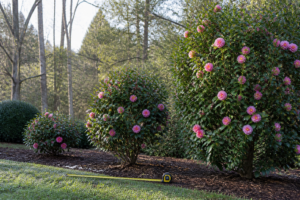
Crouched beside a hulking six-foot shrub this morning, secateurs in hand, I keep staring at the little plastic tag still zip-tied to its trunk — it says “compact.” That single word has misled me more times than I care to admit over the past fifteen years of buying nursery-labeled camellias, only to watch them balloon into border-devouring giants. Sizing on these plants is a genuine minefield, and the label rarely tells you what actually matters.
Whether you’re working with a pocket-sized plot or you’ve simply had enough of wrestling an oversized shrub back into shape every year, understanding dwarf camellia varieties will save you a world of frustration. Here’s the encouraging part: genuinely tiny camellias do exist, and they’re every bit as gorgeous as their full-sized cousins. Over the past five years I’ve deliberately hunted down and grown the truly compact cultivars, and I want to pass along what I’ve actually found works.
Consider this your filter against nursery-tag marketing spin. I’ll walk you through which varieties genuinely remain small, which ones are impostors, and how to keep them thriving in a tight footprint. Actual figures, actual cultivar names, actual garden results — that’s what follows.
Dwarf, Compact, Miniature — Untangling What Each Term Really Means
Here’s the piece that baffled me for years on end: “miniature camellia” has absolutely nothing to do with how big the shrub grows.
In camellia terminology, “miniature” describes bloom size and nothing else. A miniature-flowered camellia produces blossoms smaller than 2.5 inches across — yet the bush carrying those tiny flowers could easily top seven feet. I found this out the hard way when a plant I’d ordered expecting something petite turned out to be a towering, vigorous grower with dainty little blooms perched way up high.
Dwarf is the term you want if square footage is your real concern. A genuine dwarf camellia tops out somewhere between three and four feet, even a full decade in. These are your real space-savers — think ‘Baby Bear’ and ‘Tiny Princess’.
Compact is the murkier category. It signals slower growth and tighter branching — neater than a standard-sized shrub, sure, but not interchangeable with “dwarf.” A compact camellia can still climb to six or eight feet after twenty years in the ground. Plenty of gardens can absorb that, but “reasonable” and “tiny” aren’t the same thing. I found this out with ‘Kanjiro,’ a lovely compact sasanqua I planted assuming it would hover around three feet. Eight years on, it had spread to six feet across and needed a serious haircut to stay proportional to the rest of the border.
The question worth asking at the nursery isn’t “is it compact?” — it’s “what height should I expect at ten years?” Skip the vague promises printed on the tag and demand a real number. That’s the only way to sidestep the mistakes I made.
Genuine Dwarf Camellias Worth Planting
These are the cultivars I steer people toward when space is truly at a premium. Every measurement below reflects realistic ten-year growth under average garden conditions — not marketing optimism.
‘Baby Bear’ — About as Small as Camellias Get
Looking for the absolute smallest camellia out there? ‘Baby Bear’ is it. This hybrid tops out at just one to two feet in both height and spread even after a decade. This is true miniaturization of the whole plant — not merely small flowers on a big bush.
Its blooms are single, soft pink, and understated — proportionally matched to that petite frame. I keep mine in a forty-litre terracotta pot on my shaded patio, and it flowers reliably every winter without eating up any real square footage.
‘Baby Bear’ is a natural fit for rock gardens, alpine troughs, or any snug container. It also does beautiful work tucked beneath taller shrubs as underplanting. The habit is neat and self-contained, needing barely any pruning. In my own experience, it’s about as trouble-free as camellias come — pests leave it alone, and it isn’t picky about soil so long as drainage is solid.
Fair warning: your average garden centre probably won’t stock ‘Baby Bear’. I order mine through specialist camellia growers instead. If your space is genuinely tight, it’s worth the extra hunting.
‘Shi Shi Gashira’ — My Go-To for Low Hedges
If I had to narrow my compact camellias down to a single cultivar, it would be ‘Shi Shi Gashira’ without hesitation. This one’s the workhorse of my whole garden, and I’ve pointed countless fellow gardeners toward it over the years.
This sasanqua type settles in at three to five feet tall, with a spreading, gently weeping shape that ends up wider than it is high. The semi-double blooms arrive in a rich rose-pink, flowering heavily from autumn straight through winter. I’ve yet to have a disappointing bloom season with this one.
What sets ‘Shi Shi Gashira’ apart is how dependable and neat it stays. Unlike lankier varieties, every single flower sits at eye level — no craning your neck required. Its branching naturally fills in dense and tidy, with almost no formative training needed. I’ve used it as low hedging, as a cascading feature draping over a low wall, and in pots where I want a mounded silhouette.
Growing in zone 8a, mine is bulletproof and low-maintenance. It flowers generously even tucked into part shade. It’s also widely stocked and fairly priced — genuinely one of the best-value camellias you’ll find anywhere.
More Compact Cultivars Deserving a Spot in Your Garden
‘Mine-no-yuki’ (also marketed as ‘White Doves’) is another sasanqua that stays pleasingly small — two to four feet, with a graceful weeping or spreading form. It produces semi-double white flowers in abundance and works wonderfully as low-level interest or draped over a wall. I’ve got one cascading along a low fence line, and visitors never fail to comment on how elegant it looks in full bloom.
‘Yuletide’ is likely the compact sasanqua you’ll spot most often at nurseries. Single red blooms show up reliably in late autumn, and the plant tops out at a manageable four to six feet. It’s tough, cold-hardy, and honestly earns its popularity — it’s common because it simply performs.
‘Tiny Princess’ belongs to the japonica family and offers white or pale pink flowers on a genuinely dwarfed frame — three to four feet after a decade, noticeably tighter than standard japonicas. Blooms are small, single to semi-double. It’s a bit harder to track down than ‘Yuletide’, but worth the search if japonicas are your preference.
‘Quintessence’ is another compact japonica hybrid worth a look, offering small white flowers and a neat growth habit. It performs nicely in pots and settles around three to four feet with time.
Compact — Not Quite Dwarf, But Close — Varieties
These cultivars outgrow the true dwarfs, but they’re still slower and tidier than standard camellias. If your garden can absorb something in the four-to-six-foot range, this group has plenty to offer.
‘Kanjiro’ is the cultivar behind my earlier fine-print lesson. This semi-double pink sasanqua really does grow tidily, which is exactly what fooled me into assuming it would stay small. It reaches four to six feet across, tidy habit and all. These days I prune it every year right after it finishes blooming — do that, and you get a genuinely gorgeous rose-pink, semi-double flowering shrub.
‘Survivor’ is a compact japonica hybrid producing pink blooms and topping out at four to six feet. Its real selling point is cold tolerance — I grow it in zone 7b, where it flourishes while standard japonicas sulk through winter. Pairing a compact frame with serious hardiness makes this one genuinely valuable.
‘Nicky Crisp’ was a discovery I made a few years back and haven’t stopped growing since. Orchid-pink flowers, a compact four-to-five-foot habit, and — the real bonus — actual fragrance. If you want a small camellia you can smell from across the patio, this is your plant. I’ve linked my full fragrant camellias guide further down for anyone wanting more scented options.
‘Brushfield’s Yellow’ stands out as one of the more compact yellow-flowering japonicas around. Primrose-yellow anemone-form blooms sit on a plant that reaches four to six feet, and the tidy growth habit means you’re not stuck pruning constantly. Great pick for gardeners after something unusual without sacrificing footprint.
‘Spring’s Promise’ offers a gentler shade of pink with peony-form flowers, staying within the compact japonica range at four to five feet. Perfect if you’re after a cottage-garden mood without committing to a massive shrub.
Raising Small Camellias in Pots
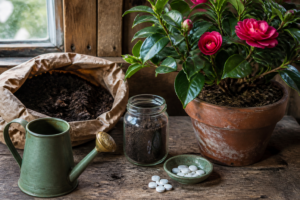
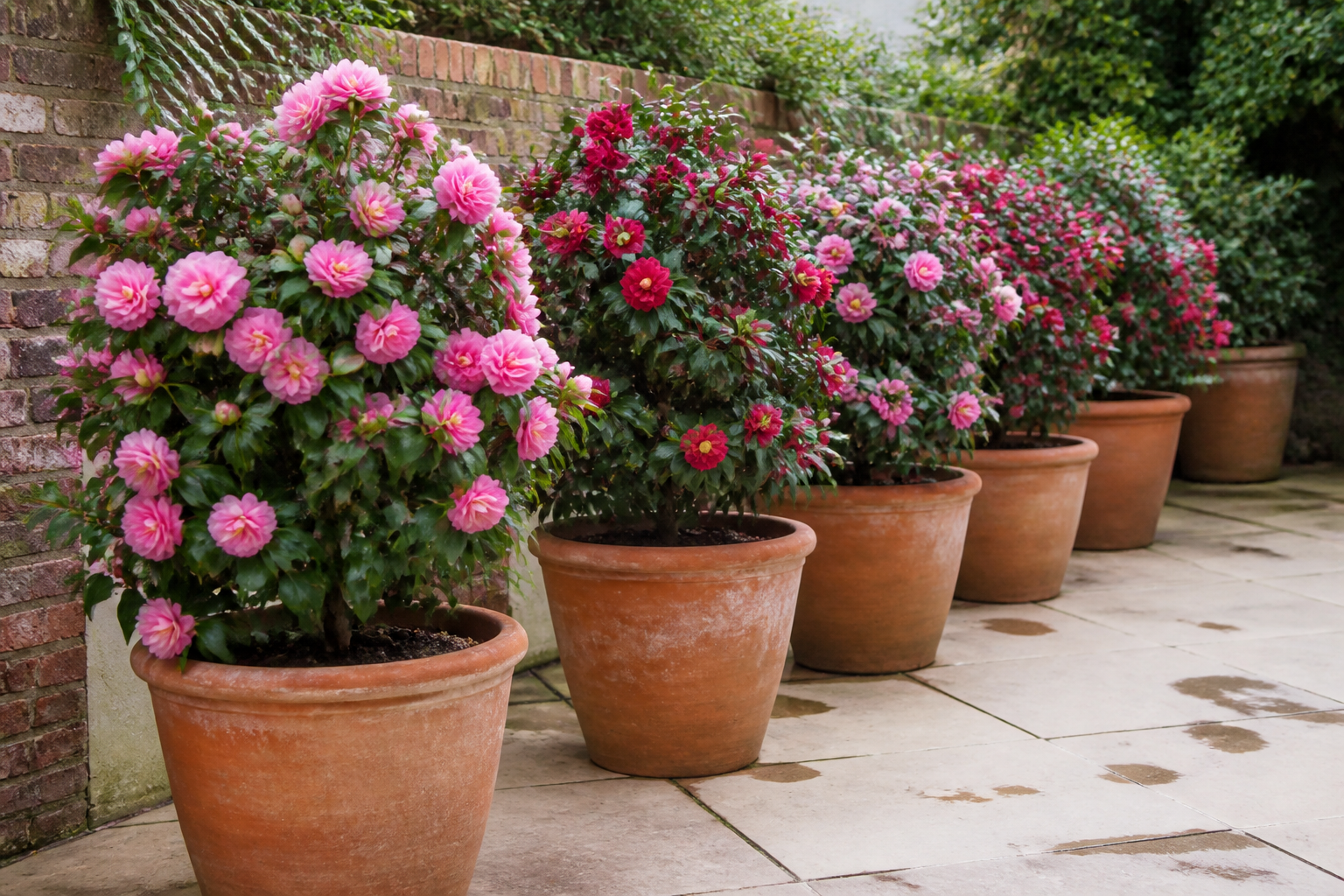
Container culture is where dwarf and compact camellias really earn their keep. Overall size stays under control, and you get to dictate exactly where the blooms sit — invaluable when fragrance is part of the appeal.
Choose a pot at least forty centimetres across — bigger is generally better, and a fifty-litre container suits something like ‘Shi Shi Gashira’ well. Ericaceous compost isn’t optional here; standard multipurpose mixes run too alkaline for a plant that demands acid soil.
Rainwater is your best watering source if you can collect it. Tap water will do in a pinch, but rainwater genuinely suits lime-sensitive plants better. Aim for consistently moist compost — never soggy, never bone-dry.
Plan to repot every two to three years, ideally in spring before new growth kicks in, and top-dress with fresh ericaceous compost in the years between. Feed from late winter through midsummer using a liquid ericaceous fertiliser — I apply a diluted dose every fortnight throughout the growing season.
Here’s a bonus you don’t expect until you experience it: potted camellias put flowers right at nose height. Grow something fragrant like ‘Nicky Crisp’ in a container, and you’ll actually catch the scent. On a standard-sized shrub, those same lovely blooms end up six feet overhead, perfume wasted on the air above your head. Small potted camellias fix that entirely.
Pruning to Keep Compact Camellias Looking Compact
What separates a “compact” shrub from an unruly sprawl usually comes down to pruning technique — and timing matters more than most people assume.
Prune immediately after flowering wraps up — for most cultivars, that’s late winter or early spring. Never touch the shears in autumn, since you’ll be cutting off next season’s developing buds. Camellias set flowers on the previous year’s wood, so getting the timing wrong costs you a whole bloom cycle.
True dwarfs like ‘Baby Bear’ barely need pruning at all — a light tip-trim to hold the shape is plenty. These naturally compact plants simply don’t call for heavy cutting.
For the four-to-six-foot compact varieties, an annual trim keeps things in check. Every spring I cut back roughly a third of ‘Kanjiro’s new growth and shorten any branches that have gotten ahead of themselves. It keeps the shrub looking deliberate rather than unkempt.
Light pruning is what drives bushiness — snip just the top few centimetres off young shoots. Steer clear of cutting into bare wood unless you’re doing a genuine renovation prune. New growth breaks readily near the cut, thickening up the plant.
A gentle, consistent approach beats drastic cutting every time. Camellias respond well to light tip-work but sulk badly if reduced to stubs. Frequent modest trims will always outperform an occasional severe hack.
Where to Find Trustworthy Dwarf Camellia Stock
Straight talk: sourcing true dwarf camellias takes more diligence than shopping for standard varieties. Plenty of nurseries slap “compact” and “dwarf” on labels interchangeably, and that’s simply inaccurate.
Specialist camellia nurseries are worth seeking out. Their staff actually understand the gap between true dwarfs and merely compact cultivars, and they can give you honest mature-size expectations. Pricing is often on par with big-box garden centres anyway, and plant quality tends to be noticeably better.
When a genuine dwarf variety turns up, grab it. Cultivars like ‘Baby Bear’ aren’t always in stock, and passing one by usually means waiting a full year for another chance. I’ve missed out this way more than once, and it stings every time.
Before you buy, ask directly: “What’s the realistic mature height at ten years?” If the answer’s vague or nonexistent, take your business elsewhere. A nursery that knows its stock will have a real number ready.
Final Thoughts: Choosing the Right Cultivar Changes Everything
Two decades back, I planted full-sized camellias simply because I didn’t know any better, then spent years hacking them back into submission. The lesson stuck: get the size right from the start, and you save yourself endless labor down the road.
Dwarf camellia varieties are anything but a consolation prize. ‘Shi Shi Gashira’ holds its own against any full-sized camellia for beauty, just wrapped in a far more manageable shape. ‘Baby Bear’ delivers the same winter magic as a shrub three times its stature.
If you’re gardening in a small space, working with containers, or you’d simply rather not spend every spring wielding pruning shears, small camellia varieties are the genuinely smart pick — not a lesser one.
Put in the time to source these cultivars from specialists. That effort rewards you every winter with perfectly scaled blooms and a garden that feels intentional rather than accidental. Your back will thank you, your borders will look considered, and you’ll finally get why people fall so hard for camellias.
About This Article

Written by Helen Pritchard. Helen Pritchard is a lifelong gardener in the Pacific Northwest who has grown more than 200 named camellia cultivars over two decades. She writes practical, experience-based guides to camellia care, from variety selection and pruning to troubleshooting yellowing leaves and bud drop. More about this site.
Verify this against a primary source
Specifics change, and your situation may differ from the one described here. These are the authorities worth checking directly:
- American Camellia Society — cultivar registration and culture guides
- USDA Plant Hardiness Zone Map — zone verification for your location
- Royal Horticultural Society — camellia cultivation and pest guidance