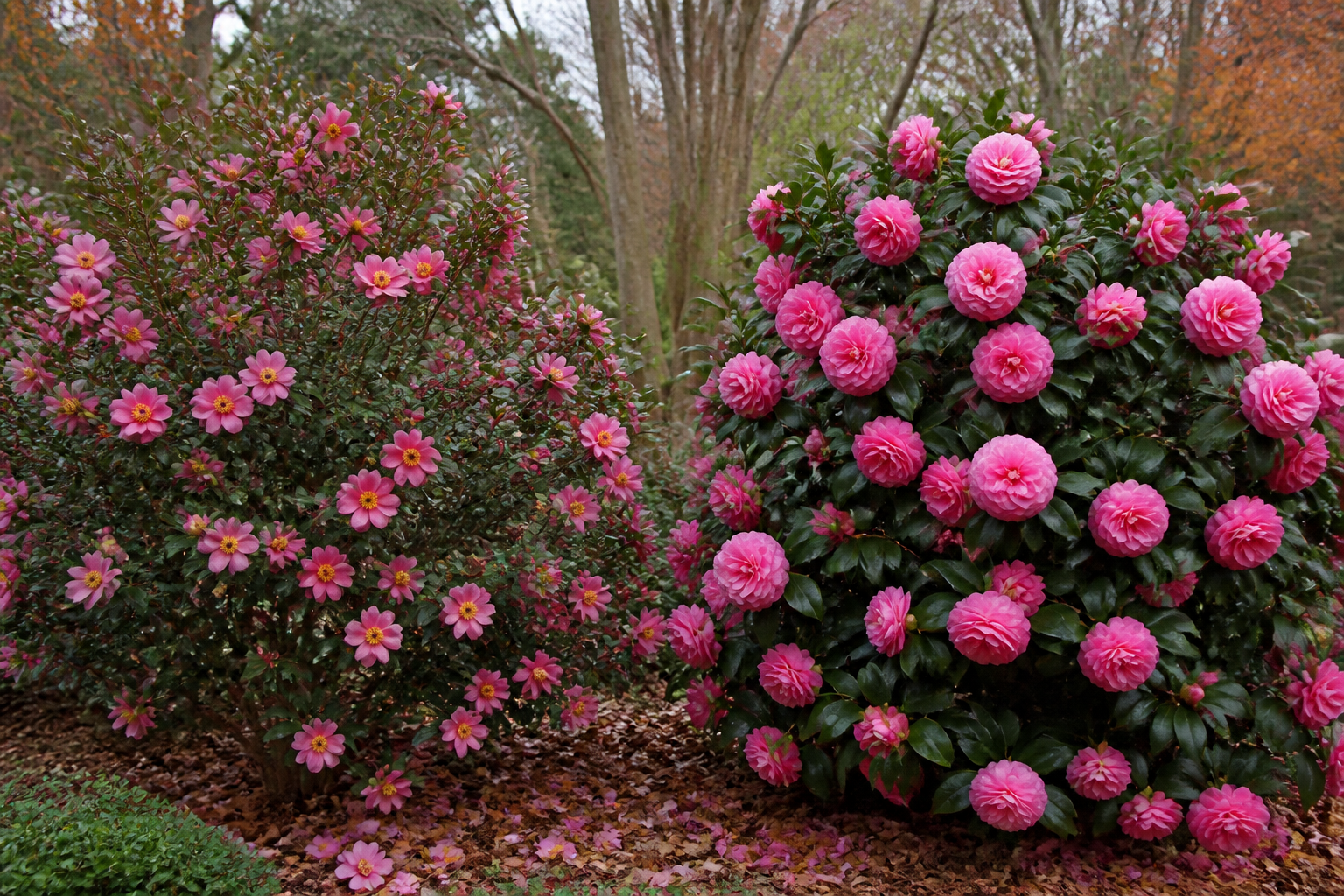
Picture a torn plant tag in someone’s hand — that’s the image I keep coming back to from a spring garden show, where a woman stood at my table holding two labels, unable to decide between them. “Sasanqua or japonica — which one?” It’s a question I field constantly, and after two decades tending upward of two hundred named camellia cultivars across three different USDA zones, I can tell you the answer shapes far more than most people expect. Settling the camellia sasanqua vs japonica question determines your entire bloom calendar, the footprint the plant will eventually claim, and whether you’re snipping flowers in October or waiting until April. Let me walk through what years of trial, error, and close observation have taught me, so you can pick the right one for your own space.
Sasanqua and Japonica, Side by Side
The cleanest way to frame this: sasanqua and japonica are separate species under the camellia umbrella. Both produce breathtaking flowers, sure, but their bloom windows don’t overlap, their growth speeds differ dramatically, and each fills a distinct role in the landscape. Get a handle on these fundamentals now, and you’ll spare yourself years of planting the wrong shrub in the wrong spot.
Japonica is the old-guard camellia, the one people picture first. Big blossoms. Unhurried growth. A bloom season running from winter into spring. When someone says “camellia” without qualifiers, they’re almost always imagining a japonica’s formal, densely petaled flower set against dark, glossy foliage.
Sasanqua takes the opposite approach — showing up sooner in the calendar. Petals are smaller and looser. It grows faster and with more vigor. Flowering happens in fall and early winter. It tolerates sun readily and works beautifully as hedging or screening. From where I stand, sasanqua is the shortcut gardeners reach for when they need quick structure paired with color before most gardens have anything going on.
There’s a third player worth flagging: Camellia reticulata. I’ll give it a full section further down since it earns one. For the moment, though, let’s stay focused on the pair you’ll run into most.
Getting to Know Camellia Japonica
Think of camellia japonica as the elder statesman of the group — unhurried, dignified, and genuinely spectacular once it comes into its own. Slow to gain size. Formal in shape. If your goal is a showpiece specimen that draws the eye and holds it, japonica is usually the right call.
Prepare yourself for a slow burn on growth. A young japonica generally puts on somewhere between 6 and 12 inches a year. Given decades, it can climb to 6–15 feet, though regular pruning keeps that in check. There’s no rushing this plant — you’re planting for the garden you’ll have in ten or twenty years, not next season.
Flower Shapes and Sizes You’ll Find in Japonicas
This is japonica’s moment to shine. Blossoms typically span 3 to 5 inches, occasionally more, and the sheer range of forms is remarkable.
You’ll come across single-petaled blooms with just a lone layer, semi-doubles that reveal their stamens between layered petals, formal doubles packed edge to edge, anemone forms with ruffled centers, peony-style blossoms that resemble a hybrid rose, and rose-form doubles, tidy and symmetrical. With that much variation on offer, building a japonica collection with real personality is entirely possible.
My own garden leans on ‘Adolphe Audusson’ for its dependability — a blood-red semi-double that shows up like clockwork every year. ‘Nuccio’s Jewel’ brings pink-edged white petals in a lush peony arrangement that stops garden visitors mid-sentence. ‘Bob Hope’ goes deep red, semi-double, nearly black under strong sunlight. Every one of them carries its own signature.
Bloom Timing and Standout Japonica Varieties
Depending on where you garden and which cultivar you’ve chosen, japonica flowers typically show themselves anywhere from December to April. Early risers like ‘Magnoliiflora’ — a timeless pink semi-double — can open as early as November, while late bloomers push the show well into spring.
That late-winter-into-spring window is a real strength. While the rest of the garden is still hibernating, your japonica is putting on a full display. There’s a small thrill in clipping a flawless bloom in the dead of February, when nothing else nearby is even trying.
Past ‘Adolphe Audusson’ and ‘Nuccio’s Jewel’, I’d point you toward ‘Desire’ — a formal double, white with pink margins, graceful and slow to fade. ‘Magnoliiflora’ holds a soft spot in my collection too; it’s a centuries-old variety that never seems to skip a season. Want something a bit unusual? ‘Jury’s Yellow’ produces pale yellow flowers, though technically it isn’t a straight japonica — a distinction I’ll unpack in a moment.
What Japonicas Need to Thrive
Shade tolerance is one of japonica’s defining traits, and it’s the main thing separating it from sasanqua. It’s happiest with dappled light, or morning sun paired with afternoon cover.
In my own Zone 8a plot, I tuck japonicas beneath tall deciduous trees so they catch soft morning rays without absorbing the afternoon’s heat. If your climate runs cooler, you can get away with more sun exposure. Head further south, though, and shade stops being optional.
As for winter survival, japonicas handle Zone 7 conditions (down to 0°F) without much drama. Certain cultivars, ‘Nuccio’s Jewel’ included, can even push into Zone 6. That range makes them a fairly safe bet across a large swath of the country.
On the soil front, camellias insist on acidic, sharply draining ground. I work in generous amounts of pine bark and peat to get there. Waterlogged roots will finish off a camellia faster than a hard freeze ever could — yet steady moisture through the growing months remains non-negotiable. The target is damp, never drenched.
Getting to Know Camellia Sasanqua
Sasanquas are the hustlers of the camellia world — quick, sun-loving, first to bloom. If japonica is the aristocrat, sasanqua is the no-nonsense workhorse every gardener eventually leans on.
Growth comes on noticeably quicker here. Young plants can gain 12 to 18 inches in a season, sometimes better. That means you’re not waiting twenty years for a hedge or screen to take shape — sasanquas fill gaps and define spaces almost in real time.
Bloom Style and Growth Shape of Sasanqua
Sasanqua flowers run smaller than japonica’s — usually 1.5 to 3 inches across — and they carry a looser, more casual look. A lot of gardeners assume this counts against them. I did too, once. Now I’d call it charm rather than a shortcoming.
Most sasanquas settle into single or semi-double form; peony types exist but never reach the layered intricacy japonicas can pull off. What they trade away in formality, they make up for with a light, airy quality, and some cultivars carry actual fragrance — a trait almost entirely missing from japonicas.
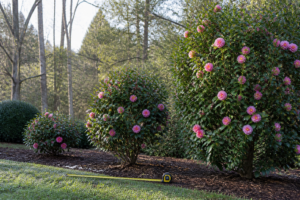
As for shape, sasanquas grow into wide, shrubby mounds rather than the upright, tree-like habit older japonicas develop. That spreading, cascading form is exactly why they excel as hedges, espaliers, and casual screening.
Sasanqua Bloom Season and Cultivars Worth Growing
Here’s the real draw: sasanquas typically flower from October clear through January, well ahead of japonicas. That timing gap alone opens up a huge range of design options in the garden.
‘Yuletide’ gets planted more than any other sasanqua in my garden — bright red singles that open reliably by December, tailor-made for holiday color. ‘Kanjiro’ delivers soft rose-pink flowers on a naturally tidy plant. ‘Shi Shi Gashira’ hugs the ground, nearly prostrate, with rose-pink double blooms that work well as a groundcover.
‘Mine-no-yuki’ weeps gracefully and carries semi-double white flowers — stunning trained flat against a wall. ‘Hugh Evans’ grows with real energy and produces pink blooms in abundance. ‘Jean May’ offers shell-pink semi-doubles on a sturdy, upright frame. Each one adds a different note to the garden.
Sun, Hedges, and Espalier — Sasanqua’s Best Roles
Sun exposure is where sasanqua outclasses japonica by a wide margin. In cooler regions, it often prefers full sun outright. My Zone 8a garden sends sasanquas to the spots where afternoon sun is unavoidable — japonicas would struggle there, but sasanquas do just fine.
That sun tolerance unlocks design moves japonica simply can’t offer. Use sasanquas to hide an unattractive view, build a living wall, or mark the edge of a garden bed. They stay compact enough for a small yard yet grow fast enough to fill in quickly.
I’ve trained ‘Yuletide’ flat against a south-facing wall for eight years now, and it’s become a densely blooming two-dimensional feature. Pruning takes little effort, flowering is heavy, and by autumn the whole wall practically glows. No japonica could deliver that effect on the same timeline, or as consistently.
Coastal gardens have a lot to gain from sasanqua’s vigor and its tolerance for salt — it shrugs off wind and sea spray far better than japonica manages. And for hedging purposes, nothing else compares: it outpaces boxwood and beats privet on visual interest alone.
Camellia × Williamsii — The Third Option Most Gardeners Miss
Here’s a wrinkle that tripped me up early on, and it may trip you up too: plenty of camellias sold under the “japonica” label are actually Camellia × williamsii hybrids — crosses between C. japonica and C. saluenensis.
‘Donation’ stands out as the best-known williamsii hybrid — semi-double, pink, dependable, and easy to find at most nurseries. ‘Anticipation’ (a red peony-form) and ‘Jury’s Yellow’ (pale yellow) follow the same pattern. Growers often shelve them under “japonica” simply because they look and behave so similarly.
So what actually separates them in practice? Williamsii hybrids need roughly the same care as japonicas and bloom on a similar schedule. But they tend to flower more freely, and — this is the detail that matters — spent blooms fall away cleanly instead of hanging on as browned, papery husks. I’ve found that self-cleaning habit genuinely useful; your plants stay tidy without any deadheading effort on your part.
So if a tag reads “williamsii,” don’t second-guess it. These are strong performers — just treat them the way you’d treat any japonica.
Camellia Reticulata — For Gardeners Chasing Drama
I promised to return to reticulata, and it’s earned the attention. Native to Yunnan Province in China, this species produces the biggest flowers you’ll find anywhere in the camellia family.
Certain reticulata cultivars produce blossoms measuring 5 to 7 inches across — bold, showy, almost too large to seem real once they’re in bloom. ‘Captain Rawes’ tops my personal list: crimson, semi-double, enormous flowers, and a presence that dominates whatever bed it’s planted in.
The catch is cold sensitivity — reticulatas can’t match japonica’s hardiness and generally need Zone 8–9 protection to survive. They’re also harder to source and cost more when you do track them down. My own ‘Captain Rawes’ sits tucked into a sheltered pocket of my Zone 8a garden, well out of reach of late spring frost.
Garden in a warm region, or lucky enough to have a favorable microclimate? Reticulatas will reward you with flowers that rival peonies in scale. For everyone else, they’re better thought of as an occasional luxury than a garden staple.
Deciding Between Sasanqua and Japonica
Here’s a straightforward framework, drawn honestly from years of experimenting — including plenty of missteps that turned out fine anyway.
Reach for sasanqua when: You’re after autumn and early-winter blooms. You need rapid growth for screening. Your sunniest spots defeat most other plants. Hedging or espalier is the goal. You’re gardening near the coast. Loose, informal shapes appeal to you more than formal ones.
Reach for japonica when: You want large, formal blooms. Late winter through spring flowering fits your calendar. You’ve got shaded corners begging for interest. You want a slow-growing plant that becomes a permanent feature. Maximum variety in flower form matters to you. Cutting a pristine bloom in February sounds appealing.
My real recommendation? Plant both — that’s exactly what I do. They aren’t rivals competing for the same job; they’re partners covering different ones. A ‘Yuletide’ sasanqua hedging my south wall carries color from October through December. A ‘Donation’ japonica (technically a williamsii hybrid) takes over as the spring specimen, running the show from January into April. Together they stretch camellia season to nearly eight months.
Early on, I made the mistake of picking a side — sasanqua or japonica, as though my garden couldn’t hold both. That was flat wrong. The moment I planted both types, my whole approach to camellias broadened. Different jobs, different seasons, different feel entirely.
Weigh your climate, your available space, and what your garden actually needs — but don’t box yourself into choosing just one. The most rewarding camellia gardens I know, mine included, are built around both species working together.
Wrapping Up
The gardener from that show ended up choosing both — a ‘Yuletide’ sasanqua for her sun-drenched wall and a ‘Nuccio’s Jewel’ japonica for her shaded border. Smart move. I told her she’d be grateful in three years once the sasanqua hit its stride, and again in five when the japonica finally matured into its full beauty.
Whether you end up with one type, two, or all three, you’re setting yourself up for decades of reward. Camellias are the kind of plant that settle in quietly, grow steadily, and then bloom with a generosity that never quite gets old. That’s precisely why I’ve spent twenty years building my collection — and why I have no intention of stopping.
Figure out what your garden is missing most right now. Fast structure? Plant a sasanqua. Late-winter color? A japonica fits. Pure spectacle? Try a reticulata. Then, whenever you’re ready, add the next one. Your garden — and your appreciation for these plants — will only keep growing.
About This Article

Written by Helen Pritchard. Helen Pritchard is a lifelong gardener in the Pacific Northwest who has grown more than 200 named camellia cultivars over two decades. She writes practical, experience-based guides to camellia care, from variety selection and pruning to troubleshooting yellowing leaves and bud drop. More about this site.
Verify this against a primary source
Specifics change, and your situation may differ from the one described here. These are the authorities worth checking directly:
- American Camellia Society — cultivar registration and culture guides
- USDA Plant Hardiness Zone Map — zone verification for your location
- Royal Horticultural Society — camellia cultivation and pest guidance