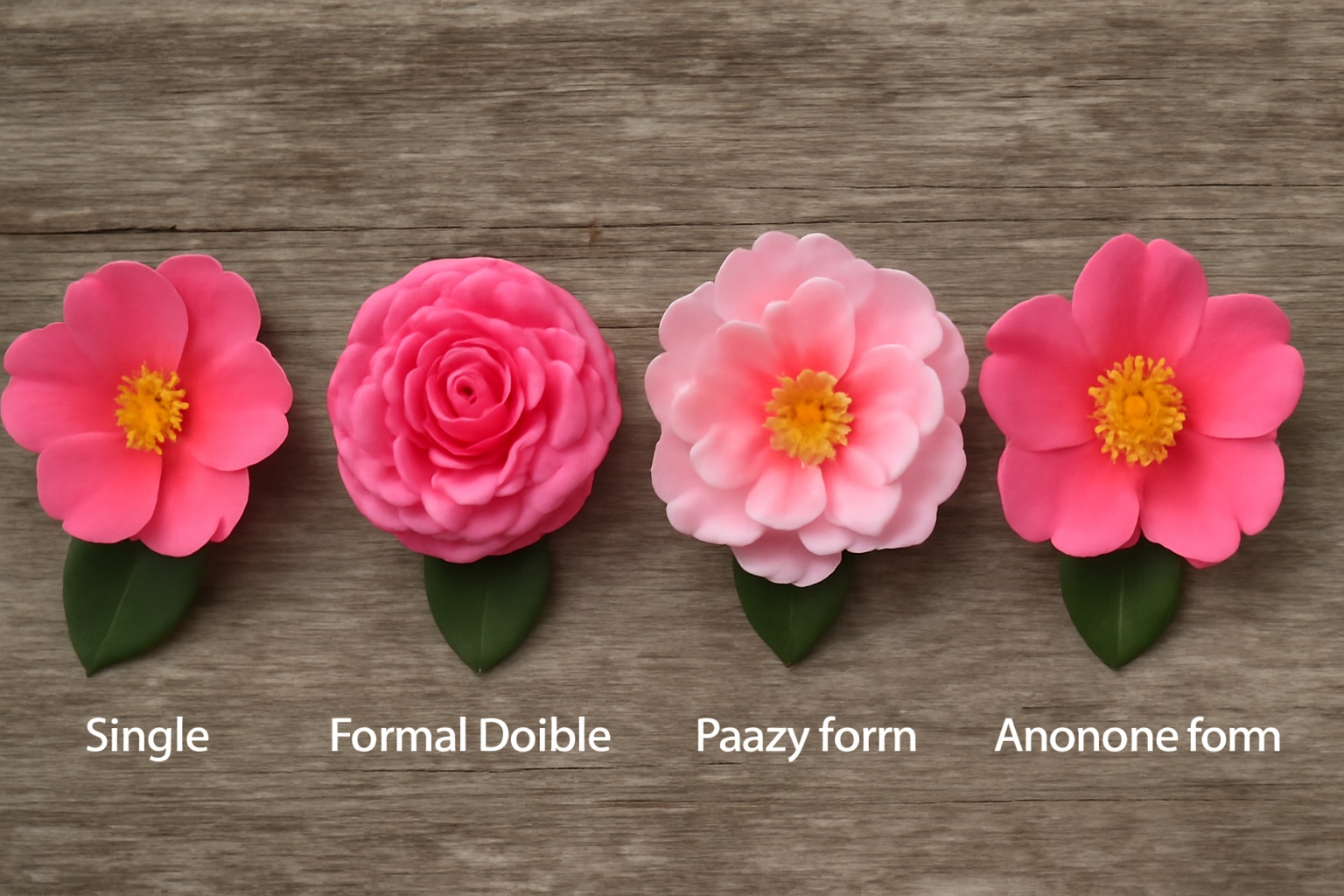
“Wait, so is this thing dying or is it just… built that way?” A gardening friend texted me that line last week, along with a photo of a flawlessly symmetrical pink bloom she was convinced looked “too perfect to be healthy.” I laughed, because I’d asked myself almost the identical question years earlier. I’d brought home a plant tagged simply “Japonica Pink,” fully expecting peony-form blooms, and then spent an entire season convinced I’d somehow damaged it when the flowers opened flat, tidy, and perfectly symmetrical. Nothing was wrong. I’d just never learned to read what a formal double actually looks like.
That mix-up sent me down a serious rabbit hole into camellia classification. Two decades and well over 200 named cultivars later, I still think it’s one of the most satisfying corners of ornamental gardening to explore. So here’s a breakdown of the two forms fellow growers ask me about constantly: formal doubles and peony forms.
Why Bloom Form Classification Actually Matters
The American Camellia Society officially sorts blooms into a handful of categories: single, semi-double, anemone, peony, rose-form double, and formal double. Each label describes a specific way petals and stamens arrange themselves once a flower is fully open. This isn’t just a fun bit of botanical trivia to toss around — it directly influences which varieties you pick, how you combine plants visually, and what you should actually expect once those buds crack open in your own garden.
From what I’ve seen, gardeners tend to fall hard for one form or the other first — formal doubles or peony forms — and rarely stay neutral for long. They represent two opposing design philosophies: one built on precision and symmetry, the other on lush, layered, slightly untamed abundance. Get comfortable with both, and you’ll shop smarter at the nursery and design your beds with a lot more intention.
Formal Doubles: Flowers Built Like Architecture
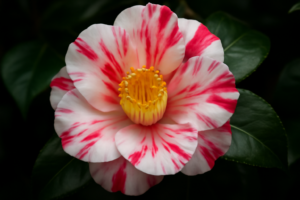
To me, a formal double camellia ranks among the most structurally flawless things nature produces. The petals stack in tidy, overlapping rows that spiral inward toward the bloom’s center with almost mathematical symmetry. The telling detail: stamens simply don’t show — they’re either absent entirely or buried completely beneath the inner petals. What you’re left with is a flower that seems almost too orderly to be real.
Picture a rosette carved with intention rather than grown by chance — the geometry is that clean, that architectural. It’s exactly why formal doubles turn out so well in photographs and why florists reach for this bloom form again and again for arrangements.
Formal Double Cultivars I’d Recommend Growing
Several of my personal favorites here come from Camellia japonica. ‘Kramer’s Supreme’ consistently impresses — a deep, velvety red with genuinely solid cold tolerance, and it’s thrived for me in zone 7b without complaint. ‘Nuccio’s Gem’ is another I return to again and again; its pure white blooms are near-perfectly symmetrical, and it’s become the yardstick I measure other formal doubles against. For something a bit unexpected, ‘Elegans Champagne’ offers a creamy, blush-tinted formal double that practically glows when afternoon light hits it.
Over on the reticulata side, ‘Francie L’ turns out oversized formal double blooms in a rich rose-pink that can genuinely make you stop in your tracks. Reticulatas, though, aren’t nearly as cold-hardy — I keep mine in zone 8b and still give them wind shelter. Gardening in zone 7b or colder? I’d steer toward japonica formal doubles instead, simply for reliability’s sake.
A practical heads-up: formal double blooms are generally good at holding their shape once open. The downside is that in wet climates, they can trap moisture between those tight petal rows, which sometimes invites petal blight. I found this out firsthand during an unusually soggy spring with my ‘Nuccio’s Gem’. Solid air circulation around the shrub really does make a difference — I go into that in more depth in my post on planting camellias for airflow and disease prevention.
Peony Forms: Organized Chaos in Bloom
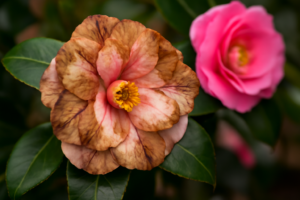
Where the formal double reads like a cathedral, the peony form reads like a country cottage garden. These blooms build a full, rounded, layered center out of a mix of petals and petaloids — those small, petal-like bits that develop out of what would otherwise be stamens. The end result really does resemble an actual peony: dense, deep, and somehow alive-looking, even though generations of deliberate breeding got it there.
Unlike a formal double, a peony-form bloom often lets a few stamens peek through that central mass. That detail is actually the key difference between peony forms and rose-form doubles, which stay more cupped and uniform at the center. The slight disorder you see in peony forms isn’t accidental — it’s the whole point of their appeal.
Peony-Form Cultivars I Rely On
‘Debutante’ is the peony-form japonica I point almost every beginner toward. It’s a soft shell-pink that flowers heavily mid-season and has proven rock-solid in my zone 8a beds for more than ten years running. ‘Brushfield’s Yellow’ is another I treasure — technically its center is a creamy ivory-yellow anemone type, but nursery catalogs lump it in with the peony forms, and it certainly shares that same rich, layered look.
‘Dr. Clifford Parks’, a hybrid with reticulata in its background, throws enormous peony-form blooms in a flame red-orange — honestly, some of these flowers are about the size of a softball. It’s stunning in zone 8b, though it needs shielding from hard freezes. Sasanqua fans should look at ‘Survivor’, which leans toward a semi-double or loosely peony form and blooms in fall, making it a nice partner to spring-flowering japonicas for stretching out your bloom season.
Formal Double vs Peony Form: A Quick Side-by-Side
- Petal arrangement: Formal doubles line up in precise, symmetrical rows; peony forms are dense and irregular, mixing petals with petaloids.
- Stamens: Concealed or entirely absent on formal doubles; peeking through here and there in the peony form’s central mass.
- Overall impression: Formal doubles come across as refined and structured; peony forms feel romantic and lush.
- In photos: Formal doubles look great shot straight-on from above; peony forms benefit from a three-quarter angle that reveals their depth.
- Handling rain: Formal doubles hold water more readily between their tight rows; peony forms shed moisture a bit more easily thanks to their irregular shape.
- Best garden role: Formal doubles fit structured borders and formal hedging; peony forms belong in cottage-style or naturalistic plantings.
One of My Bigger Design Missteps — and the Lesson It Taught Me
Years back, still fairly new to serious camellia growing, I planted a formal double right next to a peony form in the same mixed border. Both happened to be pink, and I figured they’d play off each other nicely. Instead, they clashed — the formal double’s crisp geometry made the peony form beside it look sloppy by comparison, while the peony form’s fullness made the formal double look rigid and stiff in return.
Once I understood why it wasn’t working, the fix turned out to be simple. Either cluster similar bloom forms together, or put a structural foliage plant between contrasting forms to create separation — I now use a clipped Osmanthus as that buffer, and it acts like a visual breather between the two. Since making that swap, both plants finally look like a deliberate choice instead of an accident. A small tweak, but the payoff was noticeable.
I now factor this into every bed I plan. Bloom form deserves just as much design weight as color — arguably more, since color shifts depending on light and season, while form stays put.
The Growing Conditions Behind a Well-Formed Bloom
Let me be blunt about something: genetics decide what form a bloom will take, but your growing conditions decide whether that form ever fully shows itself. Plant a peony-form camellia in poor soil or dense shade, and you might get blooms that barely crack open, or that drop off before they finish developing at all. That layered center you’re expecting simply won’t appear. That’s not the plant underperforming — that’s the environment holding it back.
Soil pH isn’t something you can skip on. Camellias need acidic soil, ideally somewhere between 5.5 and 6.5. Push past pH 6.5, and iron and manganese become locked out of the plant’s reach, which shows up as yellowing leaves — chlorosis — and noticeably weaker blooms. I test my soil every couple of years, no exceptions, and correct with sulfur amendments and acidic mulch like pine bark whenever needed.
Sunlight, Drainage, and When You Feed
Camellias generally do best with dappled shade or morning sun paired with afternoon cover. Formal doubles especially can develop petal browning — essentially sunburn — if harsh afternoon rays hit them while they’re in bloom. That’s why I keep my most prized formal doubles on the east side of buildings or tucked under tall tree canopy.
Drainage matters just as much. Camellias despise soggy roots, and soil that drains poorly sets the stage for Phytophthora root rot — a disease that kills slowly and often stays hidden until real damage has already occurred. Mounding the planting site up even 4 to 6 inches can make a real difference in soil that doesn’t drain well on its own.
When you fertilize matters too. I apply an acid-forming, slow-release feed early in spring once flowering wraps up, then follow with a lighter dose in early summer. Feeding too late — past July if you’re in zones 7b through 8b — tends to push soft new growth that’s vulnerable to early frost damage and pulls energy away from bud formation.
Formal Double or Peony Form? My Honest Take
People frequently ask which form is “better,” but honestly, that’s not really the right question to ask. They’re different tools built for different design goals. Formal doubles shine wherever you want precision, elegance, and something with a jewel-like quality — formal entryways, clipped hedges, containers on a structured terrace. Peony forms belong wherever you’re after warmth, fullness, and a romantic, relaxed feel — cottage gardens, naturalistic woodland edges, and mixed shrub borders are where they truly thrive.
I grow plenty of both and have no intention of giving up either. In my zone 8a garden, the formal doubles line the east-facing fence — nearly all japonicas, mostly ‘Nuccio’s Gem’ and ‘Kramer’s Supreme,’ with a few ‘Betty Sheffield Supreme’ thrown in for variegated interest. My peony-form plants live in the back beds under tall pine canopy, where ‘Debutante,’ ‘Dr. Clifford Parks,’ and a handful of seedlings I’ve raised myself put on a lush, layered display from January clear through March.
Where to Go From Here With Bloom Forms
Getting comfortable identifying and working with camellia bloom forms is genuinely one of those skills that separates a casual grower from a serious collector. It reshapes how you shop, how you design your beds, and how you figure out what’s “wrong” when a plant isn’t behaving as expected. Once you can glance at a bloom and know instantly whether it’s a formal double or peony form — and understand the conditions each one needs to fully express itself — you’ll buy with confidence and plant with real purpose.
Here’s a concrete step to try: next time you’re browsing at a nursery or scrolling an online camellia catalog, pick three varieties you’re eyeing and track down their official bloom form classification before you commit to buying. Check whether each one is a formal double, a peony form, or something else altogether. Then think through where that form would actually sit well in your garden. Make that a habit, and it’ll quietly transform how your whole collection comes together over time.
If you want guidance on picking varieties by season and zone, check out my post on early, mid, and late-season camellias for extended bloom. And for anyone wanting to dig further into the complete official bloom form lineup — singles, anemones, rose-form doubles, and everything else — I’ve put together a full classification guide covering the entire American Camellia Society system. These plants never really stop giving you more to learn.
About This Article

Written by Helen Pritchard. Helen Pritchard is a lifelong gardener in the Pacific Northwest who has grown more than 200 named camellia cultivars over two decades. She writes practical, experience-based guides to camellia care, from variety selection and pruning to troubleshooting yellowing leaves and bud drop. More about this site.
Verify this against a primary source
Specifics change, and your situation may differ from the one described here. These are the authorities worth checking directly:
- American Camellia Society — cultivar registration and culture guides
- USDA Plant Hardiness Zone Map — zone verification for your location
- Royal Horticultural Society — camellia cultivation and pest guidance