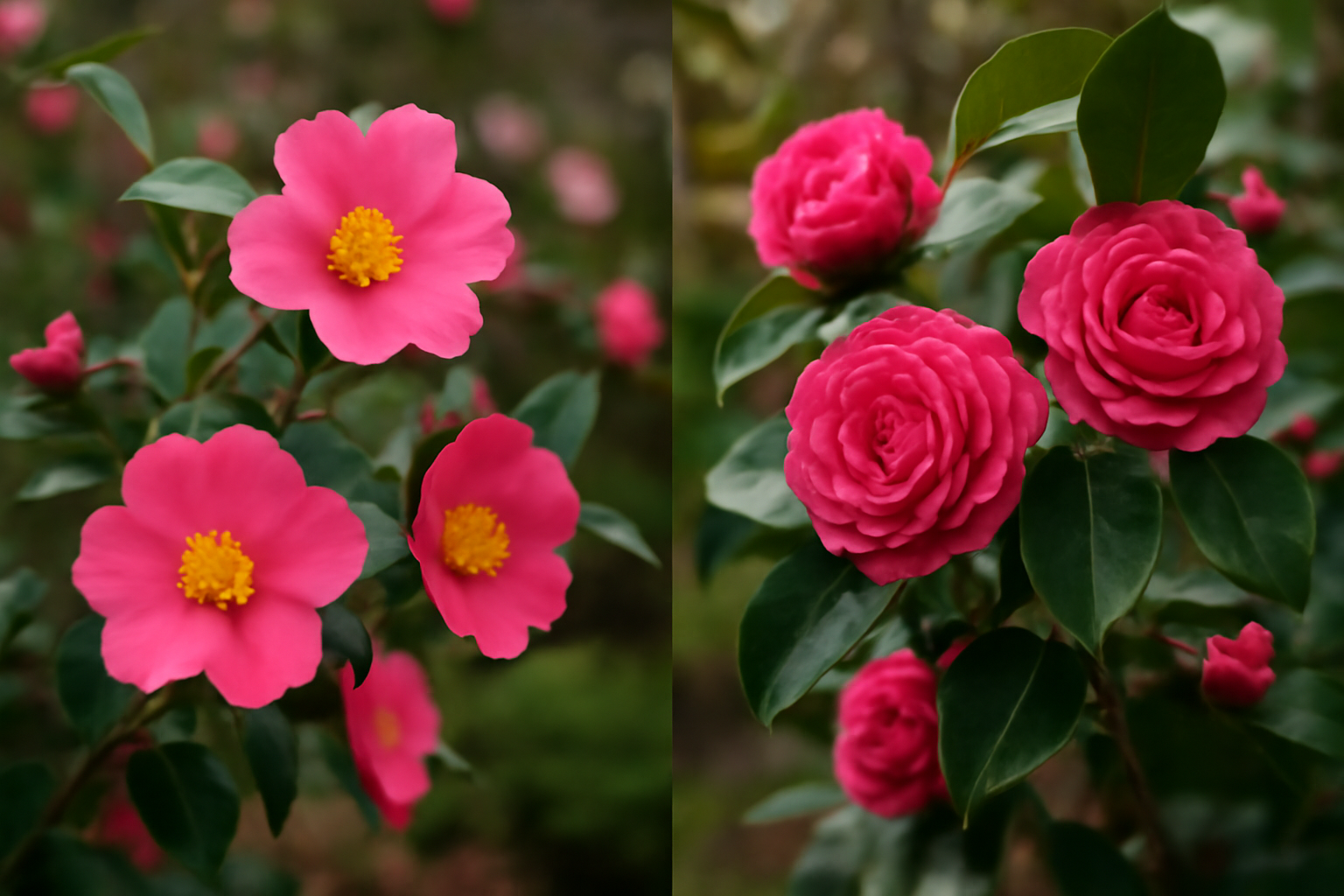
Nursery tags will tell you “full sun to part shade,” maybe a hardiness zone number, and little else. What they won’t tell you is that Camellia sasanqua and Camellia japonica lose their flowers to cold in two completely different ways, at two completely different times of year — and that gap is exactly what my neighbor stumbles over every October when she sees my sasanquas already blooming while her japonica hasn’t so much as budded. She grows a lovely one; mine is a wall of autumn color while hers sleeps until spring. That contrast is the fun part, and it’s the part everyone asks about. What nobody asks about, until it’s too late, is what that same timing difference means for freeze exposure. After twenty years tending more than 200 named cultivars across three garden sites spanning zones 7b, 8a, and 8b, freeze damage — not “which one’s prettier” — is the question people bring to me most, usually right after a rogue cold spell has already wiped out three weeks of blooms they never saw coming.
Why the Bloom-Timing Gap Is Really a Cold-Exposure Problem
Camellia sasanqua flowers in autumn and early winter — roughly October into December. Camellia japonica waits until late winter into spring, generally January through April. That’s not just a scheduling quirk that determines when you get to enjoy flowers. It means each species faces a distinct type of cold event at a distinct point in the season, and the risks aren’t interchangeable.
Sasanquas throw their blooms open before winter has truly arrived, so an early hard freeze can catch fully opened flowers completely by surprise. Japonicas, on the other hand, do their riskiest work mid-winter — their buds swell and open right in the middle of the year’s coldest, most erratic stretch, which is a different hazard entirely. Both species share a genus and comparable overall hardiness, yet they fail in opposite ways. Knowing which vulnerability applies to which plant matters far more than most planting guides bother to explain.
Sasanqua’s Cold Vulnerability, Explained
As a species, sasanqua handles Zone 7 conditions without complaint, and its wood and foliage take real cold in stride. The danger isn’t to the shrub itself — it’s to whatever blooms happen to be open the moment a freeze rolls through. Since sasanquas start flowering as early as October, before winter weather patterns have stabilized, a hard freeze in mid-November can turn three weeks’ worth of open blooms black overnight in zone 7b, and even zone 8a isn’t immune when an odd cold snap comes through. The shrub couldn’t care less. Losing that year’s flower show, though, still hurts.
There’s an actual breeding fix worth knowing, even if extreme cold isn’t your situation. Dr. William Ackerman, working at the U.S. National Arboretum, crossed the truly cold-hardy Camellia oleifera with sasanqua, hiemalis, and vernalis selections in order to push fall-flowering camellias into colder territory. What came out of that work — the “Winter” series, including cultivars such as ‘Winter’s Interlude,’ hardy to Zone 6b and field-tested down to about -15°F — held up with barely any winter injury even in a protected Zone 6 setting. Retail buyers will often find several of these marketed under the Ice Angels label. Anyone gardening at the frigid fringe of camellia country is making a genuinely different bet with these hybrids than with a plain species sasanqua.
For the rest of us, there’s an easier fix I lean on all the time: favor cultivars that flower toward the tail end of sasanqua season instead of the earliest bloomers. ‘Yuletide’ has bailed me out of freeze heartbreak more times than I can count, since its December bloom window sidesteps our nastiest early cold. Planting an early-October bloomer somewhere exposed in zone 7b is a calendar gamble that a December-flowering cultivar simply doesn’t ask you to take.
Japonica’s Cold Vulnerability, Explained
Japonicas generally perform reliably across Zones 7 through 9, and their mature wood copes with winter cold about as well as sasanqua’s does. Here, the danger is almost entirely a matter of bud timing. Because flower buds swell and unfurl anywhere from January to April, it’s precisely during that swelling or newly-opened stage that a late freeze in February or March can wreck the bloom — even while the shrub carrying it comes through untouched and flowers normally the following year.
In colder zones, breeders answered this with the “April” series — cultivars such as ‘April Dawn,’ ‘April Snow,’ and ‘April Remembered,’ bred by Dr. Clifford Parks specifically to boost winter hardiness. These remain among the very few C. japonica selections anyone can confidently recommend for permanent outdoor planting as far north as Zone 6 — a genuinely different situation than trying a standard japonica cultivar in a marginal climate.
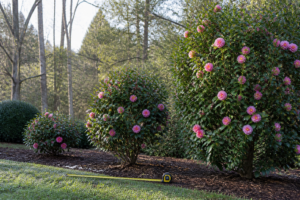
Placement matters just as much as cultivar choice. Overhead cover — an eave, a tall pine canopy — cuts down the radiant heat loss that happens on clear, still, cold nights, which noticeably lowers bud damage in borderline zones. My strongest japonicas grow beneath a stand of longleaf pines in zone 8a, and I’ve watched open buds on unprotected plants get burned by late March cold snaps while the canopy-shielded ones came through completely fine.
What to Plant, Zone by Zone
Here’s the planting approach I’d actually take, species by species, if I were setting up a garden from scratch in each of these zones.
- Zone 6b–7a: Skip straight species sasanqua or japonica here — don’t cross your fingers and hope. Go with Ackerman’s Winter-series (Ice Angels) sasanqua hybrids and Parks’ April-series japonicas instead, since those are the only selections actually bred and proven for this range. Position both against a south- or east-facing wall for the added radiant warmth, and treat overhead cover for japonica buds as a requirement, not a nice extra.
- Zone 7b: This is the coldest of my own three sites, and both species can work here — but lean on late-blooming sasanquas (‘Yuletide’ rather than an October bloomer) to skip the early-freeze window, and give japonicas some overhead canopy or eave shelter so a late-February or March cold snap doesn’t wipe out the season’s buds.
- Zone 8a–8b: In a typical year, most standard cultivars of either species do fine. Freeze damage turns into an occasional oddity tied to unusual cold events rather than something you have to plan around routinely — though I’d still steer a treasured japonica away from a wide-open, fully sky-exposed spot, since that’s precisely the placement where an unusual freeze becomes a real setback.
- Zone 9 and warmer: Freeze risk basically stops being a factor for either species at this point. The decision shifts to bloom timing, growth habit, and how the plant functions in your garden rather than cold tolerance — worth a look at a straightforward sasanqua-versus-japonica comparison for that part of the choice.
Cold-Hardy Cultivars That Deserve a Spot on Your List
When freeze risk is the deciding factor rather than an afterthought, these are the specific selections I’d hunt down by name — not the unlabeled species plants sitting on a garden center shelf.
Sasanqua Cultivars Built for Cold
- ‘Winter’s Interlude’ — An Ackerman hybrid from the Winter series (sold as Ice Angels), hardy to Zone 6b and field-tested near -15°F. Produces clear pink, peony-form flowers from November into December.
- ‘Yuletide’ — A single red bloom with vivid yellow stamens, flowering in December. It’s not a cold-bred hybrid, but its late timing dodges the early-freeze problem that October bloomers face, which is exactly why it’s my most dependable performer in zone 7b.
- ‘Setsugekka’ — Solidly hardy to zone 7, vigorous grower, a strong pick for espalier work or a standalone specimen where structure and cold tolerance both matter.
Japonica Cultivars Built for Cold
- ‘April Dawn’ — Part of Parks’ April series and among the top picks currently trusted for Zone 6. Snow-white petals flecked with pink.
- ‘April Snow’ — Also from the April series, notably strong winter hardiness, pure white blooms.
- ‘April Remembered’ — The biggest flowers of the April lineup, cream fading to pink, semi-double form, upright and vigorous.
- ‘Nuccio’s Jewel’ — Not developed for extreme cold, but dependable across Zones 7–9 when given the overhead-cover placement described earlier.
The Siting Mistake That Showed Me Exposure Never Stops Mattering
Let me walk you through ‘Professor Charles S. Sargent,’ a striking dark red formal-double japonica I once planted against a sun-drenched west-facing wall in my zone 8b garden — I needed height in that spot and didn’t want to wait for a better plan. Every year, the afternoon sun scorched the blooms before they could fully open, and the leaves took on a sickly yellow tint from heat stress. Three disappointing seasons later, I relocated it to a north-facing spot with bright, indirect light, and it turned around completely within a single growing season.
The lesson stretches well beyond summer sun. A west-facing wall doesn’t just scorch flowers during the growing season — it also produces the harshest day-to-night temperature swings in winter, because the wall soaks up heat all day and then sheds it quickly once the sun goes down. For a plant already pushing the edge of its hardiness, that kind of swing can stress buds even when the low temperature by itself wouldn’t have caused trouble. In marginal zones, I now treat wall orientation as much as a freeze-risk decision as a sun-exposure one.
So Which One Belongs in Your Garden?
Work through three questions in order. First: what’s your real USDA zone, and how near the edge are you to that 6b–7a threshold? That answer alone tells you whether to shop for ordinary species cultivars or specifically seek out Ackerman’s Winter-series and Parks’ April-series hybrids. Second: what does your planting site actually offer — open sky, tree canopy overhead, or a heat-reflecting wall — and if it’s a wall, which direction is it facing? Third, specific to sasanqua: are you choosing an early bloomer or a late one relative to when your area typically sees its first hard freeze?
Twenty years in, here’s my honest take: plant both species, but in a marginal zone, let cold tolerance guide your cultivar choice ahead of flower shape or color, every time. A stunning japonica that drops its buds to a March freeze every third year isn’t actually the smarter garden investment compared to a somewhat plainer April-series pick that blooms without fail every year. If you’re shopping named cultivars for your own yard, sort by hardiness zone first — that one filter will spare you more heartache than any other choice you’ll make in the whole process.
About This Article

Written by Helen Pritchard. Helen Pritchard is a lifelong gardener in the Pacific Northwest who has grown more than 200 named camellia cultivars over two decades. She writes practical, experience-based guides to camellia care, from variety selection and pruning to troubleshooting yellowing leaves and bud drop. More about this site.
Verify this against a primary source
Specifics change, and your situation may differ from the one described here. These are the authorities worth checking directly:
- American Camellia Society — cultivar registration and culture guides
- USDA Plant Hardiness Zone Map — zone verification for your location
- Royal Horticultural Society — camellia cultivation and pest guidance