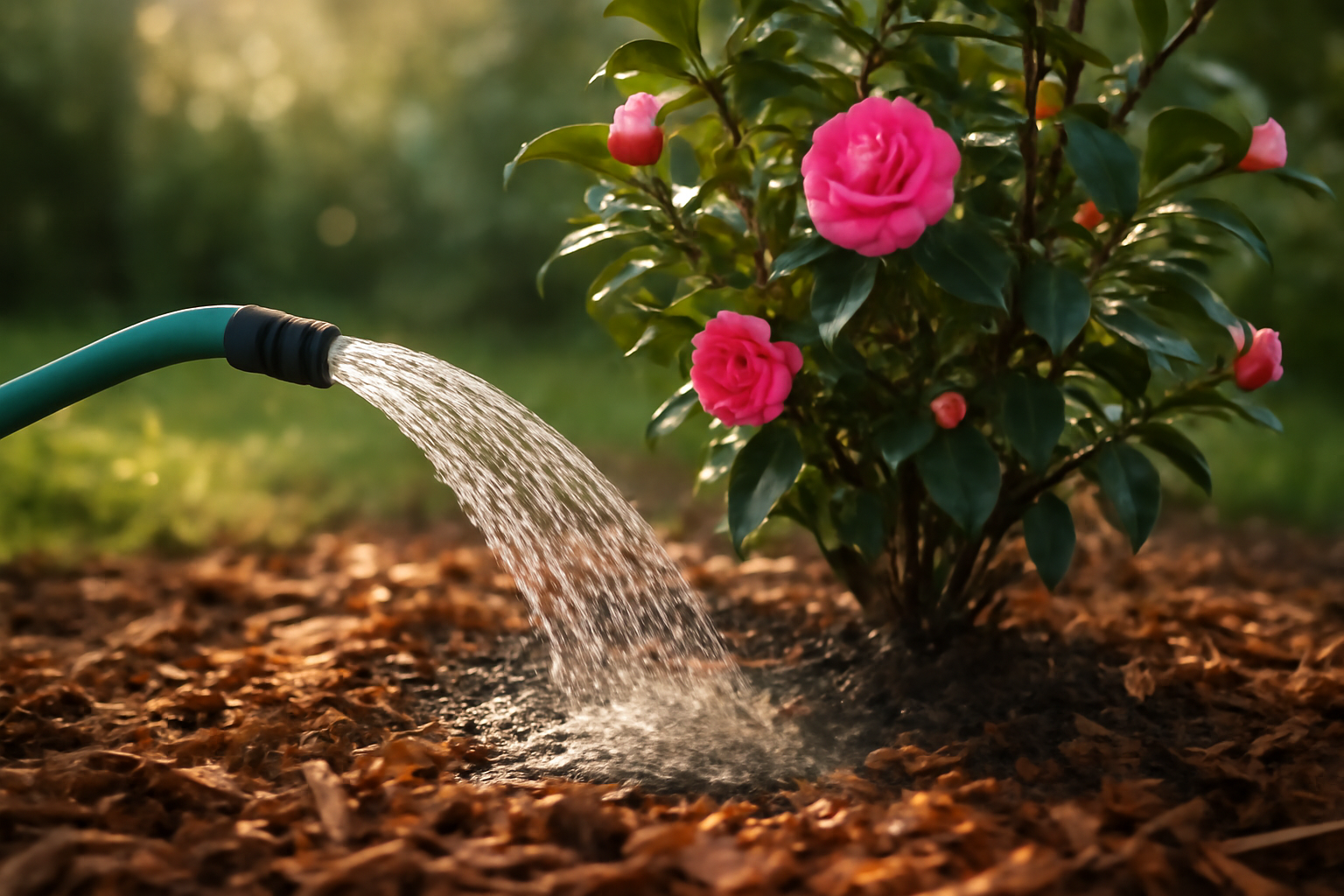
Almost every camellia grower eventually settles on one watering routine and sticks to it year-round — the same amount, the same frequency, whether it’s February frost or July swelter. That assumption feels reasonable. It’s also exactly what cost me a ‘Nuccio’s Gem.’ The plant wasn’t lost to frost, and it wasn’t neglect either — it was water, applied the identical way in the height of summer as I’d been giving it in late winter. All season long, in my Zone 8a garden, it looked worse and worse: edges of the leaves yellowing, new shoots limp instead of upright. When I finally dug into the root zone, I found precisely what I’d earned — airless, sodden soil with an off smell to it. Classic summer overwatering. Expensive lesson. So if you’ve been wondering how to water camellias the right way — not the vague “keep them moist” advice, but a real answer that shifts with season, cultivar, soil type, and whatever’s happening outside your window — you’ve landed in the right spot.
Two decades plus into this hobby, my collection has grown to over 200 named cultivars spread across three separate properties, straddling USDA Zones 7b, 8a, and 8b. Japonicas, sasanquas, reticulatas, a handful of cold-hardy hybrids thrown in — I’ve drowned plenty of them and I’ve also gotten it right more times than not. Everything below is the accumulated result, some of it learned the hard and costly way.
Why Camellia Watering Isn’t as Simple as the Standard Advice Suggests
The typical line you’ll hear about camellias is some version of “keep them moist but well-drained.” Fair enough — but on its own, that phrase tells you almost nothing useful. “Moist but well-drained” looks entirely different during a Zone 7b winter than it does in the middle of a Zone 8b August.
Part of the reason is root structure. Camellias keep a shallow, fibrous root system confined mostly to the top 12 to 18 inches of soil — precisely the layer that bakes dry fastest in summer heat and stays saturated longest after a heavy rain. That shallow architecture makes the plant genuinely vulnerable at both extremes. Let it dry out and buds drop while leaves scorch. Keep it too wet and you’re inviting Phytophthora root rot, a fungal disease that races through waterlogged, oxygen-starved soil.
From what I’ve watched over the years, gardeners who run into watering trouble with camellias tend to split into two camps. Some treat them like moisture-hungry hydrangeas and flood them constantly. Others assume a mature shrub is tough enough to shrug off drought and simply forget about it during a dry spell. Neither instinct serves the plant well.
Getting Spring Watering Right
Spring is when I pay the closest attention of the entire year. Around late March into April, the japonicas are wrapping up their bloom show while pushing that bronze-red flush of new leaves. That fresh growth is genuinely demanding — it needs steady, dependable moisture to size up properly.
My Zone 8a property usually gets decent spring rainfall, so most of my job is topping off rather than doing all the work myself. Zone 7b is a different story — spring there lurches between soaked and bone-dry, so I watch the soil far more carefully. My rule of thumb: probe an inch or two down. Dry at that depth means a thorough soak. Still damp means leave it be.
I favor depth over frequency in spring. One slow soak that pushes moisture down 10 to 12 inches beats a shallow daily splash every time — deep watering pulls roots downward, which pays off as drought resistance later in the year. Frequency isn’t irrelevant, though: most springs I’m giving established plants a drink every 7 to 10 days whenever rainfall isn’t pulling its weight.
Fresh Plantings Demand Closer Watching in Spring
Just tucked a new camellia into the ground — maybe a C. japonica ‘Kramer’s Supreme’ or a sasanqua such as ‘Setsugekka’? Spring watering for that plant is non-negotiable. It hasn’t built out the root spread yet to hunt for moisture on its own. For the first growing season, I’m watering new transplants every 3 to 5 days when rain skips town, and I keep that up for at least the first six weeks.
Before watering even enters the picture, though, I make sure the planting soil itself is suited to the job. Camellias want slightly acidic ground — pH 5.5 to 6.5 is the sweet spot. Fall outside that window and roots struggle to pull up water efficiently no matter how much moisture is available. If you’ve never checked your soil’s pH, a cheap test kit is a worthwhile ten-minute detour.
Summer: The Season Most Gardeners Mishandle
This is exactly where my ‘Nuccio’s Gem’ went wrong, and it’s also where I watch other growers stumble most often. Summer sends mixed signals with camellias. Everything about the heat and dryness screams “water more” — the leaves can look genuinely stressed — but actual need hinges on whether the plant is still growing hard or has slipped into semi-dormancy.
By midsummer, most japonicas have wrapped up their main growth spurt and eased into a quieter stretch. Don’t be fooled, though — they’re busy setting next year’s flower buds behind the scenes. Erratic watering through July and August is one of the top reasons plants drop buds the following winter, a topic I’ve dug into further in my post on why camellias drop buds.
My typical summer rhythm for mature camellias in Zone 8a runs every 5 to 7 days during dry stretches, always in the early morning. Evening watering is something I actively avoid — foliage that stays wet overnight is an open invitation for fungal trouble, particularly on tightly branched japonicas like ‘Debutante’ or ‘Governor Mouton’ where airflow is already tight.
Why Mulch Does Half the Work in Summer
No discussion of summer watering is complete without mulch. Spread a 3-inch layer of pine bark or pine straw over the root zone and evaporation drops sharply. In my own beds, mulched camellias need roughly half the watering that bare-soil ones do during a scorching, dry July. That’s a meaningful gap, not a minor perk.
Just don’t let the mulch touch the trunk — leave a couple of inches of clear space, since mulch piled against bark traps moisture and invites rot. Spread it out wide, ideally to the drip line, rather than heaping it deep near the base. I top mine off every spring and again as autumn begins.
Container Camellias Need a Different Summer Plan
Potted camellias live by different rules entirely. My reticulata collection — ‘Francie L’ and ‘Buddha’ among them — stays in large containers because reticulatas struggle outdoors in my colder Zone 7b location. Pots dry out at a completely different pace. Through a hot summer stretch, I’m checking every container daily, often watering as often as every other day.
When I water a container, I keep going until water runs freely out the drainage holes — that’s the only way to know the entire root ball got soaked rather than just the surface inch. Watering just the top layer and calling it done is one of the most frequent mistakes I see with potted plants.
Watering Through Autumn and the Sasanqua Show
Autumn changes the mood in my garden entirely. Starting in October, the sasanquas take over — ‘Yuletide,’ ‘Kanjiro,’ ‘Shishi Gashira’ — blooming their hearts out while the japonicas are still many months from their turn. Ironically, this is also the season when watering slips down people’s priority list, since cooler air makes it feel less urgent.
But plenty is happening below the surface. Japonicas are quietly plumping out next season’s flower buds, and the root system hasn’t slowed down. A dry September or October stresses the plant genuinely, mild weather or not. I try to hold a steady rhythm through fall — roughly every 10 to 14 days without rain — only easing off once temperatures settle consistently below 50°F.
One quirk I watch for every autumn: rain arriving after a long dry stretch. Soil that’s been parched a while can turn temporarily water-repellent, shedding rainfall instead of absorbing it. When I see that happening, I water in slow, repeated short rounds, letting each pass sink in before adding more.
Watering Camellias Through Winter
Winter watering trips up more new growers than any other season. The natural assumption is that dormant or near-dormant plants sitting in cold, wet weather don’t need a drop from you. In genuinely rainy climates, that often holds true. But my Zone 7b property brings cold, dry winds and bright, frosty days that pull moisture out of the plant without any rain arriving to replace it.
Desiccation — moisture leaving through the leaves faster than roots can resupply it — is a genuine winter risk, especially for large-leafed japonicas like ‘Berenice Boddy’ and ‘Pink Perfection.’ On a dry, windy winter afternoon, those glossy leaves keep losing water regardless of the cold, and if the ground is frozen or simply dry, the roots have no way to keep pace.
Knowing When to Water — and When to Hold Off — in the Cold
I water on opportunity rather than schedule in winter, choosing mild windows when temperatures climb above 40°F. Every couple of weeks I check the soil an inch down; if it’s dry there, I water thoroughly on a mild morning so it has time to soak in before nighttime temperatures fall again.
What I won’t do is water frozen ground, or water when a hard freeze is expected within 24 hours — wet roots take freeze damage far worse than dry ones do. Still, a plant that goes into a freeze well-hydrated handles it better than one that’s drought-stressed, so getting the timing right matters enormously.
In my harshest Zone 7b spots, I’ll sometimes reach for an anti-desiccant spray like Wilt-Pruf on my most exposed japonicas. It doesn’t replace good watering habits, but it does cut down leaf moisture loss during the worst cold snaps.
Reading the Warning Signs: Too Much Water vs. Too Little
Learning to interpret what your camellia is telling you matters more than any watering schedule I could hand you. Overwatered and underwatered plants both look distressed, but once you know the tells, the two are easy enough to separate.
Underwatering shows up as:
- Brown, crisp leaf margins, showing up most often in summer
- Buds dropping before they get the chance to open
- Leaves curling in on themselves or losing their usual shine
- New growth wilting in the morning hours, not just from midday heat
Overwatering shows up as:
- Yellowing leaves, especially the older growth toward the plant’s interior
- A soft, mushy feel at the stem base or crown
- A sour, rotten odor coming up from the soil
- Soil that stays soggy and never dries out between waterings
- New shoots emerging pale or yellow instead of the usual bronze-green
So if you’re looking at all-over yellowing plus soggy soil underneath, stop the watering immediately and check your drainage before doing anything else. If instead you’re seeing crisp brown edges on otherwise fine-looking leaves during a dry stretch, that’s a straightforward moisture shortfall. Caught early, both situations are simple fixes. Left alone, both get considerably harder to reverse.
Habits I Rely On Year-Round
After twenty-plus years at this, I’ve landed on a handful of habits that make watering camellias more straightforward no matter what the calendar says.
- Rely on a moisture meter for containers and recent plantings. Finger-testing works fine in garden beds, but pots can trick you — dry up top, waterlogged underneath.
- Direct water to the base, never overhead. A drip system or a slow-running hose at soil level beats overhead sprinklers on camellias every single time.
- Understand what soil you’re working with. Sandy ground drains quickly and needs watering more often; clay holds onto moisture longer but can compact and stay waterlogged. I work grit and organic matter into my clay beds ahead of planting.
- Favor rainwater over tap water if your municipal supply runs alkaline. Camellias do best with slightly acidic water, and alkaline tap water will gradually shift soil pH upward. I save rainwater specifically for my most pH-sensitive cultivars.
- Keep a running record. I log watering dates and soil conditions in a plain garden journal, and that habit has shown me patterns I’d otherwise miss season to season.
About This Article

Written by Helen Pritchard. Helen Pritchard is a lifelong gardener in the Pacific Northwest who has grown more than 200 named camellia cultivars over two decades. She writes practical, experience-based guides to camellia care, from variety selection and pruning to troubleshooting yellowing leaves and bud drop. More about this site.
Verify this against a primary source
Specifics change, and your situation may differ from the one described here. These are the authorities worth checking directly:
- American Camellia Society — cultivar registration and culture guides
- USDA Plant Hardiness Zone Map — zone verification for your location
- Royal Horticultural Society — camellia cultivation and pest guidance