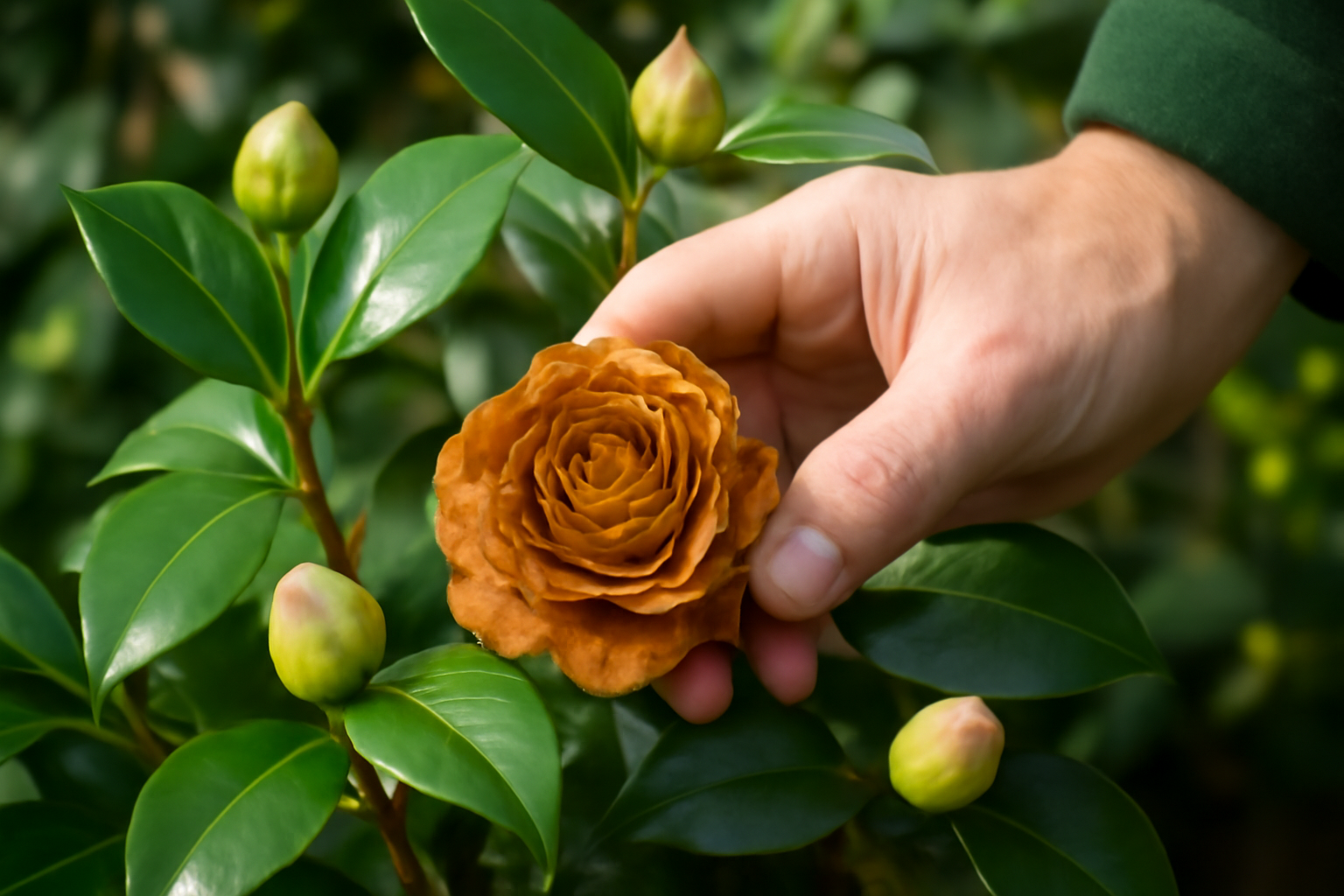
A soggy stretch we had this past March — nearly ten straight days of rain here in zone 8a — left my japonica beds littered with collapsed, mud-brown blooms, and it drove home the question readers send me more than any other: is deadheading camellias actually necessary? On the surface it seems trivial. Snap off the ruined flowers, tidy the bed, carry on. Yet after more than two decades tending a collection that’s grown past 200 named cultivars spread across zones 7b, 8a, and 8b, my honest answer is: it depends on the plant, the situation, and what you’re trying to accomplish. That gray-area answer, though, is where the real substance lies.
Certain camellias in my beds visibly benefit when I strip away their finished flowers. Others thrive whether I bother or not, spent blooms and all. And a handful I tidy up purely for reasons that have zero connection to plant vigor. So I’ll walk through the logic I actually apply in my own garden, the reasoning behind each choice, and what factors are worth weighing in yours.
Defining Deadheading in the Camellia Context
Let’s nail down the vocabulary before anything else. Deadheading refers strictly to pulling off flowers that have already finished, before they can produce seed. Applied to camellias, that means clipping or snapping away blooms once their petals have gone brown and the flower is unmistakably spent. It’s not a synonym for pruning branches, and it doesn’t involve touching buds — it’s confined to the dead flower heads themselves.
That line matters because camellias don’t behave like roses or dahlias, where removing old flowers directly coaxes out a fresh round of blooms. Camellia flower buds for the next season form during summer — well after the current bloom cycle has wrapped up. So whatever reason you have for deadheading a camellia, it won’t be the same reason you’d deadhead most other flowering shrubs.
Is Deadheading Actually Required for Camellias?
Plainly put — no, not as a blanket rule. Your camellia won’t wilt in protest or bloom less the following year just because you skipped tidying up spent flowers. From what I’ve observed, a healthy specimen planted in properly amended, acidic soil — aim for a pH somewhere between 5.5 and 6.5 — will keep flowering season after season regardless of whether you deadhead.
That said, there are particular scenarios where the practice earns its keep. Let’s look at each one.
Disease Pressure Changes the Calculus
This is the scenario where I don’t hedge — deadheading matters a great deal. Camellia petal blight, caused by the fungus Ciborinia camelliae, plagues gardens throughout much of the South and the Pacific Northwest. Its signature is hard to mistake: petals brown quickly from the edges inward, producing a rigid, almost mapped-out discoloration rather than the gentle fading you’d expect from ordinary petal decline.
Blighted flowers that hit the ground leave behind sclerotia buried in the soil, and those structures release spores when the season comes back around. That means letting infected flowers linger — on the shrub or scattered underneath it — quietly sets you up for a worse outbreak next year.
My zone 8a beds show the clearest damage on the largest-flowered japonicas. Cultivars such as ‘Nuccio’s Gem,’ ‘Kramer’s Supreme,’ and ‘Governor Mouton’ seem particularly prone whenever a wet spring rolls through. On those specific plants, I’m rigorous about removing spent blooms and sealing the fallen petals in a bag rather than tossing them into the compost pile. It noticeably cuts down on reinfection the next time around.
Deadheading Purely for Looks
Not every camellia sheds its petals gracefully. Some cling to dying blooms in a way that’s genuinely unappealing. My ‘Blood of China’ — a late-blooming japonica I’m otherwise fond of — is notorious for holding onto its fading deep-red flowers until they collapse into an ugly rust-colored mush. Left alone, those spent flowers just sit there dragging down the whole display.
For a plant like that, my motivation is entirely cosmetic, and I don’t think that needs justifying. If the camellia sits near your front door, beside a patio where you actually linger, or anywhere you look at it often, keeping it presentable is reason enough to pull off the tired blooms.
Seed Production and Energy Trade-offs
This factor takes a little more explaining. Camellias are capable of setting seed, and doing so does pull resources away from the plant. Still, for most mature, established camellias in a garden setting, this barely registers — a robust, well-nourished shrub won’t notice the drain from producing a modest amount of seed.
Where it starts to count is with young plants, compact cultivars, or types that set seed prolifically. In those cases, removing flowers before pods form can redirect energy toward root establishment and bud formation instead. I keep an especially close eye on this with several of my smaller reticulata hybrids, since they tend to take longer to settle in and can use every advantage I give them.
Sasanquas: Just Step Back
Here’s a spot where I won’t soften my opinion. Deadheading sasanqua camellias, in my view, is rarely worth the labor. These bloom mostly in fall and early winter — in my zone 7b garden, they often start as early as October. They churn out enormous numbers of small blooms, and those blooms fall away on their own without any help. Honestly, the natural petal drop is part of what makes them charming.
Cultivars such as ‘Setsugekka,’ ‘Yuletide,’ and ‘Kanjiro’ can produce hundreds of flowers across a six-to-eight-week stretch. Deadheading each one by hand would eat up your entire schedule. Fortunately, the fallen petals break down fast and don’t carry the same disease risks that plague the bigger-flowered japonicas.
Spare yourself the effort — let your sasanquas run their natural course.
The Right Way to Deadhead a Camellia
Once you’ve decided deadheading fits your situation, technique becomes important. Rush the job and you risk damaging the tiny growth buds tucked just beneath each spent flower. Here’s the method I rely on in my own beds.
Picking the Right Moment to Remove Old Blooms
I clear flowers as each one finishes rather than waiting for the entire shrub to be done blooming. With a long bloomer like ‘Debutante’ or ‘Nuccio’s Jewel,’ that stretches the job out over several weeks. Resist letting everything brown out first — delay just gives fungal spores extra time to establish and makes the cleanup more tedious.
When petal blight is the concern, speed matters most. I aim to get to affected blooms within a day or two of spotting the symptoms.
Getting the Technique Right
The bloom sits atop a short stem, and just underneath it you’ll typically find a small axillary bud or emerging growth point. The objective is removing the flower without harming that bud. Here’s the approach I favor:
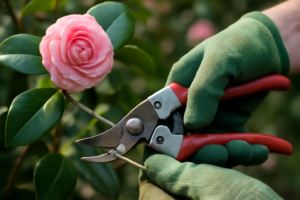
- Reach for clean, sharp bypass pruners, or simply use your fingers with a gentle twist-and-pull motion.
- Take hold near the base of the flower, just behind the petals, and rotate slightly as you lift upward.
- Done right, the flower separates cleanly at the receptacle, leaving buds and foliage undisturbed.
- When a bloom won’t budge easily, switch to pruners instead of forcing it and risking damage.
- Swab your pruner blades with isopropyl alcohol between plants whenever disease is a concern.
Sanitizing tools used to be a step I skipped entirely. I’ll explain why I don’t anymore in just a moment.
Handling the Removed Blooms
What you do next depends on your reason for deadheading. Assuming disease isn’t in the picture, spent camellia flowers can go straight into the compost — they break down without issue. But if petal blight or another fungal problem is present, skip the compost entirely. Seal those blooms in plastic and send them out with the trash. And don’t overlook fallen petals lying beneath the plant, either — I make a point of raking those up too.
A Costly Slip-Up — and the Lesson It Left Me
Some years back, I was moving quickly through my japonica rows, deadheading as I went. I’d just cleared petal blight off one of my ‘Professor Sargent’ shrubs, then continued straight on to the next plants without wiping my pruners in between.
Come the following spring, three previously clean shrubs nearby had come down with the blight — including a cherished ‘Adolphe Audusson’ I’d raised myself from a cutting. I can’t say with total certainty my pruners were the culprit, but I’ve never repeated that carelessness since. These days I carry a small bottle of isopropyl alcohol and a rag in my apron whenever I’m anywhere near known blight. The extra ten seconds costs nothing and pays for itself many times over.
For a deeper look at disease management, I’ve written a more thorough post covering common camellia problems, including exactly what petal blight looks like close-up and how to tell it apart from ordinary petal browning.
Deadheading Isn’t Pruning — Keep Them Separate
I want to call this out because I run into the mix-up constantly. Deadheading and pruning are entirely different tasks. Deadheading only involves clearing away spent flowers. Pruning, by contrast, removes stems and branches and reshapes the plant’s overall form.
Timing is where the stakes get high. For japonicas, the pruning window opens right after the bloom cycle wraps up in spring — typically March through May, depending on your zone and the particular cultivar. Miss that window and you risk snipping away the very buds set for next year’s flowers, since by summer those buds are already forming.
Deadheading doesn’t come with that same risk, because you’re not touching the plant’s structural growth. Even so, it’s better handled promptly rather than left for weeks. If you want more detail on timing and method, I’ve dedicated a separate post to pruning camellias, including how I approach my larger reticulata specimens, which call for a gentler hand.
My Type-by-Type Deadheading Habits
Managing a sizable, mixed collection has pushed me into a routine that I think scales down nicely for home gardens too. Here’s roughly how I sort through it:
Japonicas (Zones 7b–8b, Blooming January Through April)
Any japonica with a history of petal blight gets deadheaded without exception — currently that list covers ‘Nuccio’s Gem,’ ‘Kramer’s Supreme,’ ‘Blood of China,’ ‘Governor Mouton,’ and ‘Professor Sargent.’ For cultivars with a clean track record and good natural petal drop, like ‘Debutante’ or ‘Swan Lake,’ I only bother when the plant occupies a spot everyone actually sees.
Reticulatas and Their Hybrids (Zones 8a–8b)
Reticulatas steal the show — my ‘Frank Houser’ produces flowers the size of dinner plates — but they demand a bit more fuss in return. I deadhead these consistently, partly for the look and partly because I want every ounce of energy channeled back into the plant. They’re not the easiest-care shrubs in my collection, so they get extra care accordingly.
Sasanquas and Hiemalis Types (Zones 7b–8b, Blooming October Through December)
As mentioned above, I mostly leave these be. My ‘Yuletide,’ ‘Setsugekka,’ and ‘Kanjiro’ manage just fine on their own. The one exception is if I spot anything that looks like disease, in which case I’ll investigate further before deciding whether action is warranted.
So, Should You Deadhead Your Camellias? My Take
Bringing it all together, here’s where I land: deadheading camellias isn’t mandatory for most gardeners, but it’s genuinely worthwhile under specific conditions. Spot petal blight, and you should deadhead quickly, disposing of the infected material with care. Got a plant in a spot where appearance really counts? Deadhead it for your own satisfaction. Nursing a young or slow-to-establish plant along? Cutting back on seed production can give it a small but real boost.
On the other hand, if your camellias are thriving and settled into a relaxed, naturalistic planting where a few spent flowers hardly register — don’t feel any pressure to intervene. These are resilient, long-lived plants that have flowered in gardens for centuries with no one ever deadheading them.
My suggestion is to take an honest look at your own garden. If disease is showing up, if appearance genuinely matters to you, or if you’re helping a young plant along, go ahead and deadhead. Otherwise, it’s perfectly fine to let nature handle things on its own.
Written by Helen Pritchard. Helen Pritchard is a lifelong gardener in the Pacific Northwest who has grown more than 200 named camellia cultivars over two decades. She writes practical, experience-based guides to camellia care, from variety selection and pruning to troubleshooting yellowing leaves and bud drop. More about this site. Specifics change, and your situation may differ from the one described here. These are the authorities worth checking directly:About This Article

Verify this against a primary source