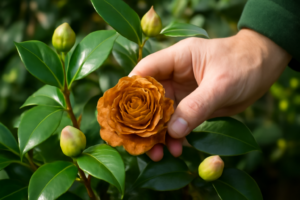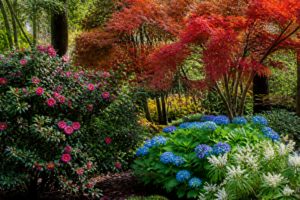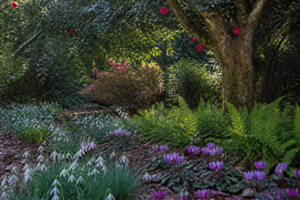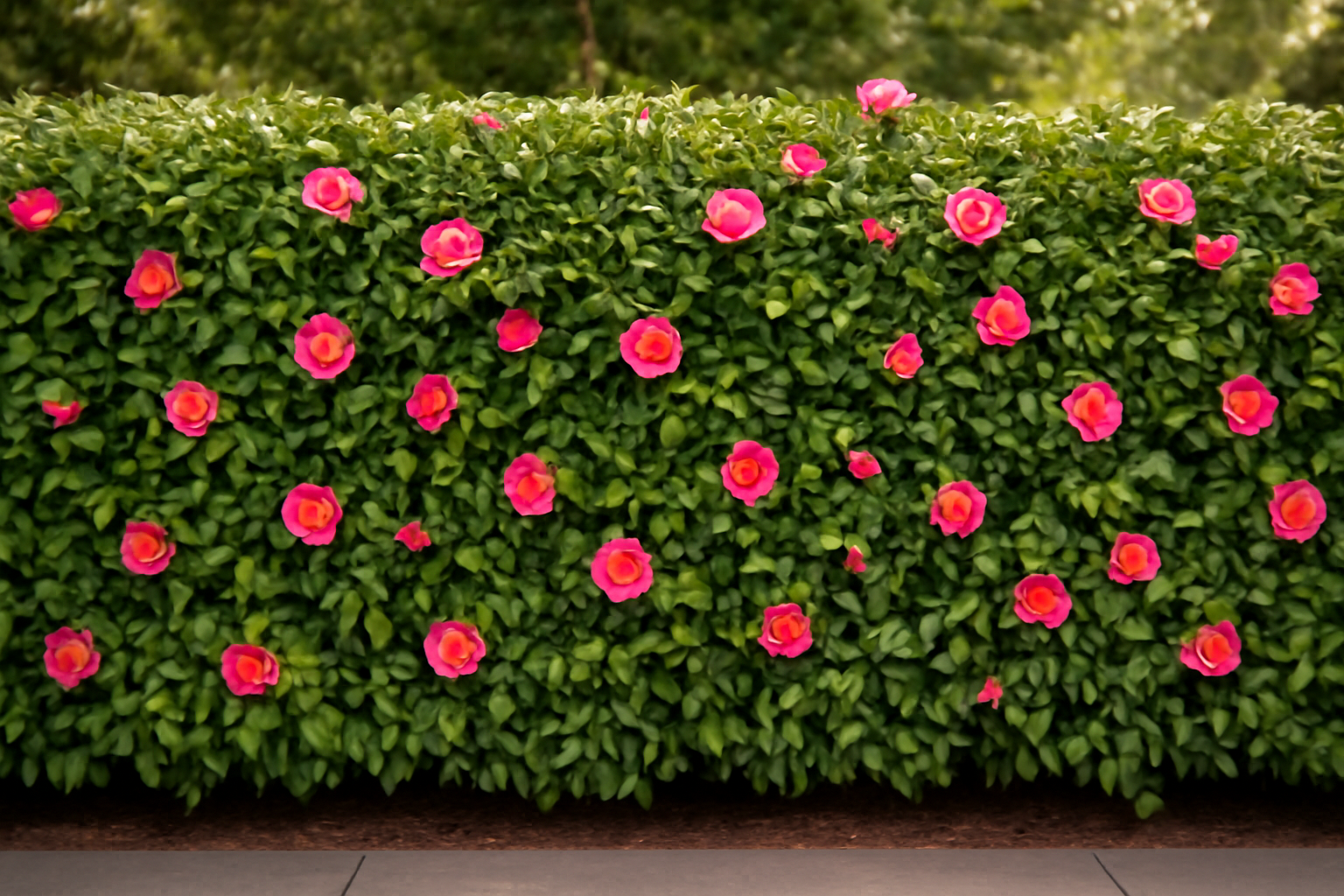
A few years ago, my neighbor put up the ugliest chain-link fence I have ever seen in my life. I am not exaggerating. It ran the full length of our shared property line — about 80 feet — and it rattled in the wind. That was the moment I decided to plant a camellia privacy hedge, and honestly, it was the best gardening decision I have made in years. Today, that fence is completely invisible from late October through spring, buried behind a wall of glossy evergreen foliage and, at peak bloom, absolutely smothered in flowers.
If you have been wondering whether camellias can do the same job in your garden, the short answer is yes — beautifully. However, there are real decisions to make about spacing, variety selection, and pruning if you want a dense, healthy screen rather than a patchy row of struggling plants. Let me walk you through exactly what I have learned across my three garden zones and 200-plus cultivars.
Why Camellias Make Such a Good Privacy Hedge
Most people think of camellias as specimen plants — one beautiful shrub anchoring a border. That is a perfectly valid use for them. However, camellias are also naturally dense, upright, and evergreen, which makes them ideal for screening. Unlike many flowering shrubs, they hold their leaves year-round and develop a thick, layered canopy that blocks sightlines even in winter.
In my experience, a mature camellia hedge also muffles sound surprisingly well. The dense foliage absorbs noise in a way that a wooden fence simply cannot. Add in the blooms — which, depending on variety, can run from September all the way through April — and you have a privacy screen that is also one of the most beautiful things in your garden.
That said, camellias are not instant gratification plants. Patience is part of the deal. A well-chosen, well-planted hedge will typically take three to five years to fill in properly. Rushing that process by crowding plants leads to problems I will cover shortly.
Choosing the Right Camellia Species for a Privacy Hedge
Species and cultivar selection matters enormously here. The three main species you will be choosing from are Camellia japonica, Camellia sasanqua, and Camellia reticulata. Each has a very different growth habit and different strengths as a hedging plant.
Camellia Sasanqua: My Top Pick for Hedging
Sasanquas are, in my opinion, the best camellias for a formal or semi-formal privacy hedge. They are generally faster-growing than japonicas, more sun-tolerant, and many cultivars have a naturally upright, columnar habit that suits hedging beautifully. Bloom time runs from September through December in most climates, giving you flowers right when your garden needs them most.
Specific cultivars I have grown and genuinely recommend for hedging include ‘Setsugekka’, which delivers large white semi-double flowers and grows vigorously upright, and ‘Kanjiro’, a deep rose-pink that is almost embarrassingly easy to grow. For a tighter, more compact screen, I love ‘Mine-no-Yuki’ (also sold as ‘White Doves’). It stays dense and tidy without much intervention from me.
Sasanquas are reliably hardy in USDA zones 7 through 9. In my zone 7b garden, I have had ‘Kanjiro’ sail through winters that dipped to 5°F with nothing more than minor tip burn.
Camellia Japonica: Slower but Magnificent
Japonicas are slower-growing, generally more shade-tolerant, and bloom from late winter through spring — typically January through April depending on your zone. For a hedge, the upright-growing cultivars work best. Spreading or weeping forms are gorgeous specimen plants but frustrating to manage in a line.
My reliable performers for japonica hedges include ‘Elegans Champagne’, ‘Governor Mouton’, and the incredibly vigorous ‘Donation’ (technically a C. japonica × C. saluenensis hybrid, but it hedges like a dream). In zones 8a and 8b, japonicas really hit their stride — growth is faster, bloom is more reliable, and they build density more quickly.
Camellia Reticulata: Beautiful but Not Ideal for Hedging
I will be honest with you: reticulatas are my passion, but they are not great hedging plants. They tend to grow open and irregular, and many cultivars are frost-sensitive below zone 8b. I grow ‘Captain Rawes’ and ‘Crimson Robe’ as large specimen shrubs, not in any kind of formal line. If you are in a mild zone 9 or 10 climate and want a loose, informal screen, a reticulata could work. For a true privacy hedge, however, stick with sasanqua or japonica.
Camellia Privacy Hedge Spacing: Getting It Right the First Time
Spacing is where I see the most mistakes made by enthusiastic gardeners — including one very enthusiastic mistake I made myself about fifteen years ago. I will get to that in a moment.
The correct spacing depends on your goals, your chosen cultivar, and how patient you are willing to be. Here are my general guidelines:
- For a formal, clipped hedge: Space plants 3 to 4 feet apart. You will get faster fill-in, but you must commit to regular pruning to prevent crowding at the root zone.
- For a natural, informal screen: Space plants 5 to 6 feet apart. This gives each plant room to develop its natural shape and prevents competition. It takes longer to fill in visually, but the plants are healthier long-term.
- For large-growing cultivars like ‘Setsugekka’ or ‘Donation’: Give them at least 6 feet, ideally 7 to 8. These are vigorous plants. They will fill the space.
Now for my hard-won lesson. When I planted my first hedge — a row of ‘Jean May’ sasanquas — I spaced them at 30 inches because I wanted privacy fast. Within four years, they were crowding each other badly. The interior branches were dying out from lack of light, and I had to remove every other plant to save the rest. I lost two years of growth in the recovery process. Do not repeat my mistake. Space generously from the start.
Planting Depth and Soil Preparation
Beyond spacing, proper planting sets up your hedge for long-term success. Camellias need acidic, well-draining soil — ideally a pH of 5.5 to 6.5. Before I plant any hedge row, I test the soil pH and amend with sulfur if needed. In my heavier clay areas in zone 8a, I also dig extra-wide planting holes and work in pine bark fines to improve drainage and acidity simultaneously.
Plant camellias at or very slightly above the surrounding soil level. This is critical. Planting too deeply is one of the most common causes of slow establishment and root rot in young camellia hedges. I set my plants so the top of the root ball sits about one inch above grade, then mound the mulch up — never against the trunk.
Pruning Your Camellia Hedge for Density and Shape
Pruning is what separates a good-looking camellia hedge from a magnificent one. The goal with a privacy hedge is to encourage dense, bushy lateral growth — not just height. That means pruning differently than you would with a specimen plant.
When to Prune
Timing your pruning correctly protects next season’s blooms. For sasanquas, which set their flower buds in summer for fall bloom, I prune immediately after flowering finishes — so typically in late December or January in my zones. For japonicas, I prune right after bloom ends, which in my zone 8b garden means late March to mid-April at the latest.
Pruning too late in the season — after mid-spring for most camellias — risks cutting off the developing buds for the following year. I discussed this in more detail in my post on pruning camellias without losing your blooms, which is worth reading alongside this one if you are setting up a new hedge.
How to Prune for a Dense Screen
In the first two years after planting, I lightly tip-prune new growth by about one-third. This encourages branching at lower nodes and builds the dense base structure you want. Do not let young hedge plants race upward unchecked — they will get leggy at the bottom and you will never fully correct it.
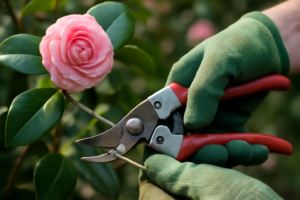
Once the hedge reaches your target height, switch to maintenance pruning. I use a combination of hand shears for detail work and a hedge trimmer for the upper surface. However, I always follow up a mechanical trim by reaching inside the hedge with hand pruners to thin out crossing and rubbing branches. This keeps the interior open enough for air and light — which prevents the fungal issues that plague poorly ventilated camellia hedges.
For a natural-looking screen rather than a formal clipped hedge, I skip the hedge trimmer entirely. Instead, I selectively remove individual branches to control size and encourage outward growth. The result looks deliberate and lush rather than sheared and stiff. My ‘Kanjiro’ hedge is managed this way, and I genuinely think it looks better every year.
Feeding and Ongoing Care for a Healthy Hedge
A hedge puts more demand on soil nutrients than a solitary specimen would, simply because you have multiple root systems competing across a line. In my experience, camellia hedges benefit from a consistent feeding schedule using an acid-forming, slow-release fertilizer formulated specifically for camellias or azaleas.
I fertilize my hedges twice per year: once in early spring as new growth begins (typically March in my zone 8 gardens) and once in early summer, no later than July. Fertilizing after midsummer pushes tender new growth that can be damaged by early frosts — a particular concern in my zone 7b planting.
Keep a 3 to 4 inch layer of organic mulch along the entire hedge row. Pine straw is my personal preference — it breaks down slowly, moderates soil temperature, and gently acidifies the soil over time. Replenish it each fall before the first frost. As a result, my hedge root zones stay consistently moist and cool through summer, which translates directly to better growth and bloom.
Watching for Problems in a Hedge Setting
Camellia hedges are more vulnerable to certain problems than specimen plants. Specifically, tea scale is the pest I watch for most vigilantly — it thrives in the reduced air circulation that dense planting creates. I check the undersides of leaves monthly and treat with horticultural oil at first sign of infestation, before it spreads along the row.
Root rot from overwatering or poor drainage is the other major concern. If you see sudden wilting and yellowing in an established hedge, check drainage first before assuming a nutrient problem. I have seen perfectly healthy-looking hedges lost to Phytophthora root rot after a wet winter in poorly-draining clay. Good soil preparation at planting, as I described above, is the best prevention.
Building Your Camellia Privacy Hedge: Where to Start
Creating a camellia privacy hedge is a long-term investment, and that is exactly what makes it so worthwhile. A well-designed hedge of ‘Setsugekka’ or ‘Kanjiro’ will outlive most fences, look better every year, and give you something a wooden or vinyl barrier never could — genuine, seasonal beauty.
My practical starting point recommendation is this: choose one sasanqua cultivar for your primary hedge if you are in zones 7 through 9, space plants at a minimum of 5 feet apart, amend your soil to a pH of 5.5 to 6.5, and commit to that first two years of tip-pruning to build density from the base up. Everything else — the mature screening, the spectacular fall bloom, the year-round glossy green backdrop — follows naturally from that foundation.
Your neighbor’s ugly fence will disappear. I promise you that from personal experience.