This post contains affiliate links. As an Amazon Associate, I earn from qualifying purchases at no extra cost to you.
After twenty-plus years of growing camellias in my Zone 7b garden, I thought I had my fertilizing routine figured out. Then came back-to-back seasons of yellowing leaves, sparse blooms, and one particularly sulky Camellia japonica ‘Nuccio’s Gem’ that refused to set buds no matter what I tried. Something was off. My soil pH had crept above 7.0, and my camellias were starving for nutrients they simply couldn’t absorb. That’s when I started seriously researching Holly-Tone fertilizer for camellias — and what I found sent me straight to Amazon.
I want to be upfront with you. I’m not a Master Gardener with a string of letters after my name. What I do have is two decades of trial and error, a yard full of established camellias, and a healthy skepticism toward anything that promises miraculous results. So when I say I gave this product a real, two-full-season test, I mean it. No shortcuts. No casual sprinkle-and-forget approach.
This review covers everything I learned — the genuine improvements, the frustrating moments, and the honest answer to whether this fertilizer is worth your money and your trust.
Why I Chose Holly-Tone Fertilizer for Camellias
My first instinct was to ask around at my local camellia society. Several experienced growers pointed me toward acid-forming fertilizers without hesitation. One member — she’s been growing Sasanquas for thirty years — mentioned Espoma specifically. That endorsement stuck with me.
From there, I dug into the science. Camellias thrive in soil with a pH between 5.5 and 6.5. Above that range, nutrients like iron and manganese become chemically unavailable, even if they’re physically present in the soil. My problem wasn’t nutrient absence — it was nutrient lockout. I needed a fertilizer that could feed the plants AND help acidify the soil over time.
Holly-Tone’s formula uses sulfur and other organic materials that gradually lower soil pH as they break down. That combination of slow-release nutrition and gentle acidification is exactly what I was looking for. I also liked that it was organic. Synthetic fertilizers can push fast, lush growth that’s actually more vulnerable to cold damage — a real concern for my borderline-hardy japonicas.
After comparing several options, I settled on the Espoma Organic Holly-Tone 4-3-4 Natural & Organic Evergreen & Azalea Plant Food; 4 lb. Bag. The 4-3-4 NPK ratio is intentionally balanced — not a nitrogen-heavy formula that pushes green growth at the expense of blooms.
First Impressions: Packaging and Initial Quality
The bag arrived in good condition. It was sealed properly, with no moisture clumping — which matters more than you’d think with organic granular fertilizers. Moisture infiltration can start the microbial breakdown process too early, reducing effectiveness before the product even hits your soil.
Opening it, the smell is earthy and organic. Not unpleasant, but definitely present. If you’re sensitive to strong garden smells, wear gloves and work outdoors. The granules themselves are small and fairly uniform. They’re easy to spread by hand or with a basic broadcast spreader.
The instructions on the bag are clear. Application rates are broken down by plant size, which I appreciated. Too many fertilizer bags give vague guidance that leaves you guessing. Espoma gives you specific measurements tied to plant height and spread — genuinely useful for a gardener with camellias ranging from compact three-footers to a sprawling twelve-foot sasanqua hedge.
My Testing Approach: Two Seasons, Multiple Varieties
I applied Holly-Tone to eight camellias across my property. The lineup included:
- Camellia japonica ‘Nuccio’s Gem’ — my problem child, double white blooms, about six feet tall
- Camellia japonica ‘Professor Charles S. Sargent’ — an older specimen, deep crimson, nearly twelve feet
- Camellia sasanqua ‘Setsugekka’ — used as a hedge along my back fence, fall bloomer
- Camellia sasanqua ‘Kanjiro’ — a newer addition, planted just two years prior
- Three unnamed japonicas inherited with the property, one of which had been struggling for years
My soil is a clay-heavy loam that drains slowly. Before the first application, I tested pH at multiple points around each plant’s drip line. Readings ranged from 6.8 to 7.2 — too high for happy camellias.
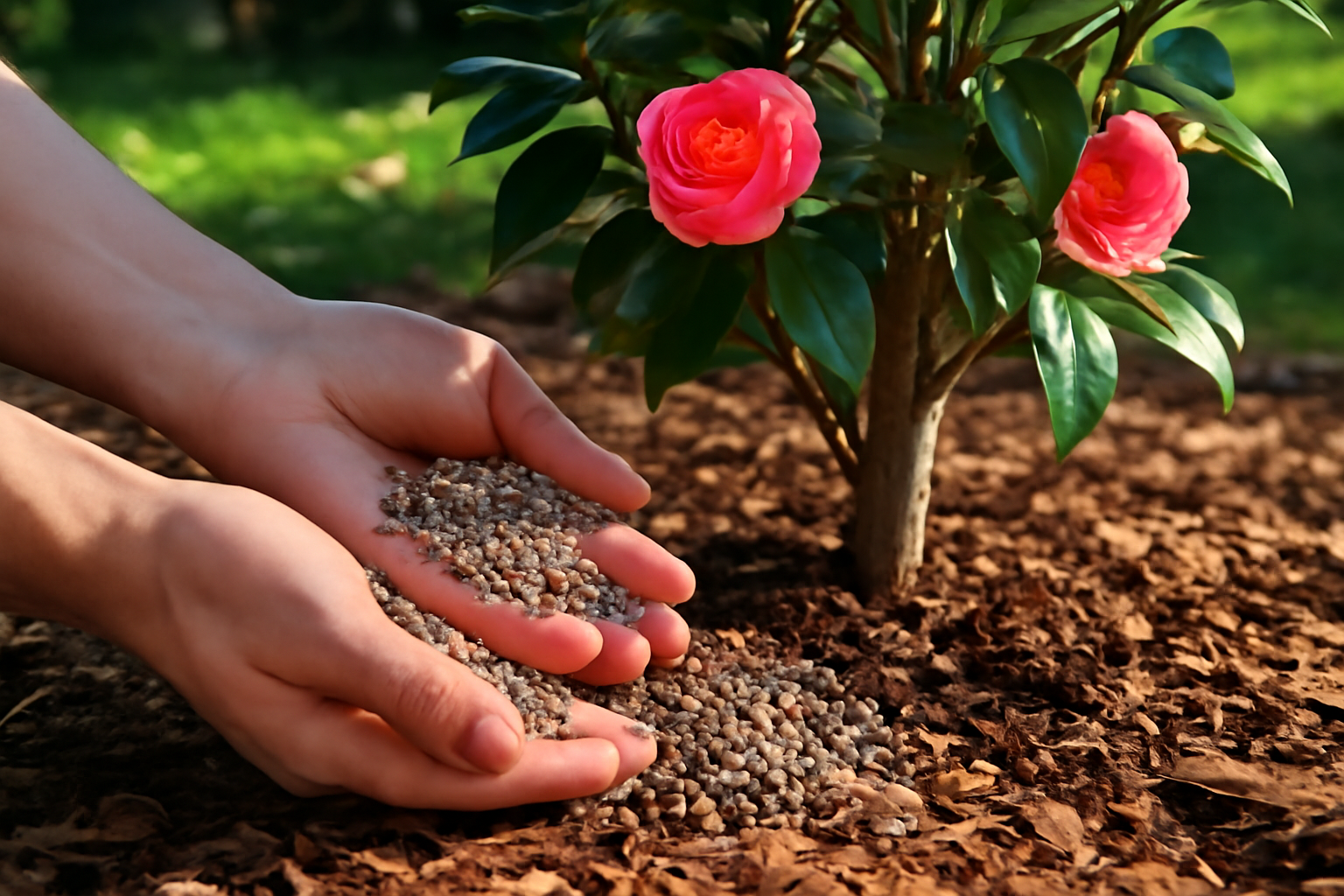
I followed the package directions precisely in year one. That meant two applications: early spring (March, just before new growth) and late spring (May, after the bloom period ended). I scratched the granules lightly into the surface and watered thoroughly after each application.
In year two, I added a third application in early fall for the sasanquas, since they’re active later in the season. I kept detailed notes throughout both years — not scientific-grade data, but enough to track meaningful changes over time.
Watering and Mulch Conditions
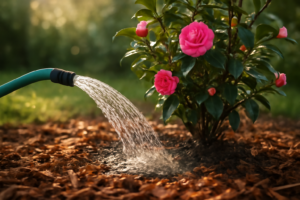
I maintained a consistent two-inch layer of pine bark mulch around all plants. This matters because mulch helps retain moisture and gradually adds to soil acidity as it breaks down. Combining mulch with Holly-Tone created a more favorable root environment overall. I mention this because fertilizer doesn’t work in isolation — your cultural practices matter just as much.
What Actually Changed After Two Seasons
Let me start with the most dramatic result. By mid-summer of year one, ‘Nuccio’s Gem’ had visibly deeper green foliage. The yellowish tinge that had plagued it for two years faded significantly. That’s a classic sign of corrected iron availability — directly tied to improved soil pH conditions. By late winter of year one, it set more buds than I had seen in three seasons combined.
The sasanqua hedge responded quickly too. ‘Setsugekka’ produced noticeably more flowers in fall of year one. The bloom period also seemed slightly extended — I was cutting flowers into December, which is later than usual for my zone.
By the end of year two, I retested soil pH. Most readings had dropped to the 6.2–6.5 range. That’s meaningful movement, and it happened through consistent organic fertilization rather than a harsh acidifying treatment that could shock roots.
The Struggling Inherited Japonica
One inherited japonica — a scraggly plant tucked in a partly shaded corner — showed modest improvement in foliage but no real bloom improvement in year one. However, year two told a different story. It produced a full flush of small pink flowers for the first time since I’d been caring for it. That felt like a genuine win, even if it took patience.
‘Kanjiro,’ the newer sasanqua, also responded well. Younger plants often show faster results with organic fertilizers because their roots are actively establishing and can take up nutrients efficiently. In my experience, this held true here.
The Downsides You Should Know About
I promised honesty, so here it is. Holly-Tone is not a fast fix. If you’re expecting lush transformation in four to six weeks, you’ll be disappointed. Organic fertilizers work by feeding soil biology first. Microbes break down the organic material and release nutrients gradually. That’s genuinely better for long-term plant health — but it requires patience.
My moment of real doubt came about eight weeks into year one. The larger ‘Professor Charles S. Sargent’ specimen looked virtually unchanged. No new flush of growth, no improved leaf color. I second-guessed myself and wondered if I’d applied it wrong. I hadn’t — this older specimen simply responded more slowly. By fall it showed clear improvement, but that waiting period tested my confidence.
The smell is also worth mentioning again. After application and watering, the earthy odor can be noticeable for a day or two. That won’t matter if your camellias are in a back garden. It might matter if they’re in a highly trafficked entertaining area.
Who Won’t Benefit from This Product
If your soil pH is already in the ideal 5.5–6.5 range and your camellias are thriving, you don’t need Holly-Tone specifically. A balanced organic fertilizer without the acidifying properties would serve you just as well without the cost.
This product also won’t solve problems rooted in drainage, root rot, or pest damage. Fertilizer is a tool, not a cure-all. On the other hand, if your issues stem from nutrient lockout caused by alkaline soil — as mine did — this is a genuinely well-matched solution.
One more note: the 4-pound bag covers less ground than you might expect if you have multiple large specimens. For a full garden with several established camellias, you’ll go through bags faster than anticipated. Budget accordingly.
Final Verdict: Is Holly-Tone Fertilizer Worth It for Camellias?
After two full growing seasons, my answer is a clear yes — with appropriate expectations. The Espoma Organic Holly-Tone 4-3-4 Natural & Organic Evergreen & Azalea Plant Food; 4 lb. Bag delivered real, measurable improvements across nearly every plant I tested it on. Foliage greened up. Bloom counts increased. Soil pH moved in the right direction — gradually and sustainably.
For gardeners in Zone 6–9 dealing with alkaline soil or struggling acid-loving plants, Holly-Tone fertilizer for camellias is genuinely one of the best tools available. It’s organic, it’s slow-release, and the science behind it is sound. I plan to keep it in my regular rotation.
Buy it if:
- Your soil pH tests above 6.5
- Your camellias show yellowing leaves or reduced bloom
- You prefer organic, slow-release feeding over synthetic fertilizers
- You’re willing to apply consistently over multiple seasons
Skip it if:
- Your soil pH is already ideal and your plants are healthy
- You need fast, visible results within a few weeks
- Your plant problems stem from drainage issues, pests, or disease
My personal rating: 4.5 out of 5. The only thing holding it back from a perfect score is the pace of results on older, larger specimens. That said, the outcome is worth the wait.
Consider the Two-Pack for Larger Gardens
If you’re managing more than four or five established camellias, the single 4-pound bag will run out faster than you’d like. In that case, consider the Espoma Organic Holly-Tone 4-3-4 Natural & Organic Evergreen & Azalea Plant Food; 4 lb. Bag — Pack of 2. It’s the same trusted formula, just in a more economical bundle. For gardeners doing two applications per year across a large camellia collection, buying in bulk simply makes sense. The per-ounce cost is lower, and you’ll always have product on hand when the application window opens.