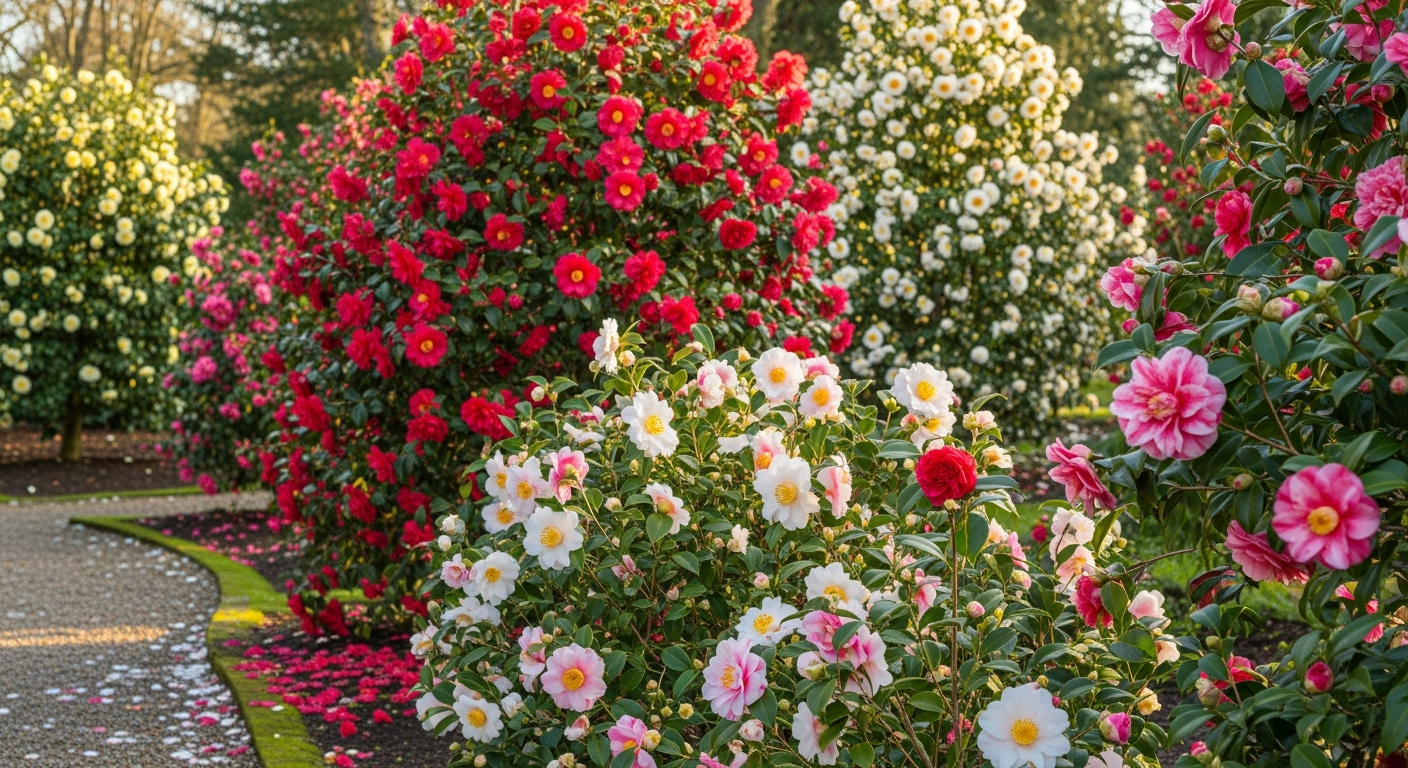

Nearly every camellia grower I’ve talked to over the years operates on the same shorthand: “camellias bloom in winter.” It’s tidy, it’s memorable, and it’s wrong for at least two-thirds of the camellias you’re likely to plant. The truth is far messier and far more useful — this genus spans a flowering window that stretches from the tail end of summer clear into spring, and which piece of that window your shrub occupies depends almost entirely on which species you’re growing. Miss that distinction and you’ll misread a perfectly healthy, on-schedule plant as a failure. The glossy evergreen foliage sticks around all year regardless, but the flowers — the whole reason most of us fell for this plant in the first place — follow a calendar that shifts dramatically by type. Sorting out that calendar is the difference between a garden with one short burst of color and one that stays lit up for months at a stretch.
When Each Camellia Type Actually Opens Its Flowers
If you garden with camellias long enough, you’ll end up growing some combination of Sasanqua, Japonica, and Reticulata — the three workhorse species behind most of what’s sold at nurseries — and each keeps its own private schedule. Once you’ve got that timeline memorized, you can stagger plantings across your beds so there’s rarely a stretch of the cold season without something in flower.
Sasanquas jump the gun on the rest of the family, unfurling their flowers as early as September and carrying on through November across most temperate climates. I remember the first time I saw my ‘Yuletide’ Sasanqua burst into bloom, its cheerful red flowers lighting up the garden when everything else was still drab. The blooms themselves run smaller and daintier than their relatives’, arriving in white, pink, and red with a scent that’s more whisper than statement. They also shrug off cold better than the other main types and, unlike Japonicas, can handle a good dose of morning sun — which makes them the natural pick for a bed that catches early light.
Japonicas are the ones people picture when they hear “camellia” — structured, symmetrical, unmistakably formal. My ‘Debutante’ Japonica, with its soft pink blooms, never fails to impress my neighbors as it flowers from December into March. These beauties produce blooms that dwarf a Sasanqua’s: heavily petaled, larger in diameter, and available in white, pink, red, and various bicolor patterns. They lean toward dappled shade rather than open sun and can’t quite match a Sasanqua’s cold tolerance, but there’s a payoff — once a Japonica flower opens, it tends to hang on longer and shrugs off cold snaps better than you’d expect.
Reticulatas save the drama for last, flowering from January through April with blooms so large and elaborate they barely look real. My ‘Spring Festival’ Reticulata, with its massive peony-like flowers, is the showstopper in my garden. They’re also the most tender of the three, generally needing warmer regions or a sheltered microclimate to thrive, so plenty of gardeners in colder zones simply can’t grow them outdoors year-round. Where conditions allow, though, the reward is enormous — semi-double and peony-form flowers in saturated reds, pinks, and whites that make the extra fussing worthwhile.
How Correcting Soil pH Brought My Sasanquas Back on Schedule
Camellias need acidic soil to flower properly, and once pH creeps upward, they respond by either withholding blooms entirely or opening them late and thin. I fought this exact problem for two full seasons with my Sasanquas before I traced it back to my garden’s stubbornly neutral soil. I still remember the disappointment of watching my ‘Setsugekka’ Sasanqua, usually so reliable, produce only a handful of blooms.
The comfort zone for most camellias sits between 5.5 and 6.5 on the pH scale. Push the soil toward neutral (7.0) or beyond, and bud formation starts to falter — the roots simply can’t pull in the micronutrients required for flowering, so the plant redirects its energy into leaves instead. Sasanquas feel this shift more acutely than Japonicas do, which is part of why mine reacted first.
Resist the urge to amend blindly — test the soil first. Either a basic home kit or a lab analysis through your local extension office will tell you precisely where your numbers stand. I learned this the hard way, spending both time and money treating soil that, as it turned out, never needed the treatment. The frustration of watching my efforts yield no results still lingers.
Once a pH problem is confirmed, work an acidifying amendment into just the top 3–4 inches of soil around the plant’s drip line. Top-dressing beats digging every time with a camellia already in the ground, since their roots stay shallow and fibrous and don’t take kindly to disturbance. Finish with a deep watering so the amendment settles in and starts doing its job.
What paid off
- My fall-blooming Sasanquas set visibly more buds within a single growing season of amending the top layer of soil.
- No need to dig up or replant anything already established — a simple top-dressing around the drip line did the trick.
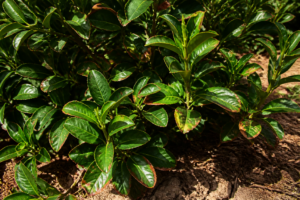
- Foliage shifted from a washed-out pale green to the deep, glossy color that tells you a camellia is thriving.
What fell short
- Don’t expect overnight results — it took roughly 2–3 months of steady watering before the pH shift actually showed up in the blooms.
- Skipping the soil test first is a gamble; I found that out by pouring money into amending a bed that was already fine.
Designing a Camellia Bed That Stays in Bloom All Season
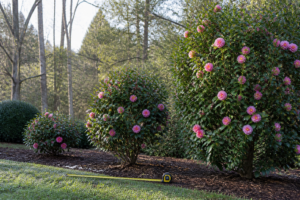
With the flowering calendar in hand, you can now build a planting plan that keeps blooms coming from September clear through April. Anchor the fall stretch with Sasanquas, fill the winter gap with a handful of Japonica varieties, and, climate permitting, close things out with a Reticulata or two for a late-season spectacle. My ‘Nuccio’s Gem’ always jumps in right when I need a winter pick-me-up.
Even within a single species, timing varies by cultivar. ‘Yuletide’ Sasanqua flowers ahead of ‘Setsugekka,’ for instance, and among Japonicas, ‘Nuccio’s Gem’ comes in noticeably later than ‘Debutante.’ Combining early and late cultivars within a type stretches your bloom window even further.
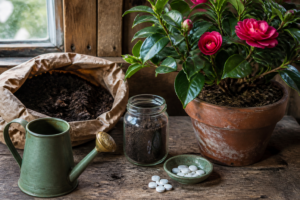
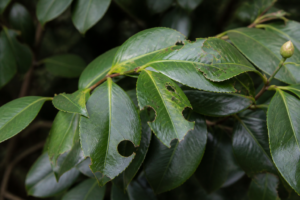
Correct soil pH matters, but it’s only part of the equation — camellias also want steady moisture, afternoon shade (Japonicas especially), and enough airflow around the foliage to keep fungal problems at bay. A layer of mulch helps hold roots cool and acidic, and it’s worth easing off fertilizer in late summer, since a heavy feeding then pushes the plant toward leaf growth instead of the flower buds you’re after. I learned this the hard way when an overzealous dose of fertilizer left my Japonicas leafy but bloom-less.
I almost gave up on that underperforming Sasanqua and ripped it out before one more season of amendment made all the difference. Grab an acidic soil amendment and test your soil first—it’s worth the small upfront effort.
About This Article

Written by Helen Pritchard. Helen Pritchard is a lifelong gardener in the Pacific Northwest who has grown more than 200 named camellia cultivars over two decades. She writes practical, experience-based guides to camellia care, from variety selection and pruning to troubleshooting yellowing leaves and bud drop. More about this site.
Verify this against a primary source
Specifics change, and your situation may differ from the one described here. These are the authorities worth checking directly:
- American Camellia Society — cultivar registration and culture guides
- USDA Plant Hardiness Zone Map — zone verification for your location
- Royal Horticultural Society — camellia cultivation and pest guidance