Ten years ago, I stood beneath my oldest camellia—a magnificent ‘Donation’ japonica that had dominated a shady corner of my garden since before I bought the house—and felt a twinge of guilt. Here was this architectural marvel, heavy with rose-pink blooms every winter, and directly beneath it was bare, compacted earth. Not a single thing grew there. I’d tried everything haphazardly over the years: hostas that turned crispy brown by midsummer, ferns that simply gave up, even a half-hearted attempt at shade-loving astilbe that languished despite my best efforts.
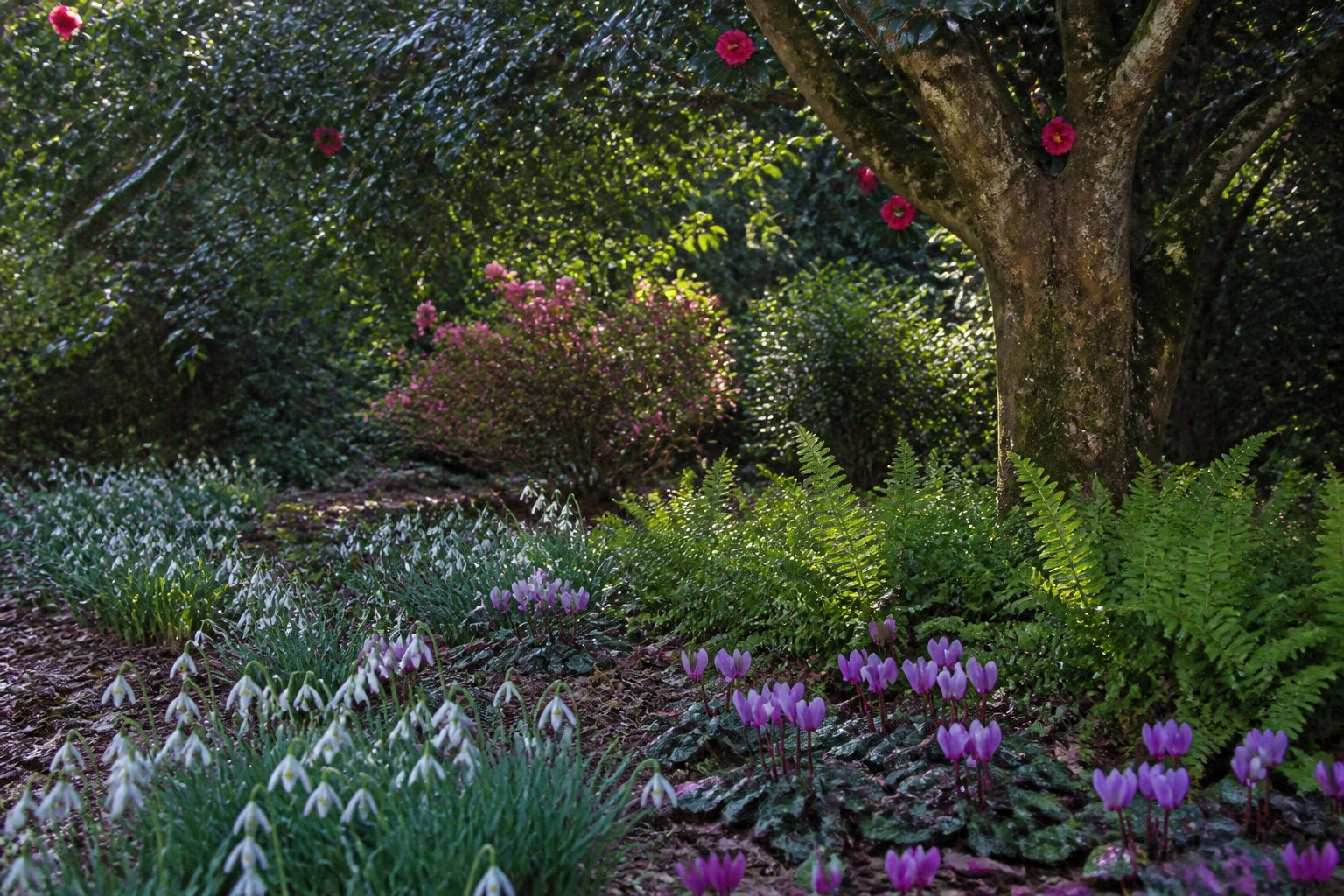
That’s when I realised I wasn’t failing the space—I was fighting camellia biology. Once I understood what was actually happening under that canopy, everything changed. Now, the same area is alive with winter snowdrops, delicate cyclamen, and fragrant sarcococca tucked into corners. It transformed from wasted ground into one of my favourite garden moments each year.
If you have a mature camellia and an empty patch of shade beneath it, you can absolutely underplant camellia successfully. It just requires understanding the specific challenges—and knowing exactly which plants have already solved them. Let me share what I’ve learned.
Why Underplanting Mature Camellias Is Tricky (But Worth It)
Camellias aren’t cooperative neighbours for most plants. Their root systems sit high and dense—typically between 8 and 18 inches deep—which means they’re competing aggressively for every drop of moisture and nutrient in that upper soil zone. You can’t dig deep beneath a camellia without hitting roots almost immediately.
Beyond the root tangle, there’s the shade problem. Camellia canopies don’t create dappled, filtered light. They create proper dry shade—the kind where rain barely penetrates and the soil stays consistently parched, except perhaps in very wet seasons. Most plants find this combination unbearable: dry soil, heavy shade, and root competition all at once.
Then there’s the soil chemistry. Camellias thrive in acidic conditions, typically between pH 5.5 and 6.5. That preference isn’t negotiable. Any underplanting scheme needs to respect the same range—which automatically rules out a huge number of common shade plants that prefer neutral or slightly alkaline soil.
So why bother? Because the plants that do handle these conditions earn their place spectacularly. There’s something genuinely magical about watching snowdrops and cyclamen emerge through the leaf litter just as camellia buds begin to show colour. The visual payoff transforms that bare zone into a proper garden room, not a gap you apologise for. Once established, these underplants ask almost nothing of you—they’re truly the low-maintenance solution to a tricky space.
The Rules Before You Plant Anything Beneath a Camellia
Before I describe what to plant, let me be crystal clear about how to actually do it safely. I learned these rules through mistakes, not textbooks.
Rule One: Leave the collar zone bare. Never, ever plant right up against the camellia trunk. Leave a clear 30–45 cm circle of bare soil around the base. Camellias despise collar rot, and any mulch or plant material piled against the trunk creates the exact damp conditions that invite fungal disease. Start your underplanting at the drip line—where the canopy edges end and rainfall would naturally fall.
Rule Two: Work between roots, not through them. Forget the spade. When I underplant an established camellia, I use a hand trowel and patience. I gently excavate only what I need, positioning new plants in the gaps between surface roots rather than breaking through the root mat. Disturbing camellia roots is asking for trouble—it stresses the tree and can invite disease.
Rule Three: Mulch thoughtfully. Pine bark and leaf mould are my choices. They conserve moisture in the dry shade zone and slowly acidify the soil—reinforcing the camellia’s preferred chemistry. Spread mulch 5–7 cm deep, but always leaving that bare collar zone. Refresh it annually.
Rule Four: Accept that this is a dry-shade garden. Once your underplants are established, they should not need regular supplemental watering. If you find yourself watering the zone beneath your camellia more than once a month in the growing season, you’ve either chosen plants that don’t actually like dry shade, or you’re watering the camellia itself (which is fine, but water at the edges, not under the canopy where you’re trying to garden).
Best Bulbs to Plant Under Camellias
Bulbs are my entry point for underplanting because they solve the timing problem beautifully. Plant them in autumn, and they emerge just as camellias come into flower. The effect feels choreographed.
Snowdrops (Galanthus) are non-negotiable. I planted these beneath my ‘Yuletide’ sasanqua eight years ago, and they’ve naturalised so happily I barely think about them. They flower January through February, perfectly timed with early sasanqua and japonica blooms. Snowdrops love dry shade and acid soil. Plant them 7–10 cm deep in clusters of at least ten—they’re not impressive as singles. ‘Flore Pleno’ and ‘Samuel Arnott’ are my varieties of choice.
Winter aconite (Eranthis hyemalis) blooms almost simultaneously with snowdrops. Bright yellow cups above ferny foliage, they create cheerful contrast. Soak the tubers overnight before planting—they’re notoriously dry in the bag. Plant 5–8 cm deep. Once happy, they’ll self-seed modestly, which I consider a bonus.
Species cyclamen—specifically Cyclamen coum—is my secret weapon for establishing permanent colour. Unlike hybrid cyclamen, which can be fussy, Cyclamen coum naturalises under shrubs and thrives in exactly the dry shade conditions camellias create. Flowers bloom January through March. Foliage is attractive even when flowers aren’t present. Plant tubers with the flatter side down, barely covered, in autumn. They self-seed after a few years, and that’s when the magic really happens.
Dwarf iris—particularly Iris reticulata—blooms early and compactly. They reach only 15–20 cm tall, so they won’t crowd your underplanting scheme. Plant them 8–10 cm deep. I especially love ‘Katharine Hodgkin’, which has blue and gold colouring that echoes some camellia tones.
Small tulip species like Tulipa sylvestris work where big hybrid tulips fail. Here’s where I’ll mention a lesson from my mistakes: I tried planting standard Darwin Hybrid tulips under my ‘Donation’ years ago. The competition for water was fierce, and they ended up spindly and disappointing. Species tulips are different. They’re smaller, more refined, and their root systems are less demanding. Tulipa sylvestris has delicate yellow flowers and actually prefers dry conditions. Plant 10–12 cm deep.
The rule with all these bulbs: plant in clusters, not scattered singles. Twelve snowdrops planted together create an impact. Twelve scattered across the zone disappear.
Shade Shrubs That Will Grow Well Under a Camellia Tree
Shrubby underplanting is where the real architecture happens. These are the plants that create structure and interest year-round, not just seasonal flashes.
Azaleas are natural companions. They share camellia’s passionate requirement for acid soil and bloom at similar times—sasanqua camellias and early azaleas can overlap beautifully. Choose dwarf or compact cultivars: I use ‘Hino Crimson’ and ‘Kermesina Rose’ beneath taller camellias. They won’t outcompete the canopy overhead, and their shallow roots sit at the same level as established camellia roots, so there’s less disruption. Dwarf azaleas top out around 1–1.5 metres, which is the sweet spot for underplanting.
Pieris japonica (sometimes called andromeda) is exceptional. It loves the acid soil camellias demand and produces hanging panicles of white, pink, or red flowers in early spring. The new foliage is often copper-red, adding colour contrast. Plant it 1–2 metres away from the camellia trunk, not directly beneath. It can reach 3 metres tall, so place it thoughtfully—perhaps at the edge of your underplanting zone rather than central to it.
Sarcococca (Christmas box) is my absolute secret weapon for dry shade. I have three plants in my gardens, all tucked into corners where almost nothing else survives. Sarcococca thrives in dense shade and poor, dry soil. It blooms January through February with the most intoxicating fragrance—delicate, sweet, almost unbelievable from such a small flower. The flowers aren’t showy, but their scent transforms the garden. Foliage is neat and tidy year-round. It’s genuinely the plant that made me realise underplanting camellias could be easy.
Small rhododendrons work beautifully too. Plant compact varieties like ‘Ramapo’ (purple, 60 cm tall) or ‘Scarlet Wonder’ (red, 60–90 cm tall). Again, they love acid soil and shade. Space them 1.5–2 metres apart to avoid crowding. Their shallow roots typically sit above camellia roots, which reduces direct competition.
Hellebores deserve a mention despite not being true shrubs. They’re semi-woody perennials that bloom January through March, often coinciding with japonica camellias. Helleborus niger (Christmas rose) and Helleborus × hybridus (Lenten rose) both tolerate dry shade once established. Plant them 45–60 cm apart. They’re particularly valuable because the flowers face downward—plant them where you’ll see them from above or below for maximum impact.
Plants to avoid: hostas, ferns, and anything that demands consistent moisture. I tried a substantial hosta collection under a camellia in zone 8a. Despite afternoon irrigation, they scorched and declined within two seasons. Ferns have similar problems in dry shade unless you’re willing to water supplementally. If you love these plants, grow them elsewhere and accept that the camellia’s shadow isn’t their space.
Ground Covers for Under a Camellia
Ground covers are the connective tissue that ties bulbs and shrubs together. They fill space, suppress weeds, and create visual continuity.
Epimedium (barrenwort) is my number-one pick for underplanting established camellias. I’ve trialled dozens of ground covers, and epimedium is the only one I unreservedly recommend beneath mature trees. Why? It’s drought-tolerant, acid-loving, spreads slowly without becoming invasive, and produces delicate flowers in late winter and spring. The foliage emerges bronze, matures to green, and often turns coppery in cool weather. Many varieties tolerate deep shade. I use Epimedium × rubrum (red flowers) and Epimedium pinnatum subsp. colchicum (yellow flowers) beneath my oldest camellias. Plant divisions 30–45 cm apart. They’ll fill the space within three years without requiring division or supplemental water once established.
Mondo grass (Ophiopogon japonicus) is more of a structural element than a colour provider. It creates neat, grass-like mounds of dark foliage and tolerates deep dry shade remarkably well. Space plants 15–20 cm apart. It spreads slowly, so patience is required, but it’s genuinely low-maintenance once established. The cultivar ‘Nigrescens’ has almost black foliage—striking beneath pale camellia flowers.
Japanese forest grass (Hakonechloa macra) works in dappled areas beneath camellias with lighter canopies. It needs slightly more moisture than mondo grass, but still performs well in dry-shade conditions. The golden cultivar ‘Aureola’ provides brightness beneath darker camellias like ‘Black Lace’ or ‘Midnight’. Space plants 45–60 cm apart and let them mound outward.
Sweet woodruff (Galium odoratum) suits moister pockets within your camellia’s shade zone. Its tiny white flowers appear in late spring, and the foliage smells delightful when brushed. I plant it around drip points where moisture naturally collects. It self-seeds modestly—I consider this beneficial, as it finds its own preferred microclimates. Space plants 30 cm apart initially.
Creeping Jenny (Lysimachia nummularia ‘Aurea’) provides colour contrast beneath dark-foliaged camellias. The golden foliage brightens shadowy corners. It tolerates dry shade well, though it performs even better with slightly moister soil. I restrict it to areas where I don’t mind it wandering slightly—it’s persistent without being uncontrollable. Space 30–45 cm apart.
My Favourite Underplanting Combination
After twenty years of trial and error, I’ve settled on a three-plant formula that works reliably beneath every mature camellia in my collection. It’s simple, it’s elegant, and it requires almost no maintenance once established.
Layer One: Epimedium as the structural carpet. Plant epimedium 30–45 cm apart across the entire zone (remembering to leave that collar space clear). Within three years, it will cover bare ground, suppress weeds, and provide year-round interest. The flowers are bonus.
Layer Two: Species cyclamen for autumn and winter colour. Plant Cyclamen coum tubers through the epimedium in scattered clusters. They’ll bloom when the camellia is at its peak, creating a visual conversation between the two plants. As the cyclamen self-seed, they’ll naturalise and deepen the effect.
Layer Three: Sarcococca tucked into corners. Plant one sarcococca plant somewhere within the underplanting zone—ideally where you’ll walk past regularly. The fragrance is transformative. It won’t create visual drama, but it makes the space feel secret and luxurious.
That’s it. Three plant types, all acid-loving, all drought-tolerant once established, all blooming within the winter–early spring window. The epimedium is your insurance policy—it will establish successfully and create the foundation for everything else. The cyclamen add magic. The sarcococca adds soul.
Plant the epimedium first and let it settle for a season. Add the cyclamen tubers and sarcococca the following autumn. By year two, you’ll have a thoughtfully layered underplanting that looks intentional and feels abundant without requiring monthly maintenance.
The Payoff
Underplanting a camellia transforms how you experience that tree and that garden space. Instead of looking down at bare earth, you’re looking at flowers, foliage textures, and fragrance. The camellia becomes part of a composed garden room rather than an isolated specimen.
The plants I’ve described here—epimedium