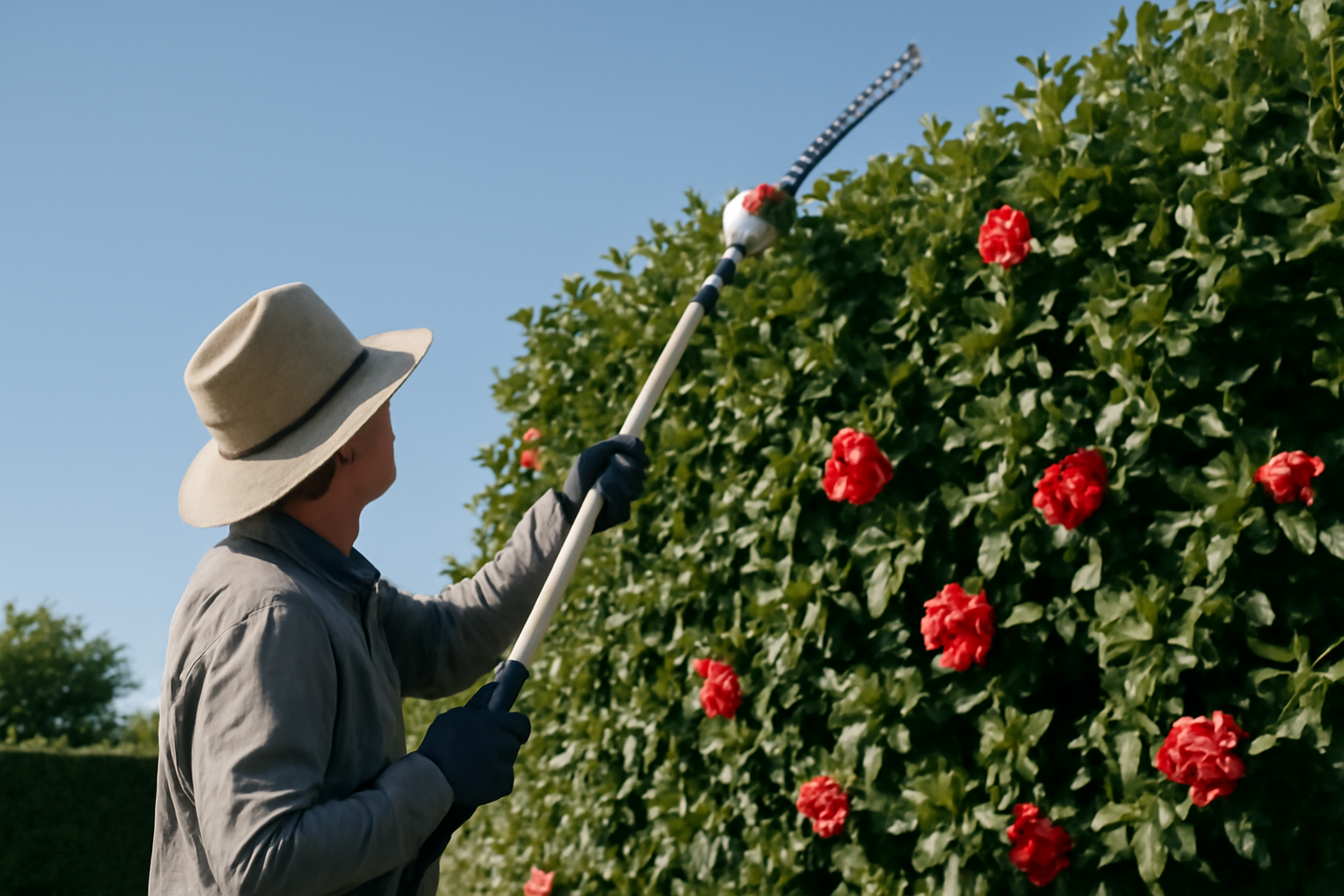
The morning I finally admitted defeat, I was staring at bare, leggy wood at the base of my ‘Kramer’s Supreme’ row — trunks thicker than my wrist, no foliage below eye level, and a canopy so far overhead I couldn’t tell how many buds had set until I hauled out binoculars. That’s when it hit me: two decades of routine autumn trims had quietly turned a tidy Camellia japonica hedge into a ten-foot wall I could no longer manage with the tools I’d always used. Ladders wobbled on the uneven ground, my shoulders ached after every session, and unopened blooms kept dropping to the mulch before I’d even finished. What I needed wasn’t the light seasonal shaping that suits a hedge that’s stayed under control — it was equipment built for a hedge that had genuinely spiraled past reasonable bounds.
My growing conditions span USDA zones 7b and 8a along the coastal Southeast, and my plantings mix japonicas, sasanquas, and a handful of reticulatas. Three japonica cultivars — ‘Kramer’s Supreme,’ ‘Debutante,’ and ‘Professor Sargent’ — make up the backbone of my main formal hedge, which by now stretches roughly forty feet and stands around eleven feet at its tallest. Cutting that length by hand with an ordinary trimmer used to mean climbing up and down a ladder upward of thirty times in a single afternoon. Every repositioning left me a little more nervous about my footing.
The Point Where a Camellia Hedge Stops Being Tidy and Starts Being a Renovation Project
A hedge that gets a quick yearly shape-up is nothing like one that’s spent a decade and a half growing well beyond anyone’s original plan — mine falls squarely into the second category. Fifteen years of layered growth leaves thick wood at the base, a snarled mess of dead and crossing branches inside where sunlight never reaches, and a top that’s simply too high to work safely from ground level. None of that calls for the methods that suit a well-kept hedge that’s never gotten out of hand — that’s a separate subject I’ve already walked through in my general guide to using a hedge trimmer on camellias, where I cover timing and the basic set of tools. Here I want to focus narrowly on what shifts once a hedge reaches the state mine was in: too tall, too thick, and long overdue for attention.
Here’s the encouraging part: camellias handle severe renovation cuts far better than most gardeners assume, sprouting back reliably from old wood even after a hard cutback. The tricky part is that a hedge this size and age comes down more safely across several seasons than in one dramatic session. Cutting the entire forty-foot run to bare wood at once would mean sacrificing nearly every bloom for a year, maybe two, while it rebuilds. Instead, I’m tackling mine in thirds: right after flowering wraps up each year, I take out the oldest, heaviest trunks from one section with thinning cuts — which encourages fresh growth lower on the plant — while leaving the remaining two-thirds untouched so it can still flower that season. The process takes longer, but I’m never left looking at a completely bare, flowerless hedge through an entire winter.
Height Versus Density: Why One Tool Can’t Handle Both
A mature, overgrown hedge like mine hands you two separate tool challenges at once, and no single trimmer can address them both.
First there’s height. At eleven feet, the top of my hedge sits well beyond anything I can safely reach standing on the ground — and that’s purely a matter of reach, since the growth up there is typically the same slender, current-season wood found on any camellia, just suspended eight or nine feet in the air. A pole hedge trimmer handles this cleanly, and that’s exactly why I bought one.
Then there’s density, and this is the part people tend to overlook when a hedge has been left unattended for years. The majority of cordless pole hedge trimmers — including 20V versions with an 18-to-23-inch head like the one I use — are engineered for slim annual growth, generally topping out around three-quarters of an inch in diameter. A hedge without renewal cuts for a decade or longer builds up wood far beyond that threshold, both near the base and inside the shaded interior, where old growth thickens year after year from being sheared at the surface alone. Push a pole trimmer into wood like that and it won’t cut cleanly — it crushes and tears, leaving rough wounds that heal slowly and invite disease. That job belongs to loppers or a folding pruning saw, never the pole attachment.
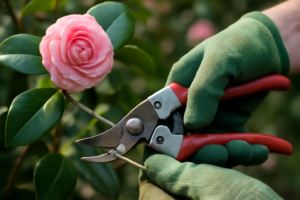
Which is why my real toolkit for this hedge isn’t a single trimmer — it’s three tools working together: the pole trimmer for shaping the surface at height, loppers for the mid-size wood I encounter deeper inside, and a folding pruning saw for anything too thick for the loppers to bite through cleanly. Try to handle this entire job with nothing but a hedge trimmer, pole-mounted or otherwise, and you’ll end up with something that looks fine from six feet away but is riddled with crushed, dying stubs once you get close.
The Pole Trimmer That Got Me Off the Ladder for Good
Once a camellia hedge pushes past ten feet, a handheld trimmer paired with a ladder turns into a genuine hazard. I needed a way to reach that top growth without teetering on shaky aluminum rungs while trying not to knock off next season’s buds.
Where It Delivered
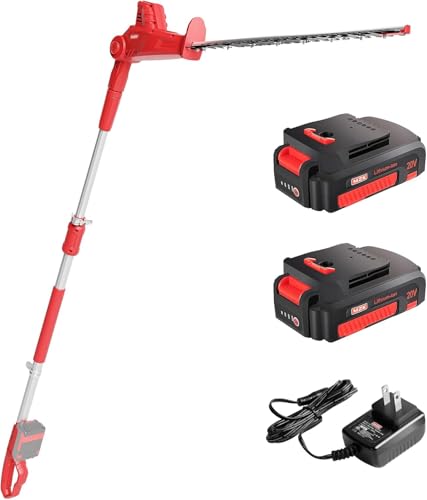
- That 18-inch head stretches comfortably up to the ten-foot line while my feet stay planted on solid ground — no ladder, no multi-day shoulder ache.
- Battery power carried me through the whole hedge in a single go, sparing me the mess of a gas can or the tangle of a cord weaving through dense camellia branches.
- The blade cuts cleanly enough to shape without tearing the glossy foliage, and this round I kept most of the forming flower buds intact — at least on the thin, current-season growth up top that it’s meant for.
Where It Fell Short
- Holding it overhead for twenty straight minutes adds up faster than I expected — by the second hour, my arms were clearly done.
- Getting a clean angle on the sides of a thick hedge takes some awkward maneuvering, and you sacrifice the control a two-handed handheld trimmer offers.
- It’s useless against the thick old basal wood a long-neglected hedge builds up — I learned that the hard way trying to force it through a trunk near the base instead of grabbing the loppers.
I questioned whether the battery would actually last long enough and whether I’d end up back on a ladder halfway through, but it didn’t. MZK 20V MAX 23-inch Cordless Pole Hedge Trimmer Attachment
How I’m Bringing This Hedge Back Down, and the Safety Lessons Along the Way
I’m currently about a third of the way through cutting this hedge back to something manageable. Each year, once the japonicas finish flowering, I run the pole trimmer over whatever sections aren’t up for renovation that season, then switch to loppers and the pruning saw to remove the oldest trunks from the section I am reworking. Progress is slow. But two-thirds of the hedge still blooms every winter instead of none, and within another couple of years the whole thing should settle into a height and thickness I can maintain with ordinary shaping instead of major surgery.
A handful of habits have changed now that the hedge towers this high, things I never thought about when it was chest-level: I won’t raise the pole trimmer above shoulder height unless someone else is nearby, because debris falling from eleven feet is far riskier than debris falling from a four-foot hedge. I wear actual eye protection now, not just sunglasses, since dense old wood kicks off splinters the moment the saw finally cuts through it — something thin annual growth never does. And I quit trying to finish all forty feet in one sitting; spreading the work across three or four shorter sessions in a week keeps my arms working and lets me actually watch what I’m cutting instead of racing against the fading light.
If there’s one takeaway here: a hedge trimmer, whether pole-mounted or not, is exactly right for surface work on a tall hedge. It cannot replace hand tools once thick, neglected wood is hiding beneath that surface. Carry both, or you’ll find yourself back on that ladder regardless.
About This Article

Written by Helen Pritchard. Helen Pritchard is a lifelong gardener in the Pacific Northwest who has grown more than 200 named camellia cultivars over two decades. She writes practical, experience-based guides to camellia care, from variety selection and pruning to troubleshooting yellowing leaves and bud drop. More about this site.
Verify this against a primary source
Specifics change, and your situation may differ from the one described here. These are the authorities worth checking directly:
- American Camellia Society — cultivar registration and culture guides
- USDA Plant Hardiness Zone Map — zone verification for your location
- Royal Horticultural Society — camellia cultivation and pest guidance