I spent fifteen years buying camellias labelled “compact” at garden centres, only to watch them sprawl into six-foot monsters that swallowed my borders. That’s when I learned the hard way: camellia sizing is gloriously confusing, and the tag doesn’t always tell you what you really need to know.
If you garden in a small space—or if you’re simply tired of aggressive pruning—you need to understand dwarf camellia varieties. The good news? Truly small camellias exist, and they’re wonderful. I’ve spent the last five years deliberately collecting genuinely compact cultivars, and I’m here to share what actually works.
This guide cuts through the marketing noise. You’ll discover which varieties truly stay small, which ones only pretend to, and how to grow them successfully in confined spaces. Let’s talk real numbers, real varieties, and real gardens.
Dwarf vs Compact vs Miniature — What Do These Labels Actually Mean?
Here’s the confusion that drove me mad for years: the term “miniature camellia” has nothing to do with plant size.
In camellia classification, “miniature” refers to flower size only. A miniature camellia produces blooms under 2.5 inches across. But the plant itself can be seven feet tall. I learned this the embarrassing way when I ordered what I thought was a tiny camellia, only to receive a vigorous upright grower with delicate little flowers.
Dwarf is what you actually want if space matters. A true dwarf camellia stays under three to four feet tall, even after ten years of growth. These are your genuine space-savers. Varieties like ‘Baby Bear’ and ‘Tiny Princess’ fit this category.
Compact is trickier. Compact means slower growth and denser branching—tidier than a standard type. But compact isn’t the same as dwarf. A compact camellia might reach six to eight feet after twenty years. That’s still reasonable for many gardens, but it’s not tiny. I learned this distinction the hard way with ‘Kanjiro’, a fantastic compact sasanqua I planted thinking it would stay at three feet. Eight years later, it was six feet wide and needed serious pruning to stay in scale with my borders.
When you shop, ask: “What’s the expected height in ten years?” Not the tag’s vague promise, but actual expectations. That’s how you avoid my mistakes.
The Best True Dwarf Camellia Varieties
These are the varieties I recommend when space is genuinely limited. All measurements are realistic expectations after ten years of growth in average conditions.
‘Baby Bear’ — The Smallest You Can Find
If you want the tiniest camellia available, ‘Baby Bear’ is your answer. This hybrid grows to just one to two feet tall and wide over a decade. It’s genuinely miniature in plant form, not just flower size.
The flowers are pale pink, single, and delicate. They’re modest in size, which suits the compact habit perfectly. I grow mine in a forty-litre terracotta pot on my shaded patio, where it blooms reliably each winter without taking up much real estate.
‘Baby Bear’ excels in rock gardens, alpine troughs, and tight containers. It’s also excellent as an underplanting beneath taller shrubs. The plant has a neat, tidy habit that requires minimal pruning. In my experience, it’s virtually pest-free and unfussy about soil as long as drainage is good.
One note: ‘Baby Bear’ is sometimes hard to find at regular garden centres. I source mine from specialist camellia nurseries. Worth the effort if you have truly limited space.
‘Shi Shi Gashira’ — Helen’s Top Pick for Low Hedging
If I could grow only one compact camellia, it would be ‘Shi Shi Gashira’. This is my absolute workhorse in the garden, and I’ve recommended it to dozens of gardeners over the years.
This sasanqua type grows to three to five feet tall, with a spreading, slightly weeping habit that’s wider than it is tall. The semi-double flowers are a wonderful rose-pink, blooming prolifically from autumn into winter. I’ve never experienced a poor flowering year.
What makes ‘Shi Shi Gashira’ special is its reliability and tidiness. Unlike taller varieties, you actually see every flower without craning your neck. The branching habit is naturally dense and requires minimal training. I use it for low hedging, as a cascading specimen over a low wall, and in containers where I want a mounding shape.
In my zone 8a garden, it’s rock-solid hardy and unfussy. It flowers prolifically even in part shade. The plant is widely available, reasonably priced, and honestly one of the best values in the camellia world.
Other Small Varieties Worth Growing
‘Mine-no-yuki’ (also sold as ‘White Doves’) is another sasanqua type that stays delightfully small. This one grows to two to four feet with a graceful weeping or spreading habit. Semi-double white flowers appear profusely. It’s excellent for low-level interest or cascading over walls. I have one trailing over a low fence, and visitors always comment on how elegant it looks in bloom.
‘Yuletide’ is probably the most widely available compact sasanqua. Single red flowers appear reliably in late autumn. Growth reaches four to six feet, making it very manageable. The plant is vigorous and cold-hardy. Honestly, it’s so common in nurseries because it works beautifully—simple as that.
‘Tiny Princess’ is a japonca-type dwarf with white or pale pink flowers. It’s more compact than standard japonicas, reaching three to four feet in ten years. The flowers are small and single to semi-double. It’s harder to find than ‘Yuletide’, but worth seeking out if you prefer japonica types.
‘Quintessence’ is another compact japonica hybrid worth considering. Small white flowers and tidy growth. It performs well in containers and reaches around three to four feet over time.
Compact (But Not Quite Dwarf) Varieties
These varieties grow larger than true dwarfs, but they’re slower and tidier than standard camellias. If you can accommodate four to six feet, these offer wonderful options.
‘Kanjiro’ is the one I mentioned earlier—my lesson in reading fine print. This semi-double pink sasanqua has a genuinely tidy habit, which is why I thought it would stay small. It does grow tidily, but it reaches four to six feet wide. Now I prune it annually after flowering. If you’re willing to do that, it’s a beautiful cultivar with rose-pink, semi-double flowers.
‘Survivor’ is a compact japonica hybrid with pink flowers. It reaches four to six feet. The real bonus? Cold-hardiness. I grow this in zone 7b and it thrives where standard japonicas sulk. Compact habit plus exceptional hardiness makes it valuable.
‘Nicky Crisp’ is a gem I discovered a few years ago. Orchid-pink flowers, compact habit, reaching four to five feet. Bonus: it’s fragrant. If you want a compact camellia you can smell, this is your cultivar. I’ve linked to my full fragrant camellias guide below.
‘Brushfield’s Yellow’ is one of the most compact yellow-flowered japonicas available. Primrose-yellow anemone blooms appear on a plant reaching four to six feet. The tidy habit means it doesn’t demand constant pruning. It’s excellent for gardeners who want something unusual without sacrificing space-consciousness.
‘Spring’s Promise’ is a softer pink option with peony-form flowers. Compact japonica type. Reaches four to five feet. Lovely for a cottage-garden feel without requiring a massive footprint.
Growing Small Camellias in Containers
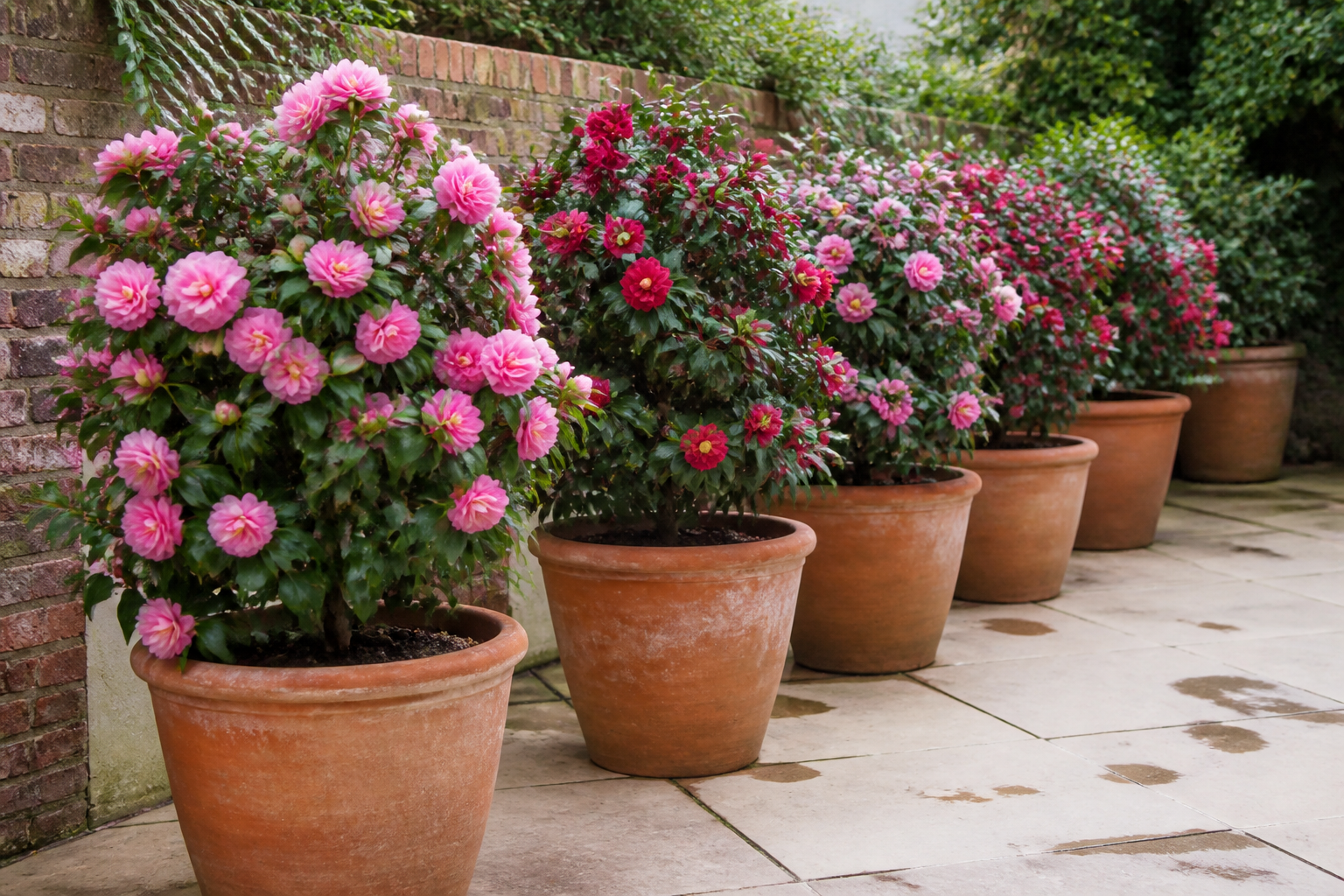
Container growing is where dwarf and compact camellias truly shine. The plant size stays manageable, and you control the blooming height—perfect if fragrance matters.
Use a pot at least forty centimetres in diameter. Larger is better; a fifty-litre container is ideal for varieties like ‘Shi Shi Gashira’. Ericaceous compost is essential. Standard multipurpose composts are too alkaline; camellias need acid soil.
Water with collected rainwater if possible. Tap water works if you don’t have alternatives, but rainwater is genuinely better for lime-sensitive plants. Keep compost consistently moist, never waterlogged.
Repot every two to three years in spring, before new growth starts. Top-dress with fresh ericaceous compost in intervening years. Feed from late winter through midsummer with liquid ericaceous fertiliser. I use a diluted feed every two weeks during the growing season.
One unexpected benefit: containerised camellias bring flowers to nose height. If you’re growing a fragrant variety like ‘Nicky Crisp’, you actually smell it. With standard camellias, beautiful flowers bloom six feet up where you can’t appreciate the perfume. Small potted camellias solve that problem entirely.
Pruning Compact Camellias to Keep Them in Scale
The difference between “compact” and “wild sprawl” is often just pruning. Getting the timing right matters more than you’d think.
Always prune right after flowering finishes. For most varieties, that’s late winter or early spring. Never prune in autumn; you’ll remove developing flower buds. Camellias bloom on last year’s wood, so timing is crucial.
For truly dwarf varieties like ‘Baby Bear’, minimal pruning is needed. Light tip-pruning to maintain shape is sufficient. These naturally compact plants don’t require aggressive cutting.
For compact varieties reaching four to six feet, annual pruning keeps them tidy. I prune ‘Kanjiro’ each spring, removing about a third of new growth and shortening any overly long branches. This keeps it looking intentional rather than overgrown.
Light pruning encourages bushiness. Remove the top few centimetres of young shoots. Avoid cutting back to bare wood unless renovation is necessary. Fresh growth emerges readily from the cut point, creating a denser plant.
A light hand produces better results than aggressive cutting. Camellias respond well to tip-pruning but resent being reduced to stubs. Regular modest pruning beats occasional severe cutting.
Sourcing Reliable Dwarf Camellia Varieties
Here’s my honest advice: buying dwarf camellias requires more care than standard types. Many nurseries conflate “compact” with “dwarf” on their labels. They’re simply wrong.
Specialist camellia nurseries are worth the effort. They understand the distinction between true dwarfs and compact types. Staff can tell you realistic mature sizes. Prices are often comparable to garden centres, and quality is superior.
When you do find a dwarf variety, buy it. True dwarfs like ‘Baby Bear’ aren’t always available. Passing one up means waiting another season. I’ve learned that lesson by missing opportunities.
Ask questions before purchasing. “What’s the mature height in ten years?” If they can’t answer, walk away. A good nursery knows their cultivars intimately.
Final Thoughts: The Right Variety Makes All the Difference
Twenty years ago, I planted standard-sized camellias because I didn’t know better. I’ve spent years pruning them ruthlessly. That taught me: choosing the right size at the start saves enormous effort later.
Dwarf camellia varieties aren’t compromise plants. ‘Shi Shi Gashira’ is as beautiful as any full-sized camellia, just in a more manageable package. ‘Baby Bear’ brings the same winter magic as anything three times its height.
For small gardens, containers, or gardeners who prefer minimal pruning, small camellia varieties are genuinely the right choice. They’re not second-best; they’re smarter gardening.
Take time sourcing these cultivars from specialists. The effort pays back every winter in perfect-scaled blooms and joyful gardening. Your back will thank you, your garden will look intentional, and you’ll finally understand why people love camellias so fiercely.