- Plant in odd numbers. Groups of three, five, or seven camellias of the same cultivar read as intentional and generous. Single specimens can look lonely under a large tree.
- Stagger bloom seasons within the planting. I never plant a block of all sasanquas or all japonicas. I interweave them so that colour moves through the space across different seasons.
- Consider ultimate size. ‘Elegans Champagne’ stays compact and suits small shade gardens. ‘Professor Sargent’ and ‘Francie L’ eventually become large shrubs — give them space from the start.
- Use vertical structure intentionally. Upright-growing japonicas like ‘Berenice Boddy’ can be trained as loose espaliers against a fence or tree trunk, adding height without consuming ground space.
- Plan sight lines from the house. My best shade garden design decision was positioning the earliest-blooming japonicas so
Some of my happiest gardening moments have happened in the dappled shade beneath a stand of old oaks. That is where I first discovered just how perfectly shade garden camellias can transform a difficult, underused space into something genuinely breathtaking. I remember standing under those oaks about fifteen years ago, frustrated by the patchy, moss-riddled ground beneath them, convinced nothing worthwhile could grow there. Then a neighbouring gardener handed me a rooted cutting of Camellia japonica ‘Elegans’ and said, “Put it in the shade. Trust me.” That single plant changed everything about how I design gardens.
Today I grow over 200 named camellia cultivars across three properties spanning USDA zones 7b, 8a, and 8b. A significant number of those plants live happily under tree canopies. In this guide, I want to share exactly how I design and plant camellia shade gardens that deliver colour, texture, and structure across all four seasons — not just the weeks when everything is in bloom.
Why Camellias Are Made for Shade Garden Life
Camellias evolved beneath the forest canopies of East Asia. That is not a romantic detail — it is a genuinely useful piece of horticultural context. In their native habitat, plants like Camellia sinensis (the tea plant) and wild Camellia japonica species grow as understory shrubs, filtered by taller trees above them. As a result, they are fundamentally wired for life with limited direct sun.
In my experience, most camellias actually perform better with four to six hours of filtered or dappled light than they do in full, harsh afternoon sun. Too much direct sun — particularly in zones 8a and 8b — scorches foliage, bleaches flower colours, and stresses roots. However, too much deep shade suppresses flowering significantly. The sweet spot is bright, indirect light under a high canopy. Think open-branched oaks, tall pines, or mature hickories rather than a dense, low-spreading maple.
Which Species Handle Shade Best?
Not all camellias respond equally well to shade. Here is how I think about the main groups:
- Camellia japonica cultivars — These are the most shade-tolerant of the lot. Varieties like ‘Elegans,’ ‘Professor Charles S. Sargent,’ and ‘Magnoliaeflora’ thrive under my oaks with minimal fussing. They bloom late winter through early spring, bridging a quiet gap in the shade garden calendar.
- Camellia sasanqua cultivars — Slightly more sun-hungry than japonicas, but many still perform well in part shade. I grow ‘Setsugekka,’ ‘Yuletide,’ and ‘Cleopatra’ along my woodland edge where morning sun comes through. They bloom autumn into early winter — invaluable for the shade garden.
- Camellia reticulata cultivars — These are the divas. Large, spectacular flowers, but they need more light than the others. I keep my ‘Francie L’ and ‘Captain Rawes’ plants on the shadier side of open, not truly under canopy. In zone 8b, this works reasonably well.
- Interspecific hybrids — Varieties like ‘Winter’s Star’ and the Ackerman hybrids are tough, adaptable, and handle part shade admirably. Many are also hardy into zone 6b, which opens up shade garden possibilities for northern gardeners.
Designing Your Shade Garden with Camellias: A Seasonal Framework
The real design challenge in a shade garden is not finding plants that survive — it is building genuine year-round interest. Camellias solve a huge part of that puzzle on their own, because their bloom seasons stack so conveniently. However, you need a framework before you start placing plants.
I always start by mapping the light. I walk the space four times: morning, midday, afternoon, and evening. I note where sun patches move, where it stays consistently dim, and where reflective light bounces off nearby walls or fences. This takes one full day, but it saves years of replanting mistakes. Specifically, I use this information to designate zones — brighter edges for sasanquas, deeper pockets for japonicas, transition areas for hybrids.
Autumn: Let Sasanquas Lead the Way
In my shade gardens, autumn belongs to the sasanquas. From October through December, varieties like ‘Setsugekka’ (white, semi-double, fragrant) and ‘Yuletide’ (bright red single, incredibly reliable) carry the display. I plant them along the brighter woodland edges where they catch more light.
‘Cleopatra,’ with its semi-double rose-pink flowers, is another favourite for this slot. It tolerates slightly more shade than most sasanquas. I use it as a bridge planting between the sunny edge and the deeper interior of my oak garden. Transition plants like this are the secret to a design that feels cohesive rather than patchy.
Winter and Early Spring: Japonicas Take Over
From January through April, Camellia japonica cultivars dominate my shade garden. This is peak season for the group, and the timing is extraordinary. They bloom when almost nothing else does.
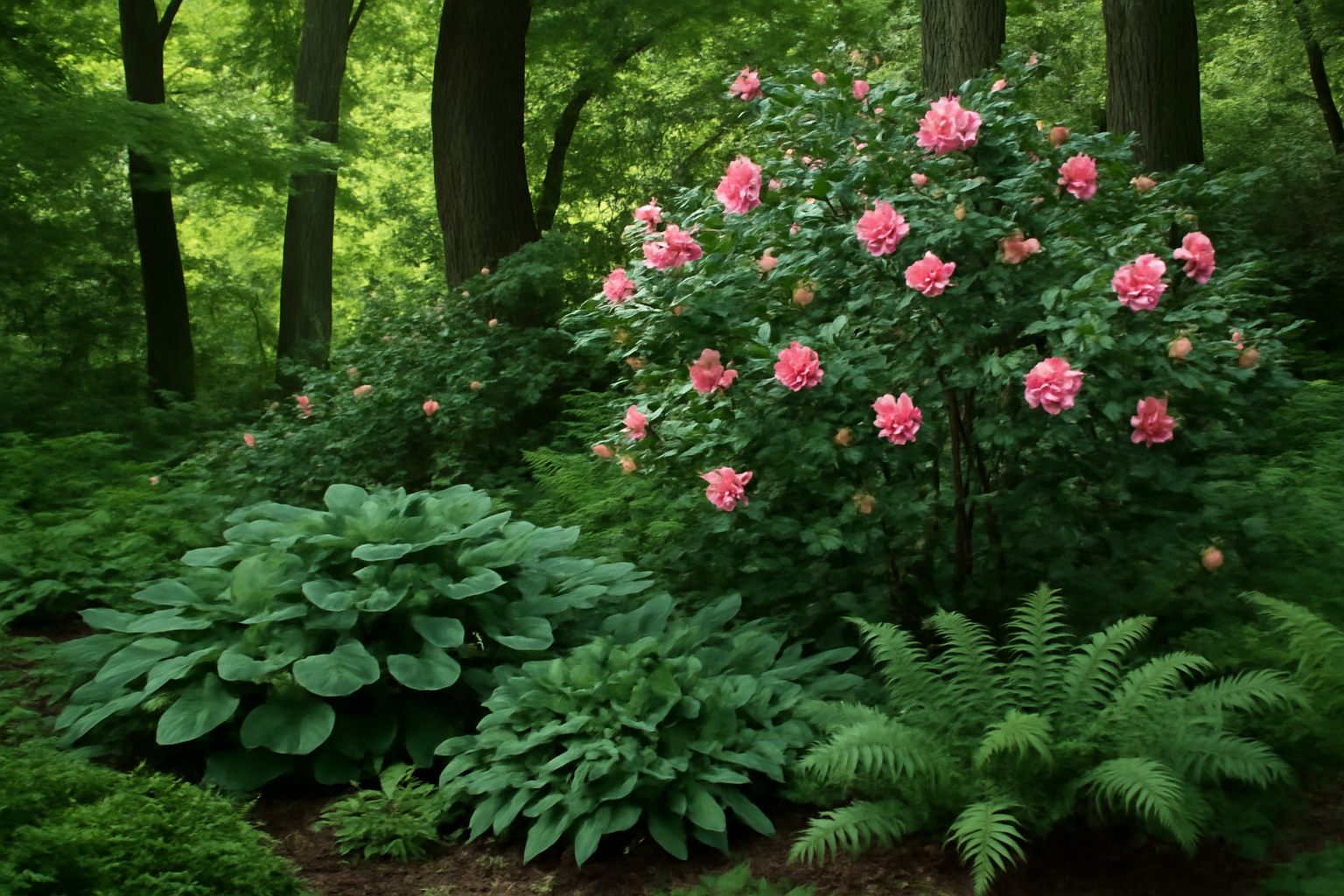
For deep shade positions, I rely on ‘Professor Charles S. Sargent’ — a dark red, formal double that is virtually bombproof under my densest oaks. For middle-ground positions, ‘Elegans’ (a soft pink anemone-form) and ‘Berenice Boddy’ (light pink semi-double) give months of colour. For the palest, most luminous effect in filtered light, I plant ‘Magnoliaeflora’ — a blush-pink semi-double that almost glows on a grey winter day.
In zone 7b, I pay careful attention to bloom timing. Early-flowering japonicas can be damaged by late frosts. For exposed shade gardens in that zone, I lean toward mid-season to late cultivars like ‘Easter Morn’ and ‘Hagoromo.’ They consistently miss the worst cold snaps.
Summer and Beyond: Foliage as the Hero
Here is the honest truth about summer in a camellia shade garden: camellias are not blooming. However, that is absolutely fine — if you have planned for it. The glossy, deep-green foliage of mature camellias is genuinely beautiful in its own right. It creates a lush, cool backdrop that makes every companion plant look better.
Summer is also when I appreciate the structural variety between my cultivars. The large, bold leaves of reticulata types contrast beautifully with the finer-textured foliage of sasanquas. New growth flushes — often bronze or coppery red — add unexpected colour interest from May through July.
Companion Planting for Shade Garden Camellias
No camellia garden should exist in isolation. The most successful designs I have created pair camellias with companions that fill seasonal gaps, add textural contrast, and share the same cultural requirements. Specifically, you want companions that also prefer acidic, well-drained soil in the pH range of 5.5 to 6.5.
These are my most-used companion plants beneath trees alongside camellias:
- Hydrangea macrophylla and serrata — They love similar conditions, fill the summer gap magnificently, and tolerate root competition from trees if given good compost and consistent moisture.
- Japanese forest grass (Hakonechloa macra) — The golden-lime colour of ‘Aureola’ is electric against dark camellia foliage. It thrives in moderate to heavy shade.
- Hellebores (Helleborus orientalis hybrids) — These bloom from late winter into spring, overlapping perfectly with japonicas. Together they create a remarkable late-winter display.
- Native ferns — Southern shield fern and Christmas fern work brilliantly in my zone 7b and 8a gardens. They fill ground-level gaps, suppress weeds, and need almost no attention.
- Mahonia — Winter-blooming, shade-tolerant, and acid-loving. ‘Soft Caress’ is an elegant, fine-textured choice that bridges the sasanqua and japonica seasons beautifully.
I wrote more about pairing plants with camellias in my companion planting post, which goes deeper into shade-layer combinations if you want to explore further.
Soil Preparation Under Trees: The Part Everyone Gets Wrong
This is where I need to be blunt. Planting camellias under mature trees without proper soil preparation is the single biggest mistake I see new camellia gardeners make. I made it myself early on, and it cost me two plants and two years of frustration.
Under an established tree, you are competing with a vast, fibrous root system that aggressively absorbs water and nutrients. The soil is often compacted, nutrient-depleted, and sometimes too alkaline from years of leaf decomposition building an alkaline duff layer. None of that suits camellias.
My Soil Preparation Method
Rather than digging deep holes and fighting tree roots, I build up. I create raised planting mounds or island beds using a mix of quality topsoil, composted pine bark, and acidic compost. I aim for a minimum depth of 18 inches of improved growing medium. This gets camellia roots above the worst of the tree root competition and gives excellent drainage — essential, since camellias absolutely hate waterlogged roots.
I also test soil pH before planting anything. My target is 5.8 to 6.2 for camellias — slightly more acidic than the broader 5.5 to 6.5 range often quoted. If pH is above 6.5, I amend with granular sulfur and acidic compost. I retest after six weeks. This step is not optional. High pH causes chlorosis (yellowing leaves) and stunted growth, no matter how perfectly everything else is done.
For mulching, I use a 3-inch layer of pine bark mini-nuggets, kept away from the main stem. This conserves moisture, moderates soil temperature, and very gradually lowers pH as it decomposes. On my zone 7b property, this mulch layer also provides meaningful root protection during hard freezes.
Watering and Feeding in a Shaded Setting
Trees create a “rain shadow” effect. This surprises a lot of new gardeners. Dense canopies intercept significant rainfall, meaning the ground beneath can be notably drier than surrounding open areas. In summer, my oak garden can go bone dry while the rest of the property receives adequate rain.
For the first two years after planting, I water newly established shade garden camellias deeply once a week during dry spells — more in summer heat. Once established, camellias are reasonably drought-tolerant. However, they still need supplemental water during extended dry periods, especially while carrying flower buds in late summer and autumn.
For feeding, I use a slow-release, acid-formulated fertiliser in early spring as new growth begins, and again lightly in early summer. I stop feeding by August. Late feeding pushes tender new growth that can be damaged by early frosts — a lesson I learned with a beautiful ‘Kramer’s Supreme’ that suffered tip damage two years running before I adjusted my timing.
Practical Layout Tips for Your Shade Garden Camellias Design
When I design a camellia shade garden from scratch, I follow a loose set of principles that have served me well across all three of my growing zones.
- Plant in odd numbers. Groups of three, five, or seven camellias of the same cultivar read as intentional and generous. Single specimens can look lonely under a large tree.
- Stagger bloom seasons within the planting. I never plant a block of all sasanquas or all japonicas. I interweave them so that colour moves through the space across different seasons.
- Consider ultimate size. ‘Elegans Champagne’ stays compact and suits small shade gardens. ‘Professor Sargent’ and ‘Francie L’ eventually become large shrubs — give them space from the start.
- Use vertical structure intentionally. Upright-growing japonicas like ‘Berenice Boddy’ can be trained as loose espaliers against a fence or tree trunk, adding height without consuming ground space.
- Plan sight lines from the house. My best shade garden design decision was positioning the earliest-blooming japonicas so
Shade Garden Design with Camellias: Creating Year-Round Interest Under Trees
You might also enjoy
Camellia Sasanqua vs Japonica: Key Differences and Which to Choose
9 min read
Best Companion Plants for Camellias: What to Grow Alongside Them
10 min read
Dwarf and Compact Camellia Varieties: Small Camellias for Small Gardens
9 min read