- Use a moisture meter for pots and newly planted shrubs. Finger testing in-ground soil is fine, but containers can fool you — dry on top, waterlogged below.
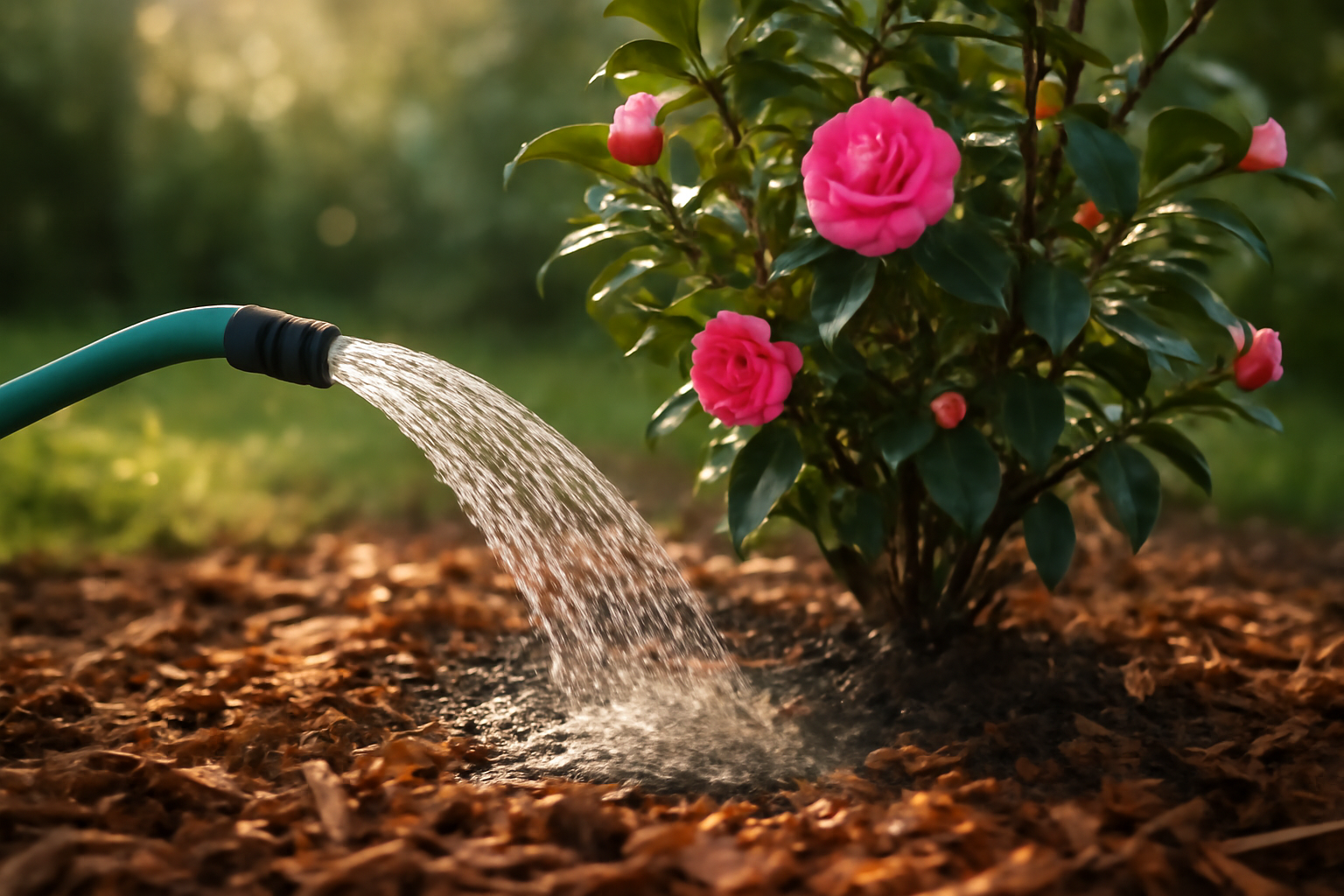
- Water at the base, not overhead. Drip irrigation or a slow hose at ground level is always better than overhead sprinklers for camellias.
- Know your soil. Sandy soil drains fast and needs more frequent watering. Clay soil holds moisture longer but can compact and stay waterlogged. I amend my clay beds with grit and organic matter before planting.
- Rainwater is better than tap water if your tap water is alkaline. Camellias prefer slightly acidic water, and alkaline tap water can gradually nudge soil pH upward. I collect rainwater for my most pH-sensitive cultivars.
- Keep notes. I keep a simple garden
I killed a ‘Nuccio’s Gem’ once. Not through neglect, not through frost, but through water — or more precisely, through watering it the exact same way in July as I did in February. It sat in my Zone 8a garden looking increasingly sorry for itself all summer, leaves yellowing at the edges, new growth limp and sad. Eventually I dug down into the root zone and found exactly what I deserved to find: soggy, airless soil that smelled faintly wrong. Overwatered in summer heat. A hard lesson. If you’ve ever wondered how to water camellias correctly — not just “give them water” but genuinely correctly, accounting for the season, the variety, the soil, and the conditions underfoot — you’re in the right place.
I’ve been growing camellias for over twenty years now. My collection currently runs to more than 200 named cultivars spread across three properties sitting in USDA Zones 7b, 8a, and 8b. From Camellia japonica to Camellia sasanqua, from reticulatas to the cold-hardy hybrids, I’ve watered them badly and I’ve watered them well. What follows is everything I’ve worked out — sometimes the expensive way.
Why Watering Camellias Is More Nuanced Than Most People Think
Most gardening advice about camellias says something like: “Keep them moist but well-drained.” That’s true. It’s also almost useless on its own. The problem is that “moist but well-drained” means something completely different in a Zone 7b winter than it does in a Zone 8b August.
Camellias have a fairly shallow, fibrous root system. Those roots sit in the top 12 to 18 inches of soil, which is exactly the zone that dries out fastest in summer and stays saturated longest after heavy rain. That root architecture makes them genuinely sensitive to both extremes. Too dry, and they drop buds and scorch. Too wet, and you risk Phytophthora root rot — a fungal disease that spreads fast in waterlogged, poorly aerated soil.
In my experience, the gardeners who lose camellias to watering problems almost always fall into one of two camps. Either they treat camellias like thirsty hydrangeas and drown them, or they assume that established shrubs are drought-tough and ignore them through a dry spell. Neither approach works.
How to Water Camellias in Spring
Spring is an active growth period, and it’s one of the times I watch my camellias most closely. By late March and into April, the japonicas are finishing up their bloom cycle and the new vegetative flush — that gorgeous bronze-red new growth — is pushing hard. That fresh growth is thirsty. Specifically, it needs consistent moisture to develop properly.
In my Zone 8a garden, spring rainfall is usually reasonable, so I’m often supplementing rather than doing the heavy lifting myself. However, in Zone 7b, where springs can swing dramatically between wet and dry, I watch the soil more closely. My rule is simple: check the soil an inch or two below the surface. If it’s dry at that depth, water thoroughly. If it still feels damp, leave it alone.
I water deeply rather than frequently in spring. A slow, thorough soak — allowing water to penetrate 10 to 12 inches down — is far better than a light daily sprinkle. Deep watering encourages roots to grow downward, which builds drought resilience later in the year. That said, frequency still matters. Most springs, I’m watering established camellias every 7 to 10 days if rain doesn’t do the job.
Newly Planted Camellias Need More Attention in Spring
If you’ve just put a new camellia in the ground — say, a C. japonica ‘Kramer’s Supreme’ or a sasanqua like ‘Setsugekka’ — spring watering is critical. New plants haven’t developed the root spread to find moisture on their own yet. For the first season, I water newly planted camellias every 3 to 5 days in the absence of rain, for at least the first six weeks.
I also make sure the planting soil is right before I even think about watering. Camellias want slightly acidic soil — pH 5.5 to 6.5 is the ideal range. Outside that range, the roots struggle to take up water efficiently even when moisture is present. If you’re not sure about your soil pH, a basic test kit is worth ten minutes of your time.
Summer Watering Is Where Most People Go Wrong
Here’s where I made my ‘Nuccio’s Gem’ mistake, and here’s where I see other gardeners struggle most often. Summer is paradoxical for camellias. They look like they need a lot of water — it’s hot, it’s dry, the leaves can look stressed — but their actual water needs depend heavily on whether they’re in active growth or semi-dormant.
By midsummer, most japonicas have finished their main growth flush and are settling into a quieter phase. However, they’re also setting next year’s flower buds. Inconsistent watering during July and August is a leading cause of bud drop the following winter — something I’ve written about more in my post on why camellias drop buds.
My general summer watering rhythm for established camellias in Zone 8a is every 5 to 7 days during dry stretches, watering in the early morning. I never water in the evening if I can help it. Wet foliage overnight encourages fungal problems, particularly on dense japonicas like ‘Debutante’ or ‘Governor Mouton’ where air circulation is already limited.
Mulch Is Your Best Summer Watering Partner
I can’t talk about summer camellia watering without talking about mulch. A 3-inch layer of pine bark or pine straw around the root zone cuts moisture evaporation dramatically. In my experience, well-mulched camellias need watering roughly half as often as unmulched ones during a hot, dry July. That’s not a small difference.
Keep the mulch pulled back a couple of inches from the main stem. Mulch piled against the trunk holds moisture against the bark and invites rot. Spread it wide — ideally out to the drip line — rather than deep and close to the plant. I refresh my mulch every spring and again in early autumn.
Potted and Container Camellias in Summer
Container camellias are a different conversation entirely. My reticulata collection — including the spectacular ‘Francie L’ and ‘Buddha’ — lives in large containers because reticulatas are marginal in my colder Zone 7b property. Containers dry out fast. During a hot summer, I’m checking potted camellias every single day and often watering every 2 days.
For containers, I water until I see water flowing freely from the drainage holes. That ensures the entire root ball is saturated, not just the top few inches. Partial watering — wetting only the top layer — is one of the most common container plant mistakes I see.
Autumn Watering and the Sasanqua Season
Autumn brings a lovely shift in my garden. The sasanquas come into their own from October onwards — ‘Yuletide’, ‘Kanjiro’, ‘Shishi Gashira’ — and they’re actively blooming while the japonicas are still months away from their show. This is also the season where watering often gets neglected, because the weather feels cooler and less urgent.
However, autumn is when your camellias are doing quiet but important work. The japonicas are developing and plumping their flower buds. The root system is still active. Dry spells in September and October genuinely stress the plants, even if the temperatures are mild. I aim to keep my watering schedule consistent through autumn — roughly every 10 to 14 days if rain is absent, tapering off only as temperatures drop below 50°F consistently.
One specific thing I watch in autumn: rainfall after a dry spell. After the soil has been dry for a while, it can become temporarily hydrophobic — water runs off rather than penetrating. When that happens, I water slowly, in multiple shorter passes, allowing the soil to absorb each round before applying more.
How to Water Camellias in Winter
Winter watering is the phase that surprises most new camellia growers. The assumption is that dormant or near-dormant plants in cold, wet weather don’t need watering. In wet climates, that’s often true. In my Zone 7b property, however, we get cold dry winds and bright frosty days that desiccate plants without any rainfall to compensate.
Desiccation — where the plant loses moisture through its leaves faster than the roots can replace it — is a real winter threat, especially for japonicas like ‘Berenice Boddy’ and ‘Pink Perfection’ that hold large glossy leaves. On dry, windy winter days, those leaves are losing water. If the ground is frozen or simply dry, the roots can’t keep up.
When to Water (and When Not to) in Cold Weather
My approach in winter is to water during mild spells — when temperatures are above 40°F — rather than on a fixed schedule. I check the soil every couple of weeks. If it’s dry an inch below the surface, I water thoroughly on a mild morning, giving it time to soak in before temperatures drop again at night.
I never water when the ground is frozen or when a hard freeze is forecast within 24 hours. Wet roots are more vulnerable to freeze damage than dry ones. That said, a well-watered plant going into a freeze is more resilient than a drought-stressed one — so timing is everything.
For winter protection in my coldest Zone 7b spots, I sometimes use an anti-desiccant spray like Wilt-Pruf on my most vulnerable japonicas. It’s not a substitute for good watering practice, but it reduces moisture loss through the leaves during bitter cold snaps.
Signs Your Camellia Is Getting Too Much or Too Little Water
Learning to read your camellias is the most important skill I can encourage. Both overwatering and underwatering produce stressed plants, but the symptoms are distinct enough to tell apart once you know what to look for.
Signs of underwatering:
- Leaf edges turning brown and crispy, particularly in summer
- Premature bud drop before blooms open
- Leaves curling inward or looking dull rather than glossy
- Wilting new growth in the morning (not just midday heat wilt)
Signs of overwatering:
- Yellowing leaves, particularly older inner leaves
- Soft, mushy stem base or crown
- A sour or rotten smell from the soil
- Consistently soggy soil that never dries between waterings
- New growth that emerges yellow or pale rather than bronze-green
As a result, if you’re seeing yellowing all over the plant with soggy soil below, stop watering and assess drainage before you do anything else. On the other hand, if you’re seeing brown crispy edges on otherwise healthy leaves during a dry spell, it’s a straightforward water deficit. Both problems are fixable early. Both become much harder to fix once they’ve progressed.
A Few Practical Watering Tips I Use Every Season
Over twenty years, I’ve settled into a few habits that make watering camellias simpler and more effective regardless of the season.
- Use a moisture meter for pots and newly planted shrubs. Finger testing in-ground soil is fine, but containers can fool you — dry on top, waterlogged below.
- Water at the base, not overhead. Drip irrigation or a slow hose at ground level is always better than overhead sprinklers for camellias.
- Know your soil. Sandy soil drains fast and needs more frequent watering. Clay soil holds moisture longer but can compact and stay waterlogged. I amend my clay beds with grit and organic matter before planting.
- Rainwater is better than tap water if your tap water is alkaline. Camellias prefer slightly acidic water, and alkaline tap water can gradually nudge soil pH upward. I collect rainwater for my most pH-sensitive cultivars.
- Keep notes. I keep a simple garden
How to Water Camellias Correctly in Every Season
You might also enjoy
Camellia Tea Scale: How to Identify, Treat, and Prevent the Most Common Pest
9 min read
How to Deadhead Camellias and Whether You Even Should
9 min readMonthly Camellia Care Calendar: What to Do Every Month of the Year
1 min read