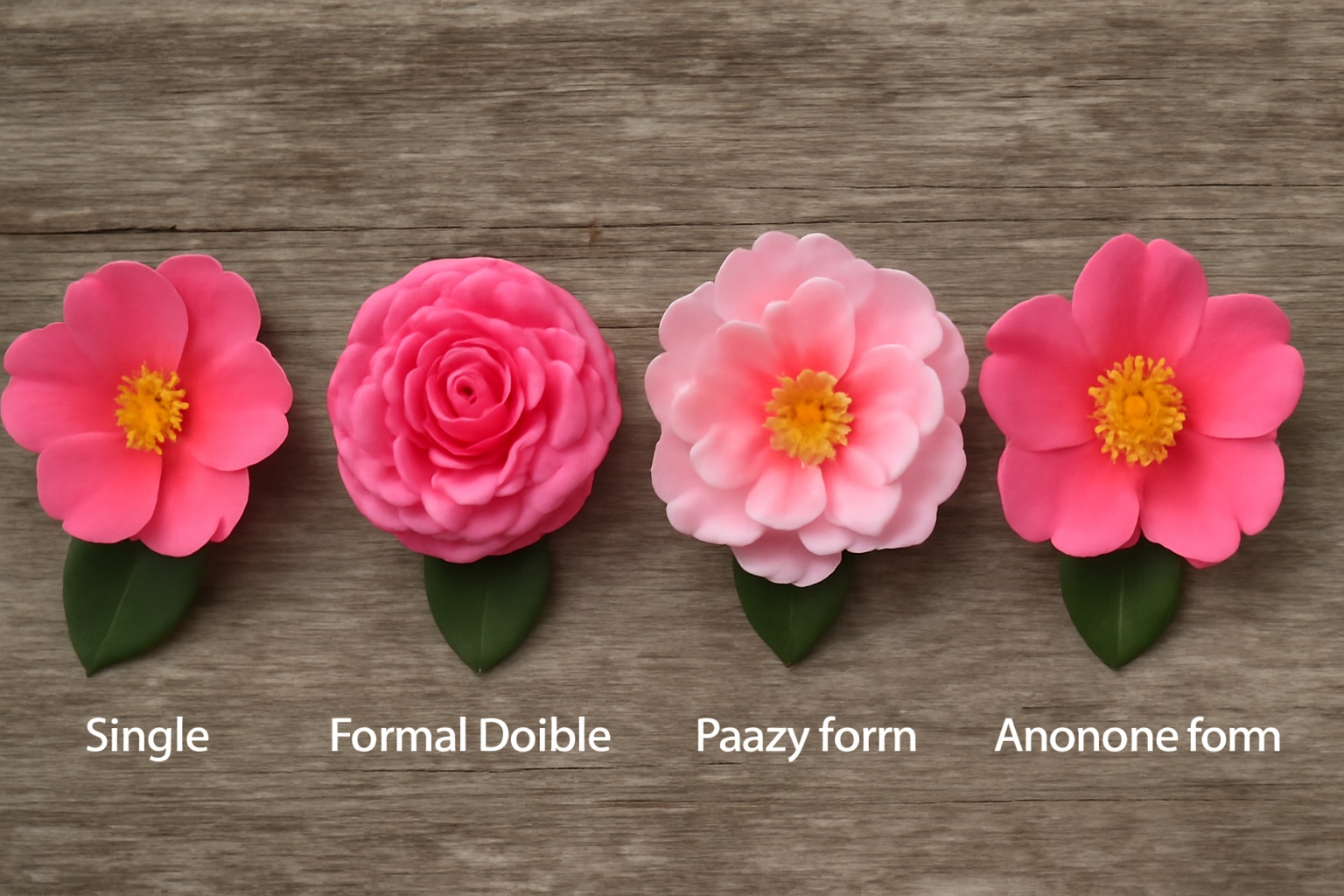
If you’ve ever stood in front of a camellia in full bloom and felt genuinely confused about what you were looking at, you’re not alone. Understanding camellia bloom forms was something I struggled with for the first few years of growing them seriously. I remember bringing home what I thought was a peony-form camellia from a local nursery — it was labeled simply “Japonicia Pink” — and then spending an entire growing season convinced I’d somehow killed it when the blooms opened flat and perfectly symmetrical. Spoiler: I hadn’t killed it. It was a formal double all along, and I just didn’t know what I was looking at yet.
That experience pushed me to really dig into camellia classification. Twenty years and 200+ named cultivars later, I can tell you this is one of the most rewarding rabbit holes in ornamental gardening. So let’s talk about the two forms I get asked about most often: formal doubles and peony forms.
Camellia Bloom Forms: Why Classification Matters
The American Camellia Society recognizes several official bloom form classifications. These include single, semi-double, anemone, peony, rose-form double, and formal double. Each describes how the petals and stamens are arranged in a fully open flower. Knowing the difference isn’t just botanical trivia. It genuinely shapes how you choose varieties, how you pair plants visually, and what to expect when buds finally open in your garden.
In my experience, most gardeners fall in love with either formal doubles or peony forms first. They represent two very different aesthetic philosophies. One is all precision and symmetry. The other is lush, layered, and a little wild. Understanding both will make you a sharper shopper at the nursery and a more intentional garden designer.
The Formal Double: Architecture in a Flower
A formal double camellia is, to me, one of the most structurally perfect things in nature. The petals are arranged in neat, overlapping rows. They spiral inward toward the center in a precise, symmetrical pattern. Crucially, no stamens are visible at all — they’re either completely absent or fully concealed beneath the inner petals. The result is a bloom that looks almost too perfect to be real.
Think of it like a floral rosette. The geometry is clean and almost architectural. That’s exactly why formal doubles photograph so beautifully and why florists adore camellia blooms in this form for arrangements.
Formal Double Varieties Worth Growing
Some of my absolute favorites in this category are Camellia japonica cultivars. ‘Kramer’s Supreme’ is a standout — a rich, velvety red with exceptional cold tolerance, performing reliably for me in zone 7b. ‘Nuccio’s Gem’ is another I keep coming back to. Its pure white blooms are flawlessly symmetrical, and it’s become a benchmark variety in my collection. For something a little different, ‘Elegans Champagne’ delivers a creamy, blush-toned formal double that absolutely glows in afternoon light.
On the reticulata side, ‘Francie L’ produces large formal double blooms in a deep rose-pink that can genuinely stop you mid-step. That said, reticulatas are less cold-hardy — I grow mine in zone 8b and give them wind protection even there. If you’re in zone 7b or colder, I’d stick with japonica formal doubles for reliability.
One practical note: formal double blooms tend to hold their shape well on the plant. However, they can trap moisture in wet climates, which occasionally leads to petal blight. I learned this the hard way one unusually rainy spring with my ‘Nuccio’s Gem’. Good air circulation around the plant makes a real difference — something I cover in more detail in my post on planting camellias for airflow and disease prevention.
The Peony Form: Beautiful Chaos
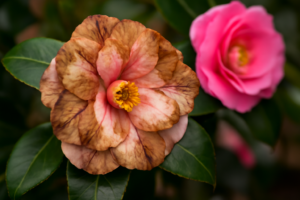
If the formal double is a cathedral, the peony form is a country cottage garden. Peony-form camellias have a full, rounded, layered center made up of mixed petals and petaloids — those small, petal-like structures that develop from stamens. The result looks, well, exactly like a peony. Blooms are full and deep. They feel alive, almost spontaneous, even though the plant has been carefully breeding toward this form for generations.
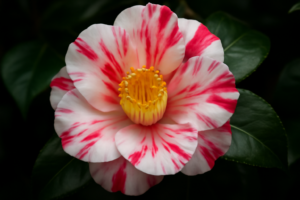
Unlike the formal double, peony-form blooms often show a glimpse of stamens mixed into that central mass. This is actually what distinguishes them from rose-form doubles, which have a more cupped, uniform center. The irregularity of peony forms is intentional and integral to their charm.
Peony Form Varieties I Grow and Love
‘Debutante’ is the peony-form japonica I recommend to almost everyone starting out. It’s a soft, shell-pink that blooms prolifically in mid-season, and it’s proven dependable in my zone 8a beds for well over a decade. ‘Brushfield’s Yellow’ is another peony-form I treasure — technically the center is a creamy ivory-yellow anemone-style, but it’s widely grouped with peony forms in nursery catalogs and has that same lush, layered quality.
‘Dr. Clifford Parks’ is a hybrid with reticulata parentage that produces enormous peony-form blooms in a flame red-orange. Seriously, these flowers are the size of a softball. Spectacular in zone 8b, though it needs protection from hard freezes. For sasanqua fans, ‘Survivor’ leans toward a semi-double to loose peony form and blooms in fall — a great companion to spring-flowering japonicas for extending seasonal interest.
Formal Double vs Peony Form: Key Differences at a Glance
- Petal arrangement: Formal doubles are highly symmetrical with precise rows; peony forms are full and irregular with mixed petals and petaloids.
- Stamens: Hidden or absent in formal doubles; partially visible mixed into the center of peony forms.
- Visual feel: Formal doubles look structured and refined; peony forms look lush and romantic.
- Photography: Formal doubles photograph cleanly from above; peony forms reward a three-quarter angle to show depth.
- Rain performance: Formal doubles can trap water more readily; peony forms shed moisture a little more easily due to irregular structure.
- Garden use: Formal doubles suit formal hedges and structured borders; peony forms complement cottage-style and naturalistic plantings.
A Mistake I Made — and What I Learned
Early in my camellia obsession, I planted a formal double and a peony form next to each other in a mixed border. Both were pink. I thought they’d complement each other beautifully. Instead, they fought visually — the clean geometry of the formal double made the peony form look messy by contrast, and the lush fullness of the peony form made the formal double look stiff.
The fix was simple once I understood what was happening. Group similar bloom forms together. Alternatively, separate them with a structural foliage plant — I now use a clipped Osmanthus between them, which acts as a visual pause. Since making that change, both plants look intentional rather than accidental. Small adjustment, big difference.
This is something I think about across all my beds now. Bloom form is as important a design consideration as color. Probably more so, in fact, because color shifts with light and season. Form stays consistent.
Growing Conditions That Support Beautiful Bloom Forms
Here’s something I want to be direct about: the genetics determine the form, but your growing conditions determine whether that form expresses itself fully. A peony-form camellia growing in poor soil or heavy shade may produce blooms that barely open, or that drop before fully developing. You won’t see the full layered center at all. That’s not the plant failing — that’s the gardener’s environment limiting it.
Soil pH is non-negotiable. Camellias demand acidic conditions, ideally between 5.5 and 6.5. Above pH 6.5, iron and manganese become unavailable to the plant. As a result, you’ll see yellowing leaves (chlorosis) and significantly reduced bloom quality. I test my beds every two years without exception. Sulfur amendments and acidic mulches like pine bark are my go-to corrections.
Light, Drainage, and Timing
Most camellias perform best in dappled shade or morning sun with afternoon protection. However, formal doubles in particular can show petal browning (“sunburn”) if exposed to harsh afternoon sun during bloom. I site my most prized formal doubles on the east side of structures or under high tree canopy for that reason.
Good drainage is equally critical. Camellias hate wet feet. Poorly drained soil leads to Phytophthora root rot, which kills plants slowly and often doesn’t show symptoms until significant damage is already done. Raised planting on a slight mound, even just 4-6 inches, makes a meaningful difference in poorly draining native soils.
Timing of fertilization also affects bloom quality. I use an acid-forming, slow-release fertilizer in early spring after bloom finishes, then a lighter application in early summer. Fertilizing too late — after July in zones 7b-8b — can stimulate soft new growth that gets damaged by early frosts and diverts energy away from bud development.
Choosing Between the Two Forms: My Honest Advice
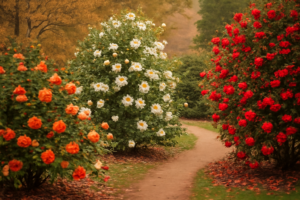
People often ask me which form is “better.” Honestly, that’s the wrong question. They’re different tools for different design intentions. Formal doubles belong in spaces where you want precision, elegance, and that almost jewel-like quality. Think formal entry gardens, clipped hedges, or containers on a structured terrace. Peony forms belong where you want warmth, abundance, and a sense of romantic fullness. Cottage gardens, naturalistic woodland edges, and mixed shrub borders are their natural habitat.
That said, I grow both extensively and wouldn’t give up either. In my zone 8a garden, my formal double border runs along the east-facing fence — all japonicas, mostly ‘Nuccio’s Gem’ and ‘Kramer’s Supreme’ with some ‘Betty Sheffield Supreme’ for variegation interest. My peony-form collection lives in the back beds under high pine canopy, where ‘Debutante’, ‘Dr. Clifford Parks’, and a few unnamed seedlings I’ve grown myself create a lush, layered scene from January through March.
Understanding Camellia Bloom Forms: Your Next Step
Learning to identify and work with camellia bloom forms is genuinely one of the skills that separates casual growers from serious collectors. It changes how you shop, how you design, and how you troubleshoot when something looks “off” in your garden. Once you can look at a bloom and immediately recognize whether it’s a formal double or a peony form — and understand what conditions help that form express itself — you’ll shop with confidence and plant with intention.
My practical action step for you: next time you’re at a nursery or browsing an online camellia catalog, look up three varieties you’re considering and find their official bloom form classification before you buy. Notice whether they’re formal doubles, peony forms, or something else entirely. Then consider where they’d sit in your garden and whether that form suits that space. That one habit will transform how your collection develops over time.
For more on selecting varieties by season and zone, have a read through my post on early, mid, and late-season camellias for extended bloom. And if you want to go deeper on all the official bloom form categories — including singles, anemones, and rose-form doubles — I’ve written a full classification guide that covers the complete American Camellia Society system. There’s always more to discover with these extraordinary plants.