
This post contains affiliate links. As an Amazon Associate, I earn from qualifying purchases at no extra cost to you.
I’ve been growing camellias for over twenty years. In that time, I’ve made plenty of mistakes — wrong soil pH, wrong pruning timing, wrong everything. However, nothing frustrated me more than watching my potted camellias slowly decline despite my best efforts. Last spring, I decided to overhaul my entire fertilizing approach for Osmocote potted camellias. That single decision changed everything about how my container plants looked by midsummer.
My problem was painfully specific. I had six camellias growing in large terra cotta and glazed ceramic containers on my back patio here in Zone 8b. Three were Japonicas — ‘Kramer’s Supreme,’ ‘Elegans,’ and a dwarf called ‘Minato-no-Akari.’ The other three were Sasanquas: ‘Setsugekka,’ ‘Shishi Gashira,’ and ‘Kanjiro.’ All six were technically alive. None of them were thriving.
The foliage looked dull. New growth was sparse and yellowish rather than that glossy deep green I love. Bloom counts had dropped two seasons in a row. I was using a liquid acidic fertilizer on a schedule I thought was consistent — but container gardening, I’ve learned, punishes inconsistency far more harshly than in-ground growing does.
Why I Chose Osmocote for Potted Camellias
I’d used slow-release granular fertilizers before, but only in my vegetable beds. A camellia grower in my local garden club — she’s been growing them since the 1980s — mentioned she’d switched to Osmocote Smart-Release Plant Food Plus Outdoor & Indoor – Granular, Continuous Release Plant Fertilizer with 11 Essential Nutrients, 2 lbs. for all her containers. She said the results were “embarrassingly good.” That got my attention.
I did my own research before committing. Camellias are acid-loving plants. They need a soil pH between 5.5 and 6.5 to absorb nutrients effectively. Above that range, iron and manganese become unavailable — and you get that telltale interveinal chlorosis on the leaves. My concern with any granular fertilizer was whether it would work within that acidic window or push pH in the wrong direction.
After reading the product details carefully, I felt reassured. Osmocote’s formula includes 11 essential nutrients — not just the standard NPK trio, but also iron, manganese, copper, zinc, boron, and molybdenum. For camellias, those micronutrients matter enormously. In addition, the slow-release coating means nutrients are released gradually based on soil temperature rather than dumped all at once. That matched exactly what container camellias need: steady, gentle feeding rather than feast-and-famine cycles.
I also considered competing products. There are camellia-specific fertilizers on the market, but many require more frequent applications and careful measuring. Frankly, I wanted something low-maintenance that I could trust between busy weeks. Osmocote’s six-month release window was a strong selling point.
First Impressions Out of the Box
The 2-lb. bag arrived quickly and was well-sealed. My first impression was that the granules looked exactly as advertised — small, uniform, pale yellow-green spheres with a waxy coating. They didn’t have a harsh chemical smell, which I appreciated. Some granular fertilizers smell sharp enough to make you step back. These were mild and almost earthy.
The measuring scoop included in the bag was a thoughtful touch. Application instructions were printed clearly on the back. For container plants, the guidance is straightforward: use one scoop (about a tablespoon) per 4-inch pot diameter. My large containers — most sitting between 14 and 18 inches across — needed roughly 3.5 to 4.5 scoops each. That calculation took about thirty seconds per pot.
One thing I noticed immediately: the bag itself is resealable and sturdy. I’ve had other fertilizer bags split or lose their seal after one use. This one stayed tight all season, which matters if you’re storing it in a humid potting shed like I do.
My Testing Approach
I applied the Osmocote Smart-Release Plant Food Plus Outdoor & Indoor – Granular, Continuous Release Plant Fertilizer with 11 Essential Nutrients, 2 lbs. to all six of my container camellias in early April. Spring timing matters for camellias because they’re coming out of their rest period and gearing up for a flush of new growth. Getting nutrients in place before that push is important.
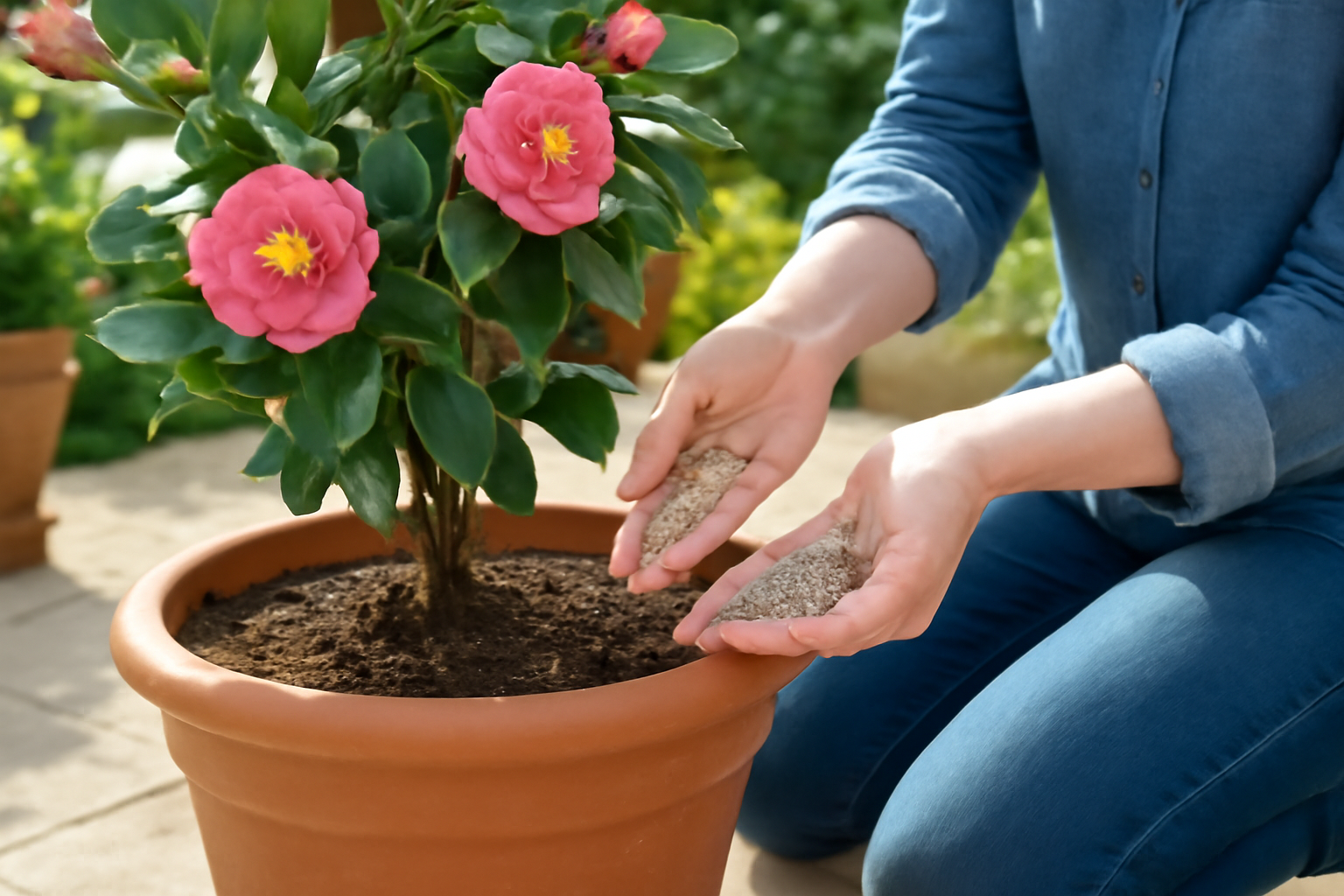
I scattered the granules evenly across the soil surface and then watered each pot thoroughly. The product doesn’t need to be worked into the soil — the coating releases nutrients with each watering. However, I did scratch the top inch of my potting mix lightly beforehand to help the granules settle rather than roll off.
All six pots were growing in a quality acidic potting mix. I’d amended them the previous fall with extra perlite for drainage and a small amount of sulfur to nudge the pH into the 5.5–6.0 range. My watering schedule runs every two to three days during warm months, which gave the granules consistent moisture for release.
I did not use any additional fertilizer during the test period. No liquid feeds, no foliar sprays — nothing. I wanted a clean read on what Osmocote alone could do. I tracked the plants from April through mid-October, roughly six months, which aligned with the claimed release window.
What Actually Changed in My Camellias
By mid-May — about six weeks after application — the change in new growth was striking. All three Japonicas had pushed out multiple inches of rich, dark green new foliage. ‘Elegans’ in particular had shoots I hadn’t seen from that plant in two years. The color shift was exactly what I’d been chasing: deep, glossy green rather than the pale, washed-out look from the year before.
The Sasanquas responded even faster. ‘Setsugekka’ put out a flush of new growth within four weeks. By July, ‘Kanjiro’ had more buds set than I had seen in three seasons. That was unexpected and genuinely exciting.
Specifically, here’s what I observed across all six plants by late summer:
- Foliage color improved noticeably on every plant within 6 weeks
- ‘Kramer’s Supreme’ showed its first vigorous new cane growth in two years
- Bud set on all three Sasanquas increased visibly compared to the prior season
- ‘Shishi Gashira’ — my most stubborn container plant — finally looked genuinely healthy
- No signs of fertilizer burn on any plant, even on the smallest pot
The fall bloom season confirmed what summer had hinted at. My Sasanquas opened beautifully. ‘Kanjiro’ especially put on a show that stopped visitors in their tracks. As a result, I felt like I’d finally unlocked what those plants were capable of doing all along.
The Japonicas: A Slightly Different Story
The Japonicas responded well to foliage and growth. However, bloom improvement was more modest. ‘Minato-no-Akari’ bloomed beautifully in late winter, as Japonicas do — so I couldn’t fully judge bloom results from this spring application alone. I’ll need another full cycle to measure bloom improvement fairly. That said, the plant health gains were real and meaningful regardless.
The Downsides You Should Know
I want to be honest here, because that’s the only way this kind of review is worth reading.
My one moment of genuine doubt came around week eight. ‘Elegans’ developed a few mildly yellowed leaves on older inner growth. My first thought was that something had gone wrong with the fertilizer or that I’d pushed the pH too far. I tested the soil — pH came back at 5.8, well within range. After some research, I concluded it was likely normal seasonal leaf drop for that variety, not a fertilizer issue. Still, it gave me a nervous few days.
Beyond that moment, there are a few genuine limitations worth considering:
- Osmocote is not formulated specifically for acid-loving plants. It works well within the camellia pH range, but it won’t actively lower your soil pH if it’s already too high.
- In very hot climates, soil temperatures above 85°F can speed up nutrient release, which may reduce the effective window below six months.
- The granules are visible on the soil surface. For decorative container displays, that may look untidy.
- The 2-lb. bag goes quickly if you have many large containers. I used most of it on just six pots.
- Results depend heavily on your starting soil health. If your potting mix is severely depleted or pH is badly out of range, fertilizer alone won’t fix the problem.
On the other hand, none of these are dealbreakers for most home gardeners. They’re simply things to know going in.
Final Verdict: Is Osmocote Right for Your Potted Camellias?
After six months of careful observation, my verdict is clear. The Osmocote Smart-Release Plant Food Plus Outdoor & Indoor – Granular, Continuous Release Plant Fertilizer with 11 Essential Nutrients, 2 lbs. is the best low-maintenance fertilizer I’ve used for Osmocote potted camellias in twenty years of growing them. It earned that title through results, not marketing.
Buy this if:
- Your container camellias look dull, slow-growing, or flower-shy despite regular care
- You want a set-it-and-mostly-forget-it fertilizer for a busy season
- You grow both Japonicas and Sasanquas and want one product for all of them
- You’re in USDA Zones 7–10 with warm growing seasons where slow-release timing is predictable
Skip this if:
- Your soil pH is above 6.5 and needs active correction first — fix that problem separately
- You prefer a fertilizer designed exclusively for acid-loving plants with a pH-lowering component
- You have a very large collection of containers and need a more economical bulk option
My personal rating: 4.7 out of 5. The only reason it’s not a perfect five is that I’d love a version formulated specifically for acid lovers. As it stands, it performs beautifully within the correct pH range — and for gardeners who maintain their soil properly, it absolutely delivers.
The Runner-Up: Osmocote in the Larger Size
If you have a large camellia collection or several big containers, the 2-lb. bag will run out faster than you expect. In that case, consider the Osmocote Smart-Release Plant Food Plus Outdoor & Indoor – Granular, Continuous Release Plant Fertilizer with 11 Essential Nutrients, 8 lbs. — the same formula in a larger format that offers better value per ounce.
It’s the same product I tested and trust. For smaller collections or first-time users, the 2-lb. is the smarter starting point. However, once you see the results and want to stock up, the 8-lb. size is worth every penny.