
This post contains affiliate links. As an Amazon Associate, I earn from qualifying purchases at no extra cost to you.
Last summer nearly broke my camellia hedge. After twenty-three years of growing camellias in Zone 8b, I thought I had watering figured out. Then a brutal July hit — weeks of 95°F days, bone-dry soil, and me traveling for work every other week. My beloved hedge of ‘Survivor’ Japonicas and ‘Yuletide’ Sasanquas started dropping buds before they even formed. That’s when I finally got serious about finding a reliable drip irrigation timer for camellias. I needed automation I could actually trust.
Hand-watering a fourteen-plant hedge is one thing when you’re home. It becomes impossible when you’re not. Camellias want consistent moisture — not soggy roots, not bone-dry conditions. They thrive in well-draining, slightly acidic soil (pH 5.5–6.5), and they punish inconsistency with bud drop, yellowing leaves, and stunted growth. I needed a smarter system.
So I spent a weekend researching timers, reading reviews, watching YouTube demos, and eventually landed on a product that genuinely changed how I manage my garden. Here’s everything I learned from months of real-world testing.
Why I Chose This Drip Irrigation Timer for My Camellias
My first instinct was to grab whatever was cheapest at the hardware store. However, after losing a ‘Professor Charles S. Sargent’ Japonica to root rot years ago from overwatering, I knew cheap and thoughtless wasn’t the answer. I needed something with a rain delay feature specifically. Camellias do not forgive waterlogged roots. Their shallow feeder roots suffocate fast in saturated soil.
After comparing half a dozen options, I settled on the Water Timer for Outdoor Garden Hose, Hose Timer with Rain Delay/Manual Mode, Automatic Drip Irrigation Controller System for Lawn Yard Garden Watering. Several things pushed me toward it specifically.
- Built-in rain delay function — critical for avoiding overwatering after rainfall
- Manual mode override for spot-watering individual plants
- Multiple scheduling options (frequency, duration, and start times)
- LCD display large enough to read without squinting in bright sunlight
- Strong user reviews mentioning durability through hot summers
In my experience, rain delay is the single most underrated feature on any garden timer. We get sporadic summer thunderstorms here in the Southeast. Without rain delay, a dumb timer waters right through them — and camellias sitting in soaked soil for days are prime candidates for Phytophthora root rot. That alone made this model worth a closer look.
First Impressions: Unboxing and Setup
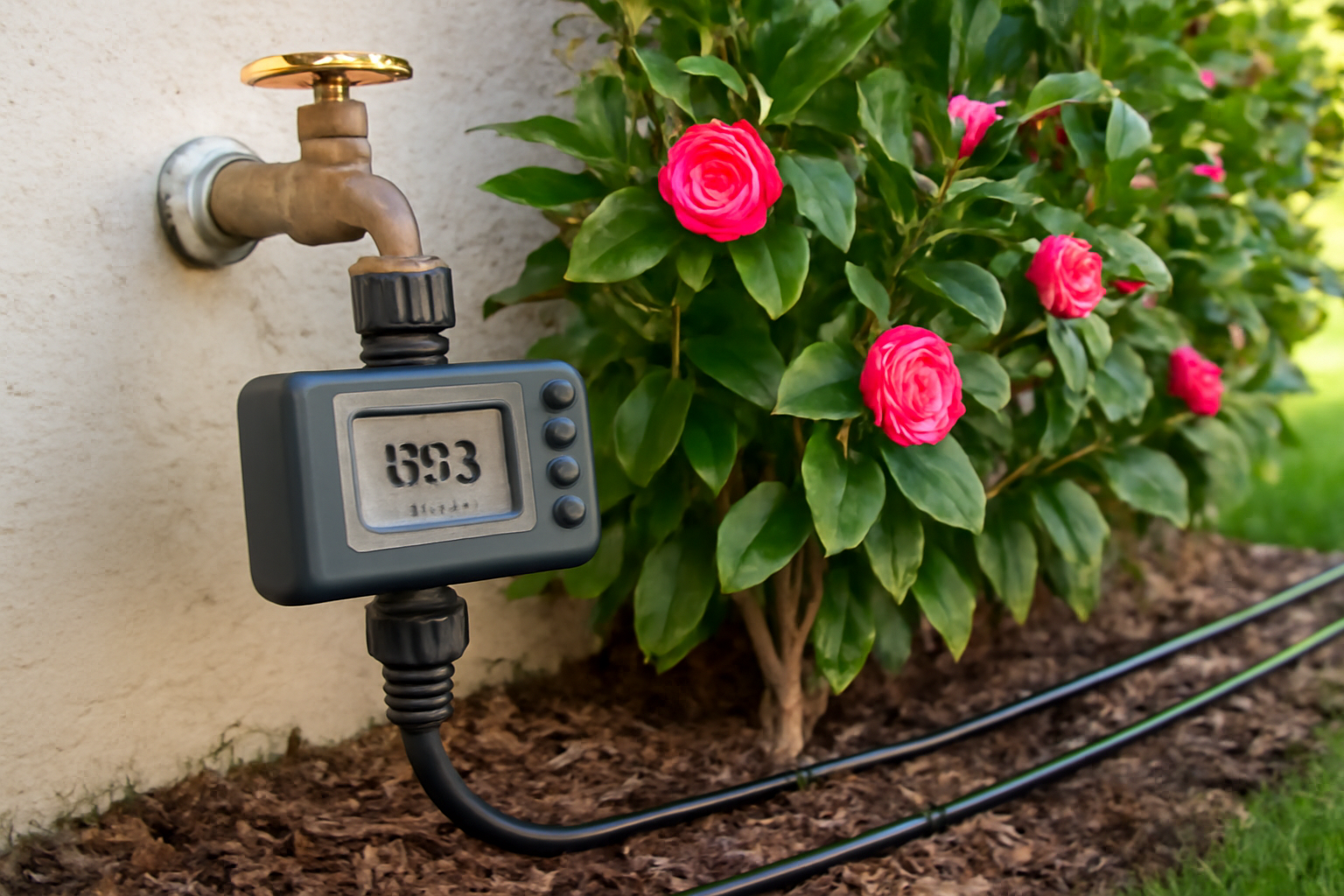
The package arrived well-protected. Everything was nestled in molded cardboard — no loose rattling, no flimsy plastic shell I had to fight open. The unit itself felt solid immediately. The casing has a rubberized texture that doesn’t feel like it’ll crack after one season in the sun. That matters when you’re leaving something attached to a garden faucet year-round.
The LCD screen is clear and well-organized. Programming felt intuitive after about ten minutes with the manual. Honestly, I’ve set up irrigation timers that took twice as long to figure out. The button layout is logical — mode, plus, minus, confirm. Nothing fancy, but nothing confusing either.
Installation took me under five minutes. I connected it directly to my outdoor spigot, attached my existing drip line, inserted the batteries, and started programming. The thread connection sealed tight with no leaks — a small thing, but I’ve wrestled with leaky fittings before and they are genuinely maddening.
One Initial Concern
My only hesitation during setup was the battery compartment. It’s tucked underneath the unit in a spot that looked like it might collect water. I added a small bead of waterproof sealant around the edge as a precaution. Whether that was necessary, I genuinely don’t know. That said, the unit has survived several heavy rainstorms since without any issue.
My Testing Approach: Four Months With a Camellia Hedge
I ran the Water Timer for Outdoor Garden Hose, Hose Timer with Rain Delay/Manual Mode, Automatic Drip Irrigation Controller System for Lawn Yard Garden Watering from late June through mid-October. That window covers the most stressful stretch of the year for camellias in my climate — peak heat, drought stress, and then the critical bud-set period heading into fall.
My hedge includes fourteen plants across three varieties:
- ‘Survivor’ Camellia japonica — eight plants, established 12+ years, heavy bloomers
- ‘Yuletide’ Camellia sasanqua — four plants, established 6 years, fall-blooming
- ‘Winter’s Star’ Camellia hybrid — two plants, newer additions, still establishing
My soil is a sandy loam amended with pine bark fines — ideal for camellias, drains well but dries out quickly in heat. I run a quarter-inch drip line with emitters spaced 18 inches apart along the hedge base. Water pressure at my spigot runs about 45 PSI, well within the timer’s operating range.
My Watering Schedule
I programmed the timer to run once daily at 6:00 AM, for thirty minutes, through July and August. September I dialed back to every two days as temperatures dropped. Camellias shouldn’t sit in perpetually moist soil — consistent but moderate moisture is the goal. Root zone depth for established camellias is typically 12–18 inches, so slow, deep watering beats frequent shallow runs every time.
I used the rain delay feature after every significant rainfall — anything over half an inch — usually setting a 24 to 48-hour delay. For comparison, I left one older ‘Survivor’ plant on my hand-watering schedule as an informal control. That gave me a rough baseline for comparison through the season.
What Actually Changed: Honest Results After Four Months
The most immediate change was psychological, and I’m not embarrassed to admit it. I stopped worrying. When I left for a ten-day work trip in August — historically my most anxious gardening month — I felt genuinely calm about my hedge for the first time. That peace of mind has real value.
Beyond the mental relief, the plants showed measurable improvement. Specifically, here’s what I observed compared to previous summers:
- Zero bud drop on ‘Yuletide’ Sasanquas through the dry August stretch — a first in three years
- ‘Survivor’ Japonicas maintained deep green foliage with no heat-stress yellowing
- The two ‘Winter’s Star’ hybrids showed noticeably stronger new growth by September
- My control plant (hand-watered) dropped four buds in late August during a week I was inconsistent
By October, my ‘Yuletide’ Sasanquas were absolutely loaded with buds — more than I’d seen in years. Consistent moisture during summer bud set is directly linked to bloom quality. The science backs this up: water stress during initiation phase triggers hormonal responses that abort developing buds. Reliable irrigation during that window simply matters.
A Moment of Real Doubt
I’ll be honest — around week six, I walked out one morning and found the timer had apparently skipped a cycle. The soil under two of my ‘Survivor’ plants felt notably drier than the rest. My immediate thought was that the timer had failed.
After some investigation, I realized the rain delay I’d set four days earlier had extended further than I expected based on my programming. User error, not product failure. However, that moment reminded me that no automated system replaces periodic hands-on checks. I started doing a quick soil probe every few days regardless. That’s just good camellia practice.
The Downsides You Should Know
No product review from me is complete without honesty about limitations. This timer does have real constraints worth knowing before you buy.
Single outlet only. If you’re running multiple drip zones from different spigots, you’ll need multiple timers. That adds up cost-wise. For a single hedge or garden bed, it’s perfectly fine. For a complex multi-zone setup, you may want a multi-outlet system instead.
No smart home integration. This is a standalone unit — no WiFi, no app, no remote access. I personally don’t mind. Simpler often means fewer failure points. However, if you want to adjust schedules from your phone, this isn’t your product.
Battery life monitoring. The low-battery indicator is small and easy to miss during a casual glance. I’d recommend marking your calendar to check batteries seasonally. A dead battery at the wrong moment — say, during a heat dome in August — would be disastrous for camellias.
Not ideal for very low water pressure. If your outdoor spigot pressure is below 20 PSI, the valve may not open reliably. Most residential faucets are fine, but older homes with pressure issues could see problems.
Final Verdict: Who Should Buy This Drip Irrigation Timer for Camellias
After four months of real-world use through a brutal Southern summer, I can say confidently: this timer delivered. The Water Timer for Outdoor Garden Hose, Hose Timer with Rain Delay/Manual Mode, Automatic Drip Irrigation Controller System for Lawn Yard Garden Watering is a genuinely solid tool for any camellia grower who wants consistent, set-and-forget watering without breaking the bank on a complex smart system.
I’d give it a strong 4.5 out of 5 stars for camellia applications specifically.
Buy This If:
- You grow camellias in a single hedge or garden bed from one spigot
- You travel frequently or have an inconsistent watering routine
- You live in a climate with sporadic summer rainfall and need rain delay protection
- You want straightforward programming without app dependency
- You’re in USDA Zones 7–10 managing heat-stressed camellias through summer
Skip This If:
- You need multiple independent watering zones
- Remote smartphone control is a dealbreaker for you
- Your outdoor water pressure is unreliable or consistently low
For anyone using a drip irrigation timer for camellias, the rain delay feature alone justifies the price. Protecting your plants from overwatering is just as important as preventing drought stress — and this timer handles both sides of that equation well.
A Solid Runner-Up Worth Knowing About
If this model sells out or doesn’t feel quite right for your setup, consider the Categories garden-care, Tools & Product Reviews