
This post contains affiliate links. As an Amazon Associate, I earn from qualifying purchases at no extra cost to you.
Last February, I stood in front of my oldest ‘Kramer’s Supreme’ Japonica and felt genuinely embarrassed. Twenty-three years I have been growing camellias in my Zone 8b garden, and somehow I had let that poor shrub turn into a tangled, leggy mess. Crossing branches everywhere. Dead wood hiding inside a dense canopy. Blooms pushed to the very outer tips where I could barely see them. I knew I needed to tackle it — and every other overgrown camellia on the property — before spring growth flushed. What I desperately needed was a reliable bypass pruner for camellias that could handle both delicate new growth and woody stems up to three-quarters of an inch thick.
The problem was my old pruners. They were a bargain pair I had picked up years ago at a hardware store sidewalk sale. Honestly, they had served me reasonably well on light work. However, after a season of heavy use on my Sasanquas — particularly ‘Yuletide’ and ‘Setsugekka,’ which grow vigorously in my clay-amended beds — the blades had dulled badly. Every cut was a squeeze-and-twist affair. Camellias do not forgive crushed stems. Ragged cuts invite disease, and my plants were already stressed from a dry summer.
I needed something better. Something I could sharpen, repair, and trust season after season. That research led me, pretty directly, to a tool that serious gardeners have been recommending for decades.
Why I Chose the Felco F2 Pruning Shears
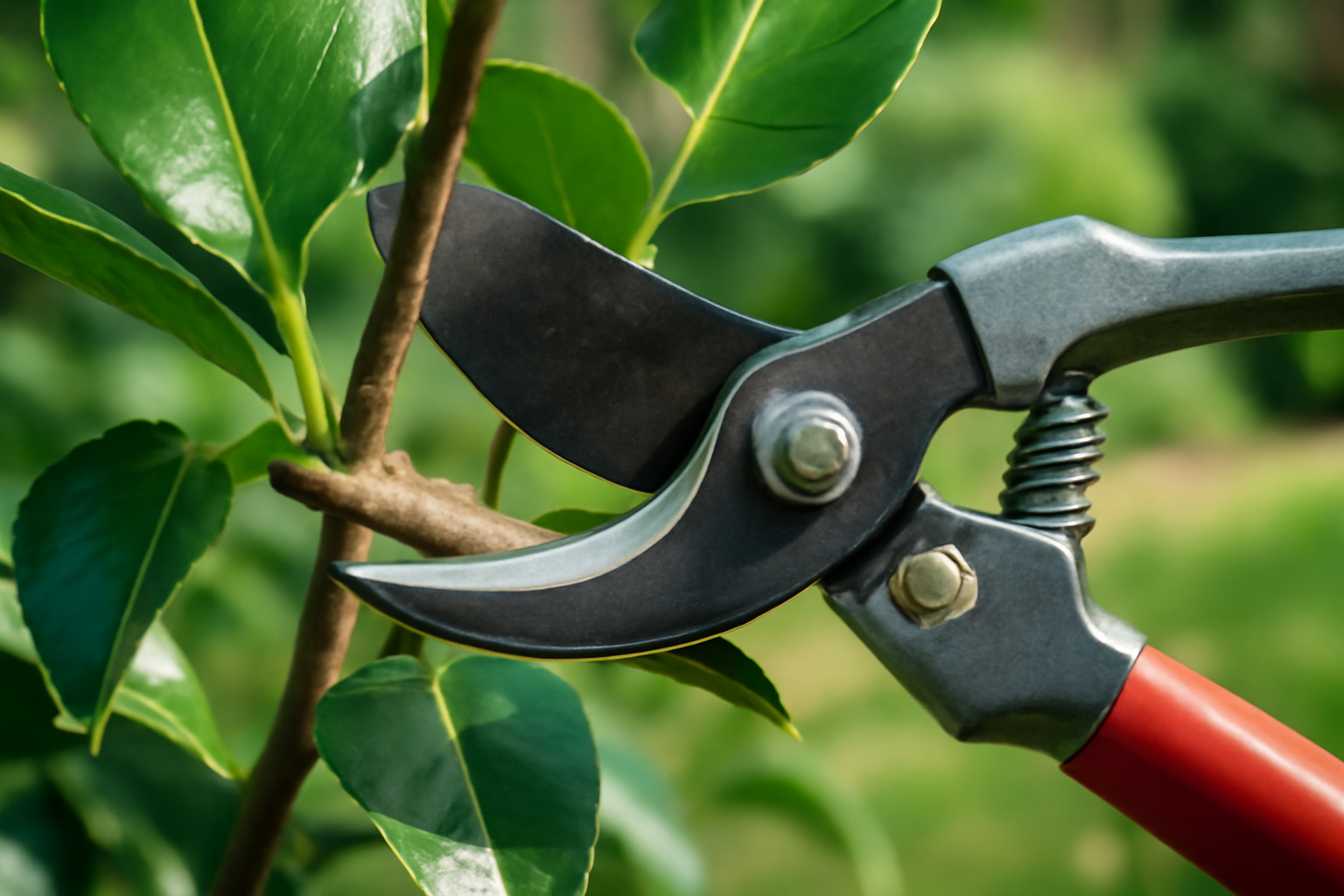
I asked around in two camellia forums I follow and got the same answer repeatedly: Felco. Specifically, the Felco F2 Pruning Shears – 9.25″ Swiss-Made Garden Clippers for Professional Pruning | Hand Pruners for Gardening | Garden Tool Cutter with Precision Bypass Blade, Aluminum Body, Replaceable Parts. The name kept coming up from professional horticulturists, nursery owners, and obsessive home growers alike.
I also read through the horticultural reasoning. Bypass pruners work by having one sharp blade slide past a broader counter blade — like scissors. That clean slicing action matters enormously for camellias. Crushed or torn vascular tissue heals slowly and creates entry points for Phytophthora root rot and canker diseases. A sharp bypass cut, made just above a node at the right angle, gives the plant its best healing chance.
The Felco F2 is 9.25 inches long with a forged aluminum body and a hardened steel blade. Every part — blade, spring, screw, cushion — is individually replaceable. That lifespan argument was persuasive. Rather than buying new budget pruners every two or three years, I could invest once and maintain them indefinitely. That felt right for a long-term gardener. I ordered a pair without much further deliberation.
First Impressions Out of the Box
The Felco F2 arrived well packaged in a simple cardboard and plastic clamshell. There was no unnecessary fuss. Opening it, the weight hit me immediately — these feel substantial in a reassuring way, not heavy in a tiring way.
The red aluminum handles are immediately recognizable to anyone who has gardened seriously. In person, the finish is clean and precise. The blade looked almost mirror-bright, and when I pressed my thumbnail against the edge, I could feel the sharpness without any pressure. That is a good sign straight out of packaging.
The opening spring tension felt firm but not stiff. My previous pruners had a spring that either fought me or went completely slack within a season. This one felt calibrated. The locking mechanism is a simple thumb latch — easy to open single-handed, secure enough that I never worried about accidental opening in my apron pocket.
Setup required nothing. Literally nothing. Open the package, squeeze the latch, start cutting. For someone who has wasted twenty minutes trying to assemble flat-packed garden tools before, that simplicity was genuinely appreciated.
My Testing Approach: Six Weeks Across Five Camellia Varieties
I gave myself a defined testing window: mid-February through late March, covering the post-bloom pruning period for my Japonicas and the late structural pruning period for my Sasanquas. My garden sits in Zone 8b, with acidic clay-loam soil that I have amended over the years to hold a consistent pH of 5.8 to 6.2 — right in the ideal range of 5.5 to 6.5 that camellias prefer.
Here are the specific plants I worked on during testing:
- ‘Kramer’s Supreme’ Japonica — my oldest and most overgrown shrub, approximately 12 feet tall with significant interior deadwood
- ‘April Kiss’ Japonica — a younger shrub needing light shaping after heavy spring bloom
- ‘Yuletide’ Sasanqua — a vigorous grower used as a hedge, requiring heavy reduction cuts
- ‘Setsugekka’ Sasanqua — semi-double white bloomer with long arching canes that needed thinning
- ‘Winter’s Star’ hybrid — a smaller, cold-hardy hybrid I grow near my fence line
Over six weeks, I used the Felco F2 Pruning Shears – 9.25″ Swiss-Made Garden Clippers for Professional Pruning | Hand Pruners for Gardening | Garden Tool Cutter with Precision Bypass Blade, Aluminum Body, Replaceable Parts exclusively. No switching back to old tools. I kept notes after each pruning session — cut quality, hand fatigue, any difficulties with specific stem sizes.
How I Pruned Each Plant
For Japonicas, I followed the standard approach: remove dead or crossing branches first, then reduce long leggy stems by cutting just above an outward-facing bud. I made cuts at roughly a 45-degree angle, angled away from the bud. For the Sasanqua hedge, I worked through reduction cuts to control height and stimulate dense new growth from lower nodes.
Stems ranged from pencil-thin new growth to woody canes approaching three-quarters of an inch in diameter. That upper range is close to the Felco F2’s rated capacity of one inch. I pushed it occasionally on a particularly thick ‘Yuletide’ stem and it handled it — though that is genuinely not where bypass pruners perform at their best.
What Actually Changed: Honest Results With the Bypass Pruner on Camellias
The most immediate difference was cut quality. Every single cut was clean. On thin new growth, the blade barely needed pressure — just a steady squeeze. On half-inch woody stems, the action remained smooth and decisive. I did not feel any of the grinding or crushing sensation from my old budget pruners.
By late March, the ‘Kramer’s Supreme’ had pushed strong new growth from multiple pruned nodes. The flush of growth was noticeably more even across the canopy compared to previous years. That is partly good timing, partly better cuts. In my experience, clean cuts really do matter for camellia recovery.
Hand fatigue was significantly lower than expected. I spent nearly three hours on the ‘Yuletide’ hedge in one session. Normally, that kind of sustained pruning leaves my forearm aching. This time, I felt only mild tiredness — nothing that kept me out of the garden the next morning.
The sap and resin residue that builds up on blades was easy to wipe off. I used a rag with a little rubbing alcohol between plants — essential hygiene when working across multiple camellias to avoid spreading fungal issues. The Felco blade cleaned up quickly and did not seem to dull despite the resin exposure.
Six Weeks Later: What the Plants Showed
All five camellias broke dormancy cleanly and pushed healthy new growth within three to four weeks of pruning. I saw no signs of dieback at pruning wounds, which can indicate disease entry on poorly made cuts. The ‘Setsugekka’ pushed the most impressive new growth — a full flush of glossy foliage along previously bare interior stems that I had opened up by thinning.
That said, I cannot attribute every positive result to the pruner alone. Timing matters. Spring fertilization matters. Soil pH matters. The Felco F2 is a tool, not a miracle. However, it removed one variable — poor cut quality — that had been silently working against me for years.
The Downsides You Should Know Before Buying
Let me be honest about the frustrations. The price is real. The Felco F2 Pruning Shears – 9.25″ Swiss-Made Garden Clippers for Professional Pruning | Hand Pruners for Gardening | Garden Tool Cutter with Precision Bypass Blade, Aluminum Body, Replaceable Parts costs significantly more than budget alternatives. For a gardener on a tight budget or someone who only prunes a single small shrub once a year, that investment is genuinely hard to justify.
There was also a moment of real doubt during week two. After working on the thick old canes of ‘Kramer’s Supreme,’ I noticed the lower jaw — the counter blade — had developed a faint scratch on the inner surface. Nothing that affected performance, but it rattled me briefly. After some research, I found this is normal wear on the non-cutting surface and does not signal a problem. Still, it surprised me for a premium tool.
The handle size is calibrated for average to large hands. Gardeners with smaller hands may find the grip spread slightly wide during sustained use. This is specifically where hand size matters most. For smaller hands, a different Felco model fits more naturally — I will touch on that at the end of this post.
Finally, these are bypass pruners — not loppers. On stems thicker than three-quarters of an inch, you are pushing the comfortable working range. For heavy structural work on old, thick camellia trunks, you still need loppers. The Felco F2 is not a replacement for every pruning tool you own.
Final Verdict: Who Should Buy This Bypass Pruner for Camellias
After six weeks of real-world use across five camellia varieties in an active Zone 8b garden, my verdict is straightforward: the Felco F2 is the best bypass pruner for camellias I have ever used, and I should have bought one a decade ago.
The clean cuts, the manageable weight, the durability, and the repairability all add up to a tool that will outlast most garden situations you can throw at it. For anyone who grows camellias seriously — multiple shrubs, regular pruning schedules, a commitment to plant health — this is the standard to aim for.
Buy this if:
- You grow three or more camellias and prune regularly
- You have average to large hands
- You want a tool you can sharpen, service, and keep for decades
- You are tired of replacing cheap pruners every few years
- You care about cut quality for plant recovery
Skip this if:
- You have small hands and find standard grip sizes uncomfortable
- You only prune one or two small shrubs once a year
- Your budget is tight and a $20 pair will genuinely get the job done for your needs
- You need to cut stems thicker than one inch regularly — get loppers for that
My personal rating: 4.7 out of 5. The only reason it falls short of perfect is the price barrier for budget-conscious gardeners and the slight learning curve around understanding blade wear. On performance alone, it earns full marks.