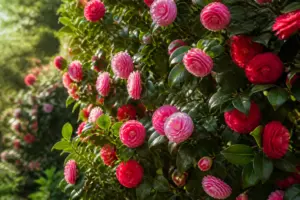
Three springs ago, I stood in front of a ‘Survivor’ camellia I had planted seven years earlier and felt genuinely defeated. The leaves had gone from that deep, waxy green I love to a sickly yellow-green with darker veins running through them. New growth was sparse and weak. It hadn’t set a single bud the previous fall. I had done everything right — or so I thought. Good drainage, afternoon shade, mulch, a balanced fertilizer in spring. And yet there it was, slowly dying in front of me.
I almost dug it out. I’m glad I didn’t. What followed was one of the most instructive experiences in my 22 years of growing camellias: a deep dive into camellia soil pH that completely changed how I think about feeding and maintaining these plants.
The Real Problem Wasn’t What I Was Feeding It — It Was What the Soil Wouldn’t Release
My first instinct was nutrient deficiency, which was correct — but I was treating the symptom, not the cause. The yellowing with green veins is a textbook presentation of iron chlorosis. I had added iron to the soil twice. Nothing changed. That’s when I pulled out a soil test kit and actually checked my pH.
The reading came back at 6.8.
Now, 6.8 is considered perfectly fine for most garden plants. For camellias, it’s a slow death sentence. Camellias are acid-loving plants that perform best in a soil pH range of 5.5 to 6.5, with the sweet spot for most cultivars sitting right around 6.0 to 6.2. At 6.8, iron and manganese become chemically bound in the soil — they’re physically present, but locked in forms the plant can’t absorb. No amount of fertilizer fixes that. You have to fix the pH first.
I had been gardening in this bed for years without testing. I had limed nearby areas for vegetables. Lime moves. That was almost certainly part of my problem. It was a humbling moment.
Why Camellia Soil pH Matters More Than Most Gardeners Realize
Soil pH affects everything — not just nutrient availability, but microbial activity and root function. When the pH climbs above 6.5, the beneficial mycorrhizal fungi that camellias rely on begin to decline. The iron, manganese, and zinc that camellias need for chlorophyll production get locked up. Your plant can be sitting in perfectly amended, nutrient-rich soil and still starve.
This is why you’ll see a camellia in one garden thriving for decades with almost no care, and a camellia twenty feet away in what looks like identical conditions struggling year after year. Soil pH — and the factors that influence it, including irrigation water quality, nearby lime applications, and even concrete foundations — varies dramatically from spot to spot in a single yard.
I’ve seen this play out in my own garden more times than I can count. My front bed, which is near a concrete sidewalk, consistently reads about 0.4 to 0.5 pH units higher than my back garden beds. That’s enough to make a real difference.
How I Brought the pH Down: A Specific, Step-by-Step Account
Once I confirmed my pH was at 6.8 and my target was 6.0 to 6.2, I had to decide on an approach. There are a few ways to lower soil pH:
- Elemental sulfur — the most reliable long-term solution, processed by soil bacteria into sulfuric acid
- Aluminum sulfate — faster acting but can accumulate to toxic levels if overused
- Acidifying fertilizers — ammonium sulfate and similar products provide modest pH reduction alongside nutrients
- Organic matter amendments — pine bark, peat, and pine needle mulch contribute to acidity over time but work slowly
For a correction this significant on an established plant, I chose elemental sulfur. It works more slowly than aluminum sulfate — typically 2 to 3 months before you see measurable change — but it’s far safer for the plant and the soil ecosystem. According to general guidance from university extension services, lowering pH by one full unit in a loam soil takes roughly 1 to 2 pounds of elemental sulfur per 100 square feet, depending on your soil type. Clay soils require more; sandy soils require less.
I worked sulfur granules lightly into the top 3 inches of soil around my ‘Survivor,’ staying well outside the drip line and avoiding direct contact with the roots. I watered it in thoroughly. Then I waited. I retested at six weeks and again at twelve weeks. By week twelve, I was reading 6.1. The difference in the plant was already visible — new growth had resumed and was a healthy, deep green.
That fall, it bloomed for the first time in two years.
Testing: Don’t Skip This Step, and Don’t Do It Casually
I want to be direct about this: soil pH testing is not optional if you’re serious about growing camellias. Testing before you amend is non-negotiable. Blindly adding sulfur to soil that’s already at 5.8 can drive the pH too low, which causes its own set of nutrient toxicity problems — particularly with aluminum and manganese.
I test my camellia beds twice a year: once in early spring before any amendments, and again in early fall. I collect samples from at least four spots in each bed and mix them together for a composite reading. This gives me a far more reliable picture than a single poke in the ground.
For quick, reliable readings between professional lab tests, I’ve found good-quality test strips more than adequate for garden monitoring. They’re not laboratory precision, but they’re consistent and practical for the kind of regular tracking I do.
An Honest Caveat: This Takes Time and Patience
I want to be upfront about something: lowering soil pH is not a one-time fix. Soil naturally buffers toward its baseline over time, especially if your water supply is alkaline (mine runs around pH 7.4 from the tap). I do a maintenance sulfur application every one to two years in my higher-pH beds. If you have a concrete foundation, walkway, or retaining wall nearby, you may need to manage pH indefinitely. That’s just the reality.
I also want to be honest that pH isn’t always the culprit. Root rot from Phytophthora cinnamomi, which is epidemic in poorly drained camellia beds, presents with similar symptoms. Before you assume pH is your problem, make sure your drainage is adequate and that you’re not seeing actual stem or root discoloration that would indicate fungal disease. I’ve seen gardeners correct their pH and still lose their plant because the root system was already compromised by rot.
This post contains affiliate links. As an Amazon Associate I earn from qualifying purchases.
What I Use and Recommend
After trying several products over the years, here’s what’s currently in my garage and what I’d recommend to anyone managing camellia soil pH:
For a slow-release, organic approach to acidification, I’ve had excellent results with True Organic Prilled Sulfur. The prilled form spreads evenly and works cleanly into the soil without the dust issues you get with powdered sulfur. It’s OMRI listed, which matters to me since I try to keep my garden practices as organic as possible.
When I need something that shows results a little faster — particularly for a plant that’s visibly struggling — I reach for Earth Science Fast Acting Sulfur Granules. The granule formulation is easy to broadcast and I’ve found it measurably moves the needle within six to eight weeks in my loam-heavy beds. It’s a solid middle ground between elemental sulfur and aluminum sulfate in terms of speed.
For testing, I currently use the NewTest Soil pH Test Kit with 125 test strips and measuring cylinders. The included cylinders make a real difference in accuracy — you’re getting a proper diluted soil suspension rather than just jabbing a strip in moist dirt. For the price, these are excellent for the kind of regular monitoring I do between professional lab submissions.
The Takeaway After 22 Years
If your camellia looks like it’s slowly declining — yellowing leaves, poor bud set, weak new growth, no obvious signs of pest damage — test your soil pH before you do anything else. Don’t fertilize. Don’t prune. Don’t add iron. Test first. It costs almost nothing and takes fifteen minutes, and it will tell you whether everything else you’re doing is even able to work.
That single number — soil pH — is the foundation that everything else sits on. Get it right, and camellias are remarkably rewarding, long-lived plants. Get it wrong, and you can pour time and money into a plant for years without ever understanding why it’s struggling.
I learned that the hard way with a ‘Survivor’ camellia that nearly didn’t live up to its name. Now I test religiously, correct when needed, and watch my plants the way I should have been watching them all along.