
This post contains affiliate links. As an Amazon Associate, I earn from qualifying purchases at no extra cost to you.
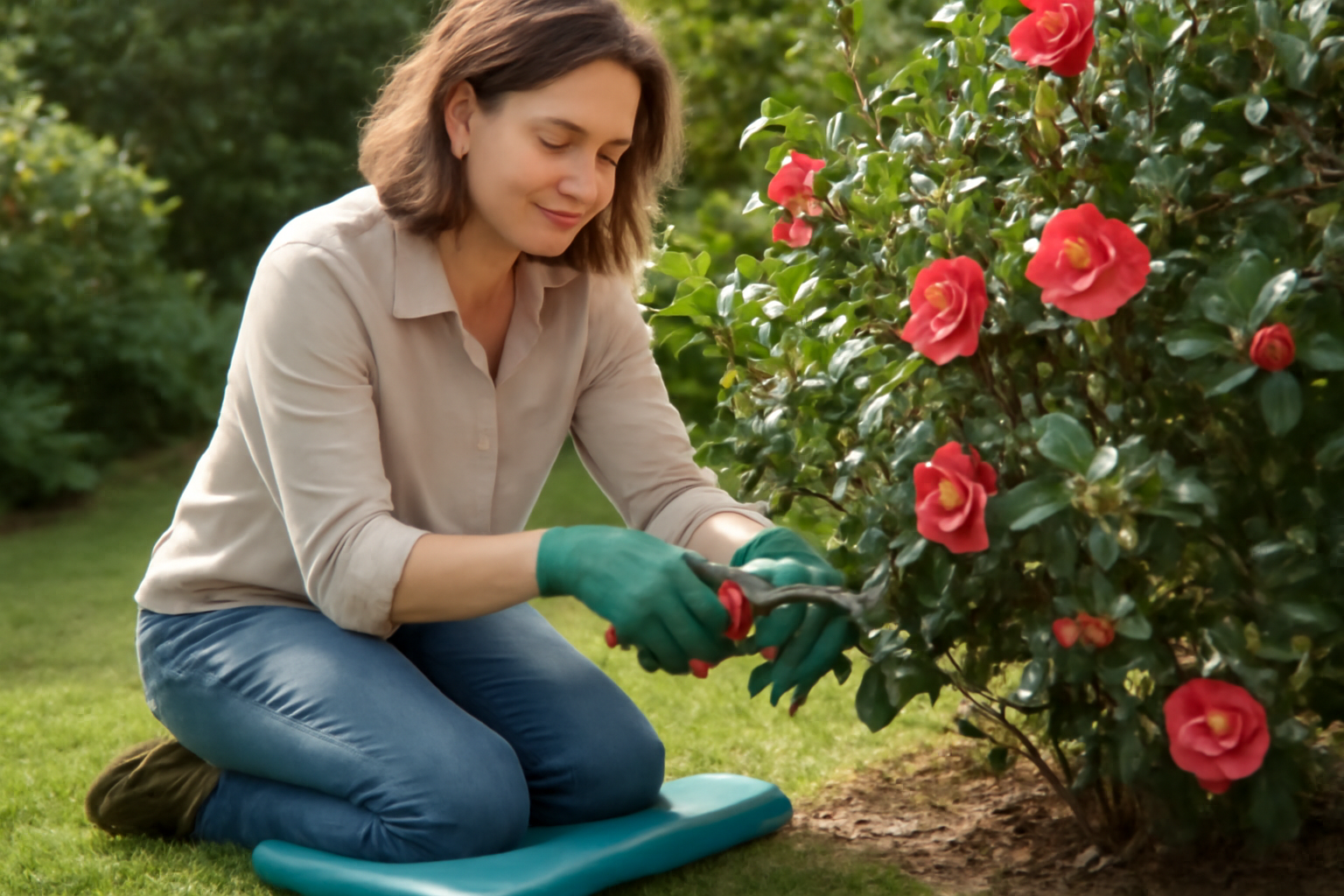
My knees started sending serious complaints about three years ago. I grow camellias in Zone 8b, and pruning season means long stretches of kneeling on hard clay soil. Between my ‘Kramer’s Supreme’ Japonicas along the back fence and the sprawling ‘Yuletide’ Sasanquas near the driveway, I spend hours crouched low during late winter and fall. A good garden kneeling pad for pruning season isn’t a luxury — it’s a necessity I ignored for far too long.
The problem crept up slowly. First it was minor stiffness after a long session. Then it became genuine pain that lasted two or three days after each heavy pruning weekend. My soil doesn’t help matters. It’s dense red clay that barely softens even after a good rain, and kneeling directly on it felt like pressing my joints into packed concrete.
I finally admitted I needed a proper solution. For two full camellia pruning seasons ��� fall 2022 into winter 2023, then again fall 2023 into winter 2024 — I put the Fiskars Garden Kneeling Pad, 11″ x 18″ Lightweight and Thick EVA Foam Knee Cushion through everything my garden could throw at it. Here’s what I found.
Why I Chose the Fiskars Garden Kneeling Pad for Pruning
I didn’t just grab the first foam pad I found. My research took a couple of weeks. I read through forums on camellia societies, asked questions in a few online gardening groups, and compared specs across a dozen options. Most cheap pads fell into two camps: too thin to matter, or too bulky to carry around easily.
The Fiskars name carried weight for me. I’ve trusted their pruning shears for fifteen years. That familiarity wasn’t the only reason I chose this pad, but it wasn’t irrelevant either. More importantly, the EVA foam construction caught my attention. EVA — ethylene-vinyl acetate — offers a firm but cushioned support that holds its shape far better than basic polyethylene foam.
The built-in handle was another deciding factor. Pruning camellias means constant repositioning. You work around a shrub methodically, cutting dead wood, thinning dense canopies, and removing crossing branches. Moving a kneeling pad dozens of times per session is a real consideration. A molded handle makes that quick and effortless. That detail alone separated the Fiskars pad from most competitors.
First Impressions Out of the Box
The pad arrived well-packaged but simple — no excessive plastic, no complicated assembly. I appreciated that immediately. It came ready to use straight out of the box, which sounds obvious but isn’t always the case with garden tools.
My first impression was honestly mixed. The pad felt slightly smaller than I expected. At 11 inches by 18 inches, the dimensions are accurate, but holding it in my hands initially made me wonder if it would actually cover enough ground. That concern faded quickly once I started using it.
The green color is bright and cheery — practical too, since I can spot it easily in dense shrub borders. The surface texture is lightly ridged, which helps with grip on uneven ground. Most notably, the foam felt genuinely dense when I pressed into it. It wasn’t that spongy, collapsing feeling you get from bargain foam. There was real substance there.
The handle is molded right into the foam — not attached as a separate piece. That matters for longevity. Separate handles tend to pull away over time. This integrated design felt built to last.
My Testing Approach: Two Full Pruning Seasons
I set out to use this pad exclusively during both pruning seasons, with no rotating in of other solutions. I wanted a genuine long-term picture, not a quick first impression.
The Camellias I Was Working Around
My camellia collection spans about 22 established plants. Most are in Zone 8b conditions — mild winters, hot humid summers, acidic clay soil sitting around pH 5.8 to 6.2. That’s comfortably within the ideal 5.5 to 6.5 range camellias prefer, so the plants themselves are thriving. The pruning work, however, is extensive.
Specific varieties I was pruning during this testing period include:
- ‘Kramer’s Supreme’ Camellia japonica — large, established shrubs requiring significant thinning
- ‘Yuletide’ Camellia sasanqua — fall-blooming, needing shape work after the bloom period
- ‘April Kiss’ Camellia japonica — a newer addition, lighter pruning but still demanding close groundwork
- ‘Setsugekka’ Camellia sasanqua — trained semi-espalier along a stone wall, requiring very low, close work
Each pruning session ran between two and four hours. Some days I worked across multiple plants in sequence. The clay soil conditions stayed consistently difficult — firm and unyielding even after moderate rainfall.
How I Used the Pad Day to Day
I used the Fiskars Garden Kneeling Pad, 11″ x 18″ Lightweight and Thick EVA Foam Knee Cushion on bare soil, on mulched beds, and on the stone path running along my back fence line. Conditions ranged from dry and dusty to genuinely wet after winter rain.
I also deliberately tested it in some awkward positions. Pruning close to the base of a large Japonica means kneeling at odd angles. Sometimes one knee is higher than the other. I wanted to see how the pad performed under those realistic, imperfect conditions rather than just straight-on kneeling on flat ground.
What Actually Changed After Two Seasons
The improvement was noticeable within the first session. That sounds dramatic, but the difference between kneeling on dense clay and kneeling on quality EVA foam really is that immediate. My knees felt cushioned without feeling unstable. The foam compressed just enough to conform to my knee without bottoming out into the ground.
After the first full season, the post-pruning soreness I’d been experiencing dropped significantly. Not entirely — I’m in my mid-fifties, and there’s no foam pad that reverses that reality. However, the two-to-three day recovery I had come to accept simply didn’t happen anymore. I’d finish a long Saturday pruning session and feel normal by Sunday evening.
Performance on Different Surfaces
On dry clay soil, the pad performed exactly as hoped — firm, stable, genuinely cushioning. On wet soil, it held up equally well. The moisture-resistant surface didn’t absorb water. A quick wipe with a rag or even just shaking it off was all the cleanup required.
On the stone path, I was initially skeptical. Stone is unforgiving and irregular. The EVA foam’s density actually helped here — it compressed into the slight unevenness of the stones without tearing or deforming. That surprised me pleasantly.
The handle proved its worth every single session. Moving from my ‘Setsugekka’ espalier around to the front of my ‘Kramer’s Supreme’ required picking up and repositioning the pad frequently. Reaching down and grabbing a handle instead of fumbling with a flat foam slab genuinely matters when you’re tired and your hands are full of pruning shears.
The Downsides You Should Know Before Buying
I want to be honest here, because this pad isn’t perfect for everyone or every situation.
The size limitation is real. At 11 by 18 inches, this covers one kneeling position comfortably. If you tend to shift your weight forward and back frequently while working — which I do when reaching deep into a large shrub — one knee can slide off the pad. It’s a minor irritation, but it’s worth knowing going in.
The foam also compressed noticeably over two seasons of heavy use. It hasn’t failed, and it still cushions well. That said, it’s visibly thinner now than it was when new. If you’re heavier than average or plan to use this for multiple hours daily over several years, the foam density will eventually diminish.
My Moment of Doubt
Midway through the second season, I had a genuinely frustrating experience. I was working on the ‘April Kiss’ Japonica along a slope in my garden. The ground angle caused the pad to slide forward repeatedly. I spent ten minutes adjusting it before giving up and just kneeling directly on the mulch for that session.
That was a real limitation. On flat or gently sloped ground, the pad is excellent. On an actual slope, it needs something to brace against — a root, a stone, your other foot. It doesn’t grip soft soil on an incline. That’s a meaningful drawback if your garden has significant grade changes.
I also wish it came in a larger size. For two-knee kneeling during longer sessions, I sometimes found myself wanting about four more inches of width. That would cover both knees comfortably without repositioning.
Final Verdict: Who Should Buy This Garden Kneeling Pad for Pruning
After two full camellia pruning seasons, my verdict on the Fiskars Garden Kneeling Pad, 11″ x 18″ Lightweight and Thick EVA Foam Knee Cushion with Handle for Gardening, Cleaning, or Construction – Moisture and Rip Resistant, Gardening Supplies, Green is genuinely positive. This is a well-made, practical tool that does exactly what it promises on flat and moderately uneven ground.
I’d rate it 4 out of 5 stars. It earns that rating for its construction quality, the smart handle design, its moisture resistance, and its real-world durability across two demanding seasons of work.
Buy This If:
- You garden on flat or gently sloped ground with hard soil
- You move your kneeling position frequently and want a handle
- You want a durable, moisture-resistant foam pad from a trusted brand
- You’re doing extended pruning sessions on camellias, roses, or other woody shrubs
- You’re looking for a single, no-fuss pad at a fair price point
Look Elsewhere If:
- Your garden has significant slopes or terracing
- You prefer two-knee coverage for longer, stationary work sessions
- You need maximum thickness for serious knee or joint problems
A Worthy Runner-Up: Grenebo 2-Pack Kneeling Pads
If the Fiskars pad doesn’t feel like the right fit, particularly if you want extra thickness or two-knee coverage, consider the Grenebo 2-Pack 1.6″ Extra Thick NBR Foam Garden Kneeling Pads. At 1.6 inches of NBR foam versus the Fiskars’ EVA construction, these offer a softer, plusher feel that gardeners with more significant joint sensitivity may prefer.
The two-pack format is a genuine advantage. You can place one pad under each knee for longer stationary sessions, which solves the coverage issue I mentioned above. On the other hand, you lose the integrated handle, and NBR foam tends to absorb moisture more readily than EVA over time. For my specific pruning style and working conditions, the Fiskars remained the better daily driver. However, the Gren